Father's Day Supplement Guide 2026: Fish Oil, Lutein & Glucosamine
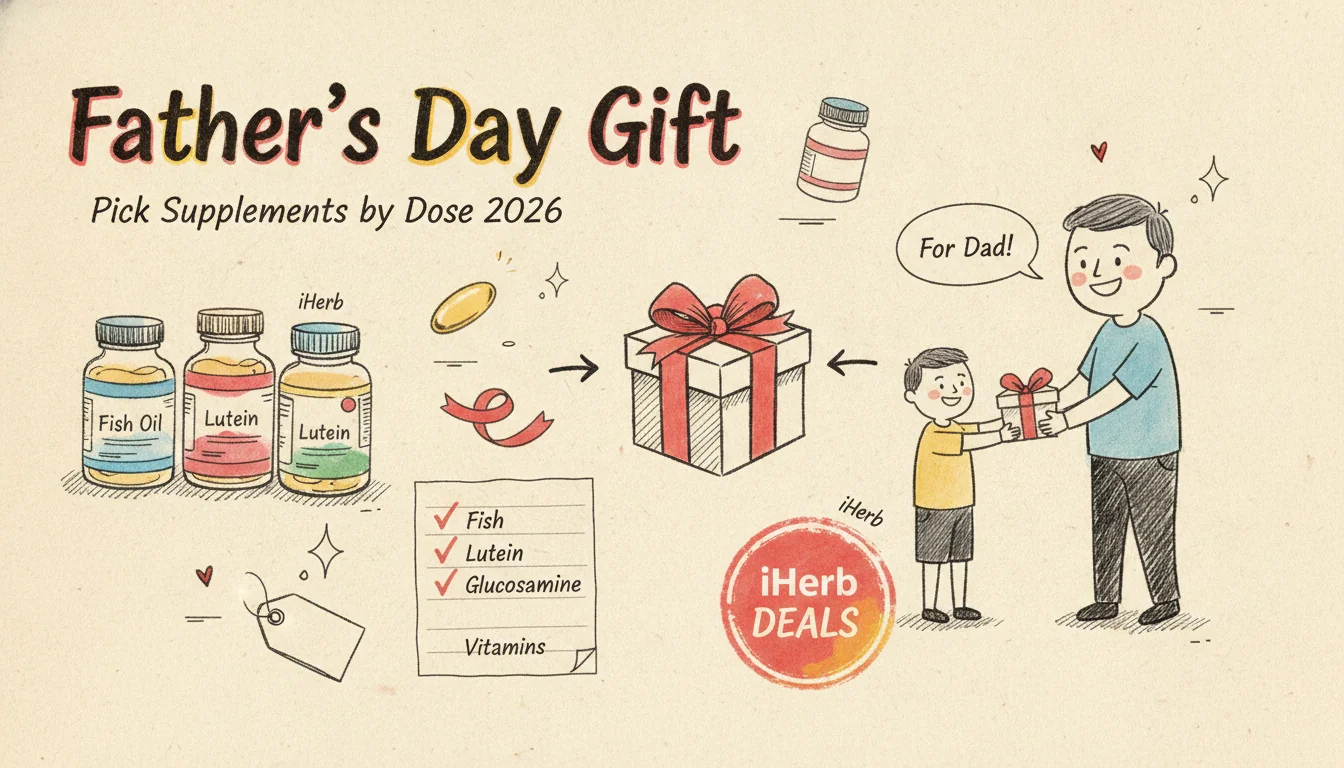
Two bottles both print "1000mg fish oil" on the label, yet the actual Omega-3 inside might be 800mg in one and only 300mg in the other. That was the first thing I figured out while shopping for my own dad.
Father's Day is coming up, and a lot of people want to gift Dad some supplements. But you stand at the pharmacy shelf for ten minutes and still have no idea which bottle to grab. My first instinct was to just buy a multivitamin that "covers a bit of everything" as the safest bet. Then I laid out the effective dose of each ingredient and realized: to cram in a dozen things, a multivitamin usually keeps each one so low it barely does anything. After that, my whole gift logic changed. Instead of one jack-of-all-trades bottle, I'd rather match Dad's lifestyle and give one or two single-ingredient bottles where the dose is actually enough. That's the kind of thing you only learn after getting burned once.
This piece isn't about miracle effects or health claims. It's only about how to choose, how to gift, what each ingredient is, and which kind of dad it suits. I cross-checked every dose figure against the public data from Taiwan's Ministry of Health and Welfare and the Health Promotion Administration, so once you know how to read a label, you'll know how to pick.
First, the Ground Rules: Supplements Are Food, Not Medicine
Let me put the single most important line up front: in Taiwan, supplements are regulated as "food," not as drugs, and they can't be used to treat or prevent disease. If your dad has a chronic condition, is on regular follow-up visits, or takes medication, run any supplement past a doctor or pharmacist before you gift it. This goes double for things like fish oil and glucosamine, which need watching when taken alongside certain drugs. This isn't a throwaway disclaimer. It's the exact line a pharmacist made a point of telling me when I took my dad in for a check-up.
So for each one below, I'll only cover "what the ingredient is for, how much to take a day, and who it suits." I won't tell you what it can "improve." Real effects vary from person to person, and taking care of your body has never come down to a single capsule. It's a regular routine plus a balanced diet, with supplements just filling the gap you don't get enough of. My own household keeps maybe 3 or 4 bottles on hand, not because more bottles equal more peace of mind.
There are also a few downsides to watch, so don't get careless just because it's "only a supplement." More is not better. Fat-soluble vitamin D and fish oil become a burden on the body when you overdo them, and long-term megadoses carry real health risks. Some ingredients also don't suit specific groups. Glucosamine needs caution for anyone allergic to shellfish, and an older parent on blood thinners should ask a doctor before adding fish oil. Treat supplements as "filling a gap," not "curing everything." Get that premise right, and the how-to-choose part below actually starts to matter.
Before You Buy, Figure Out Which Type of Dad You Have
Two dads can both be sixty, but one who walks 10,000 steps and hikes the local hills every day needs completely different things from one who sits at a desk scrolling his phone all day. Slotting Dad into the right category before you shop beats randomly buying a pile of stuff. I personally split them into four types:
The sedentary eat-out type: three meals out, rarely eats fish. This dad is short on good oils, so fish oil comes first. The active hiker type: knees are the first thing to complain, so glucosamine matches his life. The heavy-screen type: retired and stares at a phone or newspaper for hours a day, so lutein is his lane. The always-tired type: lots of social dinners, sleeps poorly, so B-complex and vitamin D are the baseline.
I sorted my own dad and my father-in-law this way, one 62 and sedentary all day, the other 68 and hiking daily, and what each needed to top up was completely different. Last time I asked first, then bought, and saved the wasted money of buying 3 random bottles that each sat unused after less than a month. Nail down which type your dad is first, then go back and read the doses for each ingredient below, and you'll know which single bottle to put your budget behind, instead of buying a little of everything and never enough of anything.
Picking Fish Oil: It's the Omega-3 Concentration, Not the Total mg
Fish oil is the bottle I most often recommend as an entry point, especially for the eat-out dad who eats fish less than twice a week. But the biggest trap with fish oil is getting fooled by the big "1000mg" on the front. That 1000mg is the "total fish oil weight." What actually matters is the Omega-3 inside it, meaning the combined EPA and DHA.
Concentration varies a lot. A bottle labeled 1000mg fish oil with Omega-3 at only 30% works out to just 300mg of active ingredient per softgel. One made to 80% or higher gives you 800mg in a single softgel. When picking, flip straight to the back and look at "how much EPA plus DHA." That number is what you're actually paying for. Note the ceiling too: Taiwan's Food and Drug Administration caps daily fish oil intake, measured as total EPA and DHA, at no more than 2 grams (2000mg). For a typical adult, around 1000mg a day is plenty, and even the WHO recommendation is only 300 to 500mg a day.
I tried flipping my two home bottles to the back to compare labels: one had only 300mg of EPA plus DHA, the other listed 850mg, yet the price gap was under NT$100 (about US$3). The high-concentration one is basically one softgel doing the work of three. So when gifting Dad fish oil, I pick a high-concentration one where a single softgel a day hits around 1000mg. He doesn't have to swallow 3 or 4 at once, and he won't accidentally blow past the 2000mg ceiling. A bottle usually runs 60 to 90 softgels and lasts 2 to 3 months, so the value is high and it's easy to explain. It's the hardest one to get wrong.
Lutein for the Eyes: 6-10mg Is Plenty, Skip the Mega-Doses
If Dad's biggest hobby after retiring is scrolling his phone, binge-watching shows, and reading the paper, lutein fits his day better than fish oil. Lutein is a compound the retina's macula already contains, and its angle is everyday visual maintenance. Again, the point is the dose and the form, not more being better.
Per Taiwan's Ministry of Health and Welfare, 6 to 10mg of lutein a day is enough for daily maintenance, and the daily upper limit is 30mg. Heavier is not better. The golden ratio used in the five-year AREDS-II study from the US National Institutes of Health is 10mg of free-form lutein paired with 2mg of zeaxanthin, so when picking, look for that 10:2 and confirm it's "free-form." Two more practical details: lutein is fat-soluble, so absorption is better taken about half an hour after a meal with some fat in it; and it needs 3 to 6 months of steady use to build up gradually, not one week for a noticeable difference. My dad clocks over 4 hours a day on his phone and the newspaper combined, so last time I picked him a 3-month supply in one go, and mentioned when gifting it that he needs to take it continuously, so he wouldn't feel nothing after 3 days and toss it aside.
Glucosamine for Joints: 1500mg, Plus One Thing Brands Rarely Mention
"Dad's knees are bad, so glucosamine can't go wrong" is a lot of people's instinct, but this bottle actually needs the most understanding before you gift it. Glucosamine is one of the building blocks of cartilage, and the effective dose validated in human trials is 1500mg a day. More does no good. Many products on the market are made as one 1500mg pill a day, which is handy for an older parent who can't be bothered splitting doses.
What really needs watching is the "type." I only confirmed this after asking a pharmacist: sulfate-form glucosamine is classified by Taiwan's Ministry of Health and Welfare as a prescription drug that a doctor has to prescribe, while most retail supplements are the hydrochloride form or N-acetylglucosamine, currently regulated as food. What I finally bought my dad was the food-grade kind, one 1500mg pill a day. Read the label clearly before buying, and don't assume the two are the same thing.
There's also one point brands rarely bring up on their own: the Taiwan Drug Relief Foundation has written plainly that for protecting joints and bone health, "a suitable form of exercise is the real key." Glucosamine is a supplement, not a pass on moving. I've kept that line in mind, and it's what I mention on the side when gifting this bottle. Rather than pinning hopes on a capsule, walking with him for half an hour a day is more solid. While reading the reviews on that iHerb glucosamine, someone left a line, "bought it for my dad, all he cares about is whether it's easy to swallow," and I noted it down. After that I really did check the pellet size and whether it splits in half before picking a form. To an older person, this small thing matters more than how pretty the dose on the label looks.
B-Complex and Vitamin D: The Easy Basics Older Adults Often Lack
If you're not sure what Dad is short on, B-complex and vitamin D are the baseline least likely to go wrong, the price is friendly too, and they suit being the "toss in one more bottle" pairing.
B-complex helps with energy metabolism and the normal functioning of nerves and muscles, so a dad with lots of social dinners who's often tired can top it up. Per the Health Promotion Administration's dietary reference intakes for Taiwanese, an adult needs roughly 1.4mg of vitamin B1, 1.6mg of B2, 1.6mg of B6, 2.4µg of B12, and 400µg of folate a day. When picking, don't get dazzled by a "super-high dose" gimmick. Last time I saw a bottle labeled at 50 times the daily recommendation, and since you don't need it, I ruled it out. Enough is enough. Vitamin D is one older adults are especially prone to lacking, because as age climbs, the skin's ability to synthesize it drops. The Ministry of Health and Welfare and the US Institute of Medicine recommend 400 to 600 IU a day for adults, rising to 800 IU for those 71 and over, with a daily ceiling of 2000 IU that you shouldn't exceed. Vitamin D is also fat-soluble, so taking it after a meal alongside fish oil works out nicely.
These two bottles together often cost less for a month than a single big dinner, yet they're the most basic supply for an older body. They're practical to gift without being flashy.
Single-Ingredient or Multivitamin? One Table Settles It
Back to the trap I fell into at the start: a multivitamin looks like the most effortless way to cover everything at once, but to make all the ingredients coexist, each dose is usually kept very low. That time I brought a multivitamin home and checked its label: fish oil was only 200mg inside, and lutein just 2mg, a long way off the daily recommendations of 1000mg and 6 to 10mg. My advice is to first go by Dad's lifestyle, lock in one or two "core single-ingredient" bottles at a full dose, then use a multivitamin to cover the baseline for the rest. The table below organizes everything above into a version you can compare at a glance, so pick your gift straight off this:
| Supplement | Main ingredient focus | Typical daily amount | Which dad it suits | What to look for |
|---|---|---|---|---|
| Fish oil | Omega-3 (EPA + DHA) | ~1000mg daily, ceiling 2000mg | Eats little fish, three meals out | Omega-3 concentration (≥80%), not total mg |
| Lutein | Lutein + zeaxanthin | 6-10mg, ceiling 30mg | Stares at phone or paper all day | 10:2 golden ratio, free-form, take after meals |
| Glucosamine | Glucosamine (cartilage building block) | ~1500mg daily | Loves hiking, knees often tired | Tell sulfate (prescription) from hydrochloride (food) |
| B-complex | Vitamins B1-B12 | From B1 1.4mg / B6 1.6mg / B12 2.4µg | Lots of dinners, often tired | Natural source, dose just enough is fine |
| Vitamin D | Vitamin D3 | 400-600 IU, 800 IU for 71+ | Rarely gets sun | Take with fat, don't top 2000 IU ceiling |
One-line takeaway: one or two full-dose single-ingredient bottles beat a single do-it-all multivitamin, both in impact and ease of picking. On a tight budget, gift the one bottle that fits Dad's lifestyle best first.
Buying on iHerb for the Best Price: How to Hit the Threshold and Save
Once you've picked the ingredients, the last piece is your wallet. The ones I take long-term myself I almost all restock on iHerb, for a simple reason: for the same international brand, a Taiwan pharmacy's sticker price is often 30 to 40 percent higher than iHerb once you add shipping, and for long-term consumables like fish oil and glucosamine, that gap really adds up over a full year.
The money-saving key is "hit the threshold and restock in one go," ordering Dad's quarter's worth of fish oil, lutein, and B-complex together rather than buying piecemeal each time. For the full promo periods and shipping thresholds, I check the iHerb deals page first before I combine an order. Using the current promos as an example: the whole site is 10% off over US$60 (GOLD60) and a flat 30% off over US$120 (GOLD120), and new users get 20% off their first order (NEW20). If you're locking in a brand like Garden of Life, which headlines fish oil and multivitamins, there's an extra 20% brand discount (2025GOL) you can stack. If you want to browse the supplement category directly, you can also head in through the iHerb supplements section and compare each bottle's ingredients and doses. Last time I combined an order and restocked 3 bottles for Dad at once, using the 30% off over US$120, and it worked out to nearly NT$900 (about US$28) cheaper than buying the same 3 bottles piecemeal at a Taiwan pharmacy.
Two reminders: one, iHerb ships from the US, and sea freight takes roughly 7 to 14 days, so if you're gifting for Father's Day, order at least 14 days ahead and don't leave it until early August; two, discount codes have spend thresholds and expiry dates, so confirm they're active before checkout so you don't combine an order for nothing.
FAQ
Q1: If I gift several bottles at once, can Dad take them together?
Fish oil, lutein, B-complex, and vitamin D can mostly be taken together after a meal, and the fat-soluble ones even help each other absorb; probiotics are better spaced apart from the others, taken on an empty stomach or an hour after a meal. But if Dad is on chronic-condition medication, the safest move is to photograph the items and confirm once with a pharmacist which ones to take together and when.
Q2: If my budget only stretches to one bottle, which one?
Go by Dad's lifestyle first. If you genuinely can't pin it down, fish oil is usually the hardest one to get wrong, especially if he rarely eats fish. But that's a rule of thumb, not the definitive answer, so it's best to ask what he cares about most (eyes, knees, energy) before deciding.
Q3: How long before supplements make a difference?
It varies from person to person, and supplements are food, not medicine, so no specific effect is guaranteed. Take lutein as an example: official data suggests 3 to 6 months of steady use to let levels build up, so don't judge by "did I feel anything in a few days." Make sure to explain this to Dad when you gift it.
Further Reading
Supplements are one kind of gift for Dad. If you're planning to take your parents out this year, or heading off yourself this summer, the health prep in these two pieces is worth reading alongside:
- Traveling Abroad With Senior Parents on Father's Day: Pacing, Long-Haul Flight Health Checkpoints, and a Travel Medicine Kit (2026)
- A Week Before a Beach-and-Sun Trip, What Goes in the Bag? An Island and Outdoor Travel Health Supply Checklist (2026)
References
- Vaccination advice and travel-health alert levels are set by your own country's health authority, and they differ between countries — check yours before you book, not a foreign agency's grading.
- Taiwan Drug Relief Foundation - Glucosamine for joints? A suitable form of exercise is the real key
- Common Health Magazine - Lutein benefits and intake at a glance
All Deals

Kang
Family Wellness Travel EditorA travel editor who brings everyday wellness habits on the road. Before any trip, she packs the travel medicine kit, figures out how to beat jet lag, and plans how to keep everyone's gut happy. Specializes in travel health, wellness getaways, pacing trips for elderly parents, and outdoor fitness prep — and breaks down what's actually worth stocking up on at iHerb.
You May Also Like
Father's Day Trip With Aging Parents: 2026 Health Guide
I've taken my parents abroad 6 times. My 2026 Father's Day guide: senior pacing, the 3 health checkpoints of long-haul flying, and saving ~US$28 on iHerb.
Steam Summer Sale 2026: JP vs AR Region Hacks Save $160
Steam Summer Sale 2026 runs June 25 to July 9. I tested Japan, US and Argentina region accounts across 5 hit games, broke down the VPN switching SOP, and laid out Valve's account-lock rules so you know what's safe and what isn't.
Opening a Japan Switch eShop Account in My Kyoto Hotel: 15-Minute Walkthrough
I opened my first Japan-region Nintendo Account in a small Kyoto hotel last December — 15 minutes flat. Full walkthrough, the safe VPN setup I use back home, prepaid card sourcing, and what the May 2026 Nintendo price hike means for the Argentina-region shortcut.