Father's Day Trip With Aging Parents: 2026 Health Guide
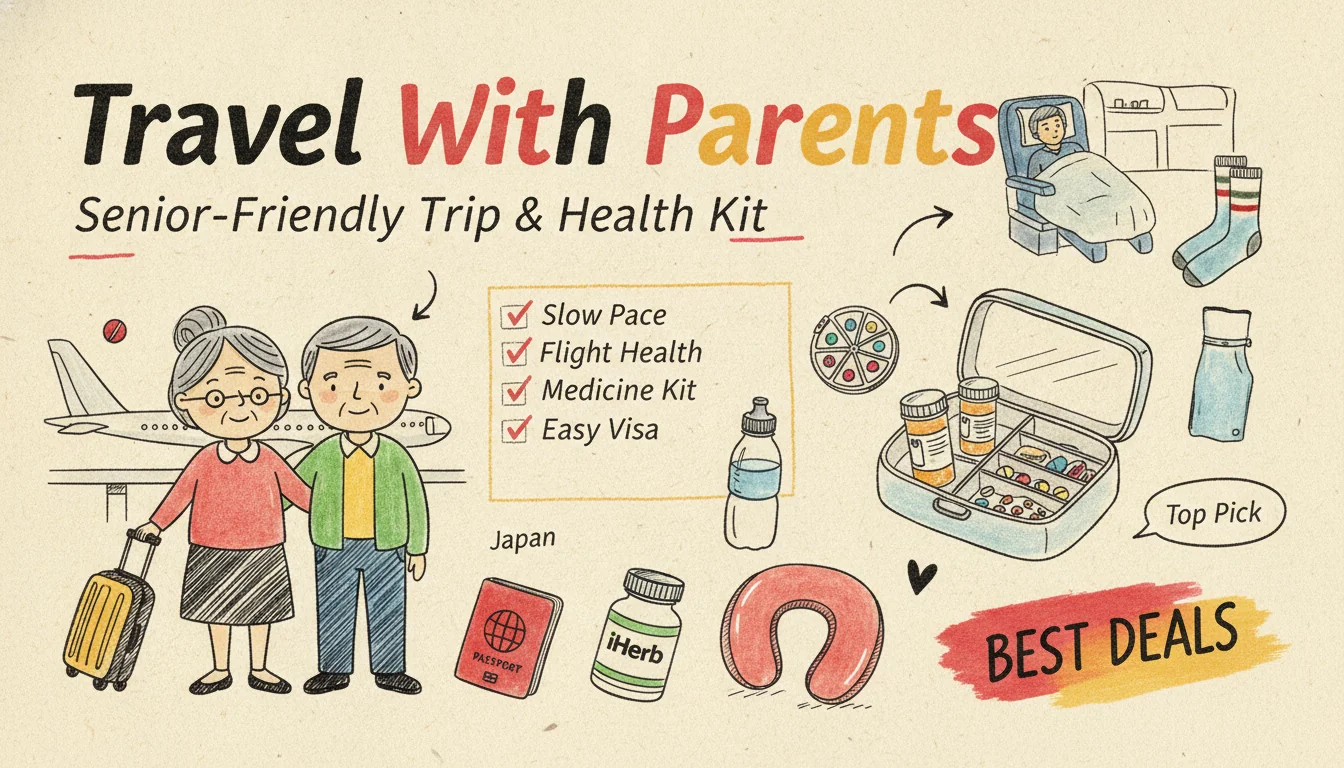
Honestly, here's the picture: it was 11 the night before we flew, and I was crouched over the suitcase sorting pill boxes. One compartment for my mom's blood pressure meds, one for my dad's stomach pills, one for the gut enzymes and B-complex we all share. By the time I finished it was past midnight.
That was the trip I took my parents to Japan. I only figured one thing out once we got home. The hard part of taking older parents abroad for Father's Day is not booking the flights. It is getting them to enjoy the trip without wearing out, and getting them home in one piece.
This post is not about sights. It is about health. How to pace the days. Which body checkpoints long-haul flying puts older travelers through. What absolutely has to go in the bag. Take care of the bodies first, and the sights start to mean something.
My dad is 70, my mom is 66, and both carry the usual high blood pressure, blood sugar, and cholesterol. I've taken them abroad 6 times in the last few years, and every mistake I made is folded into this piece. Trust me, I learned most of it the hard way.
A 5-Day Filial Trip to Japan: What My Family Spent and How We Paced It
Here is a baseline. Below is what we actually spent on a trip of 5 days and 4 nights to Kyushu last year, the two of them plus me, 3 people total, and I remember the numbers clearly.
| Item | Our cost, 3 people | Notes |
|---|---|---|
| Round-trip flights | NT$42,000 (~US$1,300) | About NT$14,000 (~US$433) each, off-peak, not summer |
| 4 nights lodging | NT$24,000 (~US$740) | Two hotels, two nights each, less hauling luggage |
| Day tours ×3 | NT$13,500 (~US$420) | About NT$1,500 (~US$46) per person per outing |
| Meals | NT$18,000 (~US$560) | Around NT$4,500 (~US$139) a day for three |
| Supplements + medicine kit | NT$2,200 (~US$68) | Stocked once before departure |
| Total | about NT$99,700 (~US$3,080) | About NT$33,000 (~US$1,020) per person |
I kept the pace loose. Over 5 days I planned only 3 main stops, and we averaged under 6,000 steps a day, walking for barely 2 hours of real moving each day. When you travel with older parents, what you save is not money, it is stamina. They never once complained of being tired on that trip, and it was the smoothest one I have run.
The Biggest Trap of Traveling With Parents: Cramming the Itinerary
Let me start with the most common mistake.
A lot of people plan a senior itinerary at their own walking speed. Five stops a day, a subway-to-bus transfer, then a two-kilometer walk. Young legs hold up. Parents' legs do not. I planned my first trip with my parents exactly that way, and by day two my mom's feet had swollen so much she could not get her shoes on.
After that I locked in one rule: 1 or 2 main stops a day, no more. Leave the rest open. According to KKday's guide on filial travel, the single thing that affects comfort most for seniors on a self-guided trip is transport. If you can pre-book a private car or join a day tour, do not make older travelers transfer at unfamiliar stations. After that trip I switched to day tours, and it got much easier.
Routes like Kyushu and Nikko in Japan, the slow-pace, low-walking kind, suit this especially well. If you want local itineraries, look at a package like KKday's Kyushu Miyazaki tour discount that bundles transport and sights together, so nobody has to lead the way on the ground.
Open space in the schedule is not wasted time. It is a chance for older bodies to catch their breath.
Three Body Checkpoints Long-Haul Flying Puts Older Travelers Through
Long-haul flying is tiring for the young. For older travelers it is a real strain. Here are the three that go wrong most often.
First, jet lag. Sleep falls apart after crossing time zones, and older people recover slower than younger ones. Before we leave I get the whole family shifting our sleep schedule 3 days early. B-complex often gets used as a support supplement when adjusting to jet lag, to help push through the daytime fatigue, but results vary from person to person. It is not medicine, so do not expect it to cure anything.
Second, leg swelling. Long stretches of sitting plus dry cabin air make older legs swell easily. On that trip my mom landed after a 5-hour flight already complaining her feet felt tight, and she had to loosen her laces two notches. After that, on any long-haul flight I make sure she stands up and walks every 1 hour and drinks 200 ml of water every 2 hours. Wear shoes that slip off easily, and loosen them as soon as you board.
Third, digestion. With different water and different food, an older person's gut is the most sensitive part. Probiotics often get used to help the gut adjust to a new environment. I take them long-term myself, start a week before a trip, and pack 5 extra servings for my parents. According to several pharmacist write-ups, probiotics and B-complex are supportive supplements, not treatments, and that needs to be the shared understanding going in.
To be clear: these are all everyday supplements, not treatment drugs. Dosage and whether they suit an older person's specific condition should always be checked with a doctor or pharmacist before you leave. Older people take a lot of chronic-condition medication, so confirming there is no conflict matters even more before stacking supplements on top.
I always compare ingredients and prices on iHerb's full offers first. Two codes work this month: JUN26SW for 15% off site-wide over US$60, or 5FM78 for 25% off plus a free tin of tea on family pickup. That round I bought B-complex, probiotics, and fish oil, 3 bottles in all. I used the 15% off over US$60, and I paid nearly NT$900 (~US$28) less than the same products at a Taiwan pharmacy. I ordered 3 weeks before departure, so sea shipping landed right in time for packing. Picking the brand matters more than picking the discount. Buy only when the ingredient label is clear.
Take care of the body up front, and the trip carries further.
The Travel Medicine Kit My Family Always Packs
The medicine kit is one thing you do not skimp on when traveling with older parents.
My family always keeps these categories on hand, sorted and labeled per pharmacist advice:
| Category | Staple items | Use |
|---|---|---|
| Cold | Cold combo, fever/pain relief (e.g. Paracetamol) | Ease congestion and sore throat, fever and headache |
| Digestion | Antacid, anti-diarrheal (e.g. Loperamide) | Bloating, acute diarrhea on the spot |
| Motion sickness | Motion-sickness pills, sea-sickness patch | Before long drives or boat rides |
| Chronic condition | Daily prescription meds (full supply + backup) | Cannot run out mid-trip, split across two bags |
A few details I only learned the hard way. Motion-sickness pills need to go in 30 to 60 minutes before departure. Taking them once you are on board is too late. Sea-sickness patches go on even earlier, 4 hours to 12 hours before the trip. Carry an older person's prescription meds in the full amount for the whole trip plus a few extra days, and split them across different bags, so losing one still leaves the other.
There are rules for bringing medication onto a plane. For prescription drugs it is best to carry the doctor's prescription or an English medication list, which makes customs easier. Before you go, check the destination's restrictions on medicines, since some ingredients are controlled locally.
A medicine kit is not packed for peace of mind. You really do end up using it.
Matching Lodging and Itinerary to an Older Person's Pace
Pick the wrong lodging and your parents are tired every single day.
I screen for three things: an elevator, within 5 minutes of a station, and a room that is easy to move around in. An old hotel with no elevator, with luggage and older legs climbing to the third floor, is a nightmare. Proximity to the station matters most. On that walk back to the hotel, even 0.3 km more registers on an older person's feet. With parents I also prefer staying in the same place. Split 4 nights into 2 rooms at most, so you haul luggage one less time. A long-stay deal like Agoda's stay-three-nights-or-more, up to 20% off lines up perfectly with a slow-travel pace. On that trip I got the per-night average down to NT$3,000 (~US$93), nearly 20% less than changing hotels every day.
If you want to treat your parents, a hot-spring hotel is a safe pick. Soaking takes no stamina, and older travelers get the most out of it. A place with an in-room hot spring, like Klook's Lake Kawaguchi Mount Fuji-view hot-spring hotels, spares them the walk to a public bath. My dad soaked 3 nights running and did not want to leave.
On the itinerary, put the most physically demanding stops on days 2 and 3. Let your parents sleep in on day 1 to fight jet lag. Keep the last day loose, do not cram it up against the flight. 1 to 2 main stops a day.
Slow is the whole point of a filial trip.
Want It Easier? A Short-Haul Visa-Free Trip Is a Safe Bet
Not every trip has to fly far. With older parents, short-haul is often more comfortable.
A flight of 3 hours to 4 hours with under 1 hour of time difference, and your parents are back on their feet the day after landing. Short-haul visa-free spots like Japan and Thailand also carry a low admin burden. Thailand has friendly prices: a 1-hour Thai massage in Bangkok runs about NT$300 (~US$9), and a flight-plus-hotel package can come in under NT$15,000 (~US$465). The gentle pace suits older travelers well, and if you want to look at options, check Trip.com's Thailand visa-free trip deals. Japan, meanwhile, wins on being clean, easy to walk, and convenient for medical care, and KKday's Japan day tours and tickets offer the widest range of choices.
For a first trip abroad with your parents, start short-haul to get your footing. Once one trip goes smoothly, pick somewhere farther next time.
Close does not mean settling. When older travelers are comfortable, that is what real filial travel looks like.
Frequently Asked Questions
Q1: Can supplements help older people with jet lag and digestion? B-complex and probiotics are everyday support supplements. Plenty of people pack them as backup when traveling, but they are not medicine and results vary from person to person. Older people take a lot of chronic-condition medication, so before stacking any supplement on top, always ask a doctor or pharmacist whether it conflicts with their existing meds.
Q2: How do you carry an older person's prescription meds safely? Bring the full amount for the whole trip plus a few extra days, and split them across different bags. It is best to include the doctor's prescription or an English medication list. Before you go, check the destination's restrictions on medication ingredients, since some are controlled locally.
Q3: For a Father's Day trip with parents, which kind of itinerary is least tiring? A slow-pace itinerary with 1 or 2 main stops a day and the rest left open. Prioritize day tours or a private car, and minimize transfers at unfamiliar stations. Pick lodging with an elevator, within 5 minutes of a station, where you can stay multiple nights.
Q4: For a first trip abroad with older parents, far or close? Start close. A short flight and a small time difference mean older travelers recover faster, and the admin burden is lower. Visa-free short-haul spots like Japan and Thailand are a solid starting point. Once one trip goes well, pick somewhere farther.
Q5: Where is the better-value place to buy supplements? Comparing prices online is usually cheaper than a physical pharmacy, but check whether the ingredient label is clear. Picking the brand matters more than picking the discount. Before buying, confirm the dosage and who it is suitable for, and ask a pharmacist if you need to.
References
- KKday's country recommendations and planning notes for traveling abroad with seniors (filial itinerary pacing and transport advice)
- Liangyi Health Network: rules and a staple-medicine checklist for bringing medication abroad (medication-carrying rules)
- Family physician's travel health kit checklist (medicine, protection, insurance)
- Personal records of medicine-kit sorting and itinerary pacing across multiple trips abroad with older parents
- For supplement ingredients and dosage, follow the product label and a doctor's or pharmacist's advice
All Deals
Limited Time Price Drop - Up to 15% off ⏳
Unlock special hotel rates at your dream destination. Book now before it's gone! · ACTIVATE NOW • Limited Time Price Drop - Up to 15% off ⏳
No Code RequiredTravel Deals up to 30% OFF
Click to view full deal details and terms
No Code Required15% off your first iHerb app order
Click to view full deal details and terms
MYAPP15Oral care – Dr. Tung's 15% off
Click to view full deal details and terms
No Code RequiredHand sanitiser & disinfectant shop
Click to view full deal details and terms
No Code RequiredNew iHerb in-house brand products, 10% off
Click to view full deal details and terms
No Code Required2,000+ immune support products, 10%–40% off
Click to view full deal details and terms
No Code Required10% off sitewide on orders over $60
Click to view full deal details and terms
GOLD60Super sale! Selected items up to 60% off
Click to view full deal details and terms
No Code RequiredTrial-size favourites from $1
Click to view full deal details and terms
No Code Required30% off sitewide on orders over $120
Click to view full deal details and terms
GOLD12020% off your first order, no minimum spend
Click to view full deal details and terms
YUN9315Idealove – Bee Ageless snail & bee venom essence, 30% off
Click to view full deal details and terms
No Code RequiredBestseller trial prices, up to 90% off
Click to view full deal details and terms
No Code RequiredHot cocoa – Coconut Cloud 20% off
Click to view full deal details and terms
No Code RequiredGarden of Life brand products 20% off
Click to view full deal details and terms
2025GOLSwanson brand products 20% off
Click to view full deal details and terms
SWANSONSanitary pads – I'm From 10% off
Click to view full deal details and terms
No Code RequiredTea – Yogi Tea 20% off
Click to view full deal details and terms
No Code RequiredBeauty & cosmetics – SKIN1004 20% off
Click to view full deal details and terms
No Code Required20% off your first order, no minimum spend
Click to view full deal details and terms
NEW20Mild By Nature – Volumizing shampoo with B-complex + biotin, citrus scent
Click to view full deal details and terms
No Code Required
Kang
Family Wellness Travel EditorA travel editor who brings everyday wellness habits on the road. Before any trip, she packs the travel medicine kit, figures out how to beat jet lag, and plans how to keep everyone's gut happy. Specializes in travel health, wellness getaways, pacing trips for elderly parents, and outdoor fitness prep — and breaks down what's actually worth stocking up on at iHerb.
You May Also Like
Complete Island & Outdoor Travel Health Kit 2026: What to Pack Before a Week in the Sun
Heading to an island or an all-day outdoor trip in summer 2026? Here is my pack-it-or-regret-it health kit: sunscreen, after-sun, motion sickness, electrolytes, gut and probiotics, with how to carry each and when it actually gets used. Includes overseas medicine rules, iHerb price-comparison tips, and a pre-trip timeline. Supplements are food, not medicine, no efficacy claimed.
Kathmandu UNESCO Tour vs DIY 2026: NPR 5,700 and Skip TIMS
Seven UNESCO sites in a day tour or three days on foot. I priced every ticket at NPR 5,700, found the free multi-entry pass, and checked which permit you need.
Takayama & Shirakawa-go From Nagoya 2026: The Pass Only Pays If You Do Not Come Back
The Shoryudo bus pass every itinerary still names stopped being sold. Priced against real Nohi Bus fares: a Nagoya round trip is ¥12,200 in tickets, and the ¥19,800 rail pass never catches it.