Complete Island & Outdoor Travel Health Kit 2026: What to Pack Before a Week in the Sun
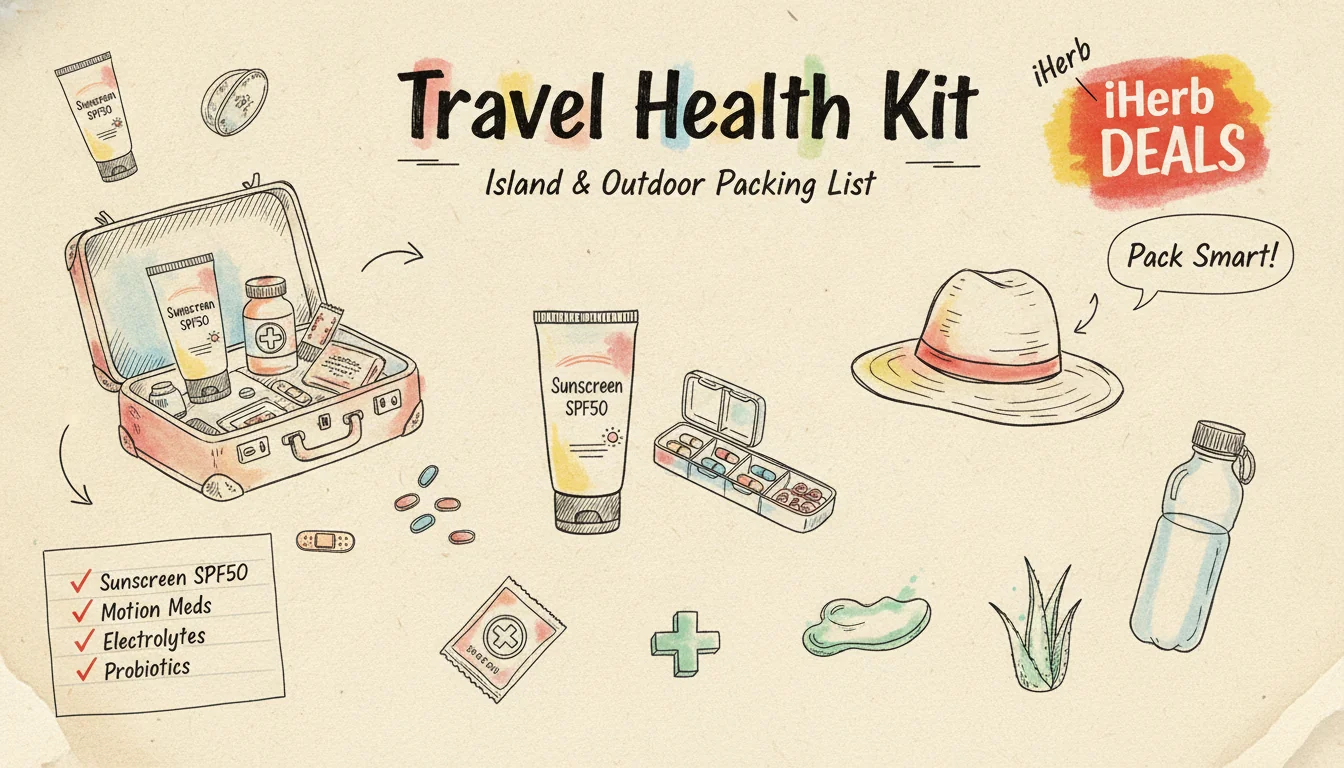
It was 11:00 PM, the evening before the flight, and I was crouched over my open suitcase, sorting 7 days of supplies into zip-lock bags one compartment at a time: sunscreen, after-sun aloe, motion sickness tablets, electrolyte sachets, gut tablets, and the few bottles I take regularly.
On last summer's island trip, I forgot my motion sickness pills, and ended up paying triple at a tiny shop by the pier before the boat left. Only after I got home did it click that these few items I always pack cost two or three times more to grab last-minute on location, and sometimes you simply cannot find them with a label you can read.
This post is not about what supplements "do." It is about which things you should bring for a week of island sun and a full day outdoors, and when each one actually earns its place. I put together this health kit over the past few years of traveling with my mom and the whole family, and I am breaking it down by scenario so you can see it the way I pack it.
First, the honest part: supplements are food, not medicine, this is about how to carry them and when they help
Let me say this up front: in Taiwan, supplements are classified as food, not medicine. They cannot make medical claims and they do not replace medical care. The vitamins, probiotics, and electrolytes I mention here are just everyday habits I keep up long-term, not something I am telling you to use to treat anything.
Three principles to keep in mind first:
- If you have a chronic condition, take regular prescription medication, are pregnant, breastfeeding, or traveling with young kids, ask a doctor or pharmacist before any supplement. Do not improvise your own mix.
- Real medicine (motion sickness tablets, gut remedies, painkillers) is what handles symptoms. Supplements do not replace it.
- If you feel unwell for more than a day or two, or run a fever, see a local doctor. Do not tough it out.
I put this section first because I have watched too many people treat supplements like a cure-all. They are not. They just keep the rhythm of that one week away a little steadier.
Overseas medicine rules: 12 bottles each, 36 total, keep original packaging
First the rules, so customs does not stop you.
Under Taiwan's current rules, over-the-counter medicine is capped at 12 units per item (boxes, bottles, tubes, or strips), with a total not exceeding 36 units, and all of it must stay in its original packaging, not loose in a pill organizer. For prescription medicine, bring the doctor's prescription or an English diagnosis certificate, and keep the quantity within your trip length. When I traveled with my mom, her blood pressure medicine followed exactly this: original bottle plus a photocopy of the prescription, together.
That one time I got lazy and dumped all my pills into a single 7-day organizer, I got pulled aside at one country's customs and questioned for 10 minutes with the box open. Lesson learned: keep the original boxes as-is, and use a small separate organizer only for "today's dose." Original packaging goes in checked luggage, while a small box goes in your carry-on. Same logic for supplements, the original bottle is the easiest path.
Liquids matter too: sunscreen, aloe gel, and the like cannot exceed 100 ml per bottle in your carry-on, all packed into one 1-liter clear zip-lock bag. Anything bigger goes in checked luggage.
Island water days: how to prep sunscreen, after-sun, and motion sickness
The UV on an island is several times stronger than on flat ground in Taiwan. On that Phuket trip, I spent one afternoon in the sun without reapplying, and my shins stayed red for a full 3 days, sore enough that I could not sleep at night.
Sunscreen: pick SPF50, PA++++, and if you are getting in the water, choose one labeled water-resistant. The number matters less than the reapplying. After sweating or swimming, reapply every 2 hours; one 50 ml tube lasts me about 5 days on my own. I bring a spare tube, because on an island a single tube easily runs you a few hundred TWD (~US$10), and a brand you trust is not guaranteed to be in stock. For consumables like this, I stock up in one go on iHerb, iHerb 30% off site-wide over US$120 (GOLD120), restocking sunscreen, after-sun, and electrolytes all at once.
After-sun cooling: I always pack aloe gel. Chilled and applied after a day in the sun, that cooling relief is the realest thing on this list. Fragrance-free is often impossible to find on location, so bringing one tube is the safest bet.
Motion sickness: for island hopping or boats out to smaller islands, if you get seasick, take a motion sickness tablet 30 minutes before boarding (this is medicine, not a supplement). The one time I toughed it out, I threw up off the stern and the whole snorkeling leg was ruined. For water day tours I book ahead at KKday Thailand island activities buy 1 get 1, so I am not stuck with an inflated price from a stall on location.
Outdoor hiking days: electrolytes, sore muscles, and your gut
A full day outdoors means sweating out more than just water, you lose salt too.
Electrolytes: for summer hikes and long outdoor stretches I always bring electrolyte powder or effervescent tablets, one sachet to 500 ml of water, which goes down easier than plain water when you are sweating a lot. The one I keep rebuying is the iHerb in-house brand, iHerb in-house brand 10% off; a big bag of their electrolytes works out to roughly 60% cheaper per serving than a convenience-store sports drink, so stocking up for a whole season does not sting.
Sore muscles: walk too much and your feet ache, so I bring pain-relief patches and a small tube of massage balm to use back at the hotel at night. Local pharmacies carry these too, but the language barrier makes picking exhausting, so bringing the ones I know saves the hassle.
Gut: outdoors you are more likely to eat at street stalls or picnic, so pack gut medicine (anti-diarrheal, anti-bloating) in its original packaging. This is medicine, take it when you need it, do not tough it out. For private transfers and mountain day trips, I book it all together at Klook Southeast Asia transfers and day tours 15% off, so I am not hunting for a ride out in the wild.
Food and stomach adjustment: probiotics and my gut routine
Switching countries means your stomach is usually the first thing to complain.
My routine is to start probiotics 7 days before the trip, not because they "block" anything, but simply because I take them regularly and do not want to break the same rhythm when I travel. I asked my pharmacist, and even he only said "fine as daily maintenance, do not treat it as something that cures illness," a line I have always kept in mind. Probiotics hate heat, so in island temperatures I keep them in a cooler bag or pick a shelf-stable form, rather than letting them sit and stew in a 30-degree-plus suitcase all day.
When your gut genuinely acts up, what helps is gut medicine, more rest, and more fluids, not probiotics. I am blunt about this: supplements are the daily routine, medicine handles the moment. The vitamins and fish oil I take long-term come along too, purely to keep the rhythm, restocked all at once when I hit the order threshold.
How do you pack a week's worth without taking up space? My method: capsules and tablets go into a 7-day pill organizer, one compartment per day, with the original bottles left at home so I do not have to haul them abroad; the heat-sensitive probiotics go into a separate small cooler bag, packed in my carry-on next to the sunscreen. That way 5 or 6 supplements compress down to a palm-sized pouch, saving half the luggage space versus bringing every original bottle. The luggage on an island return trip always overflows, so slimming this pouch first leaves room for souvenirs later.
How to buy iHerb cheaply: price gaps and deals
The electrolytes, vitamins, and fish oil I mentioned, I buy almost all of them on iHerb. The reason is one word: price.
The same bottle of a well-known fish oil that I have seen priced at NT$1,280 (~US$40) at a Taiwan pharmacy works out to around NT$740 (~US$23) on iHerb once shipping is factored in, nearly 40% less. For high-frequency consumables like electrolytes and protein powder, the gap is even more obvious. The key to saving is "hit the threshold and restock in one go," buying a whole season of electrolytes, vitamins, and sunscreen at once, which is far more economical than buying piecemeal each time. I check the full promo window and shipping thresholds at the iHerb deals page before I build the cart.
A reminder: iHerb ships from the US, sea freight runs about 7 to 14 days, so if you need it for a trip, order at least 2 weeks ahead. Do not leave it until 3 days before departure.
My island and outdoor travel health kit checklist
Here it is all in one list, so you can pack straight from it. For a 7-day island trip, 1 person:
| Category | Item | Quantity | Where |
|---|---|---|---|
| Sun care | SPF50 sunscreen, after-sun aloe gel | 1 each | Carry-on (<100ml) |
| Medicine | Motion sickness, gut, painkiller, band-aids | Original pack | Checked + carry-on small box |
| Hydration | Electrolyte sachets | 7-10 sachets | Checked |
| Daily supplements | Long-term vitamins, probiotics | One week's worth | Original bottle, cooler |
| Bug care | Insect repellent, anti-itch | 1 each | Checked |
Do not copy the list verbatim, adjust it for your destination and your body. The point is: medicine in original packaging, liquids split into carry-on, supplements prepped ahead. On that trip I added an extra "chronic medication" row for my mom, one copy each in carry-on and checked luggage, precisely because I worried about lost luggage cutting off her supply. For the island flights, hotels, and day tours themselves, I compare them together too, opening the Klook island getaway zone to line up the itinerary and the supplies in one pass.
Packing and timeline: how many days before departure to start
This kind of prep, crammed last-minute, turns out expensive and full of gaps. My timeline:
- 14 days before departure: take stock of the supplements you need to restock, and order what is missing on iHerb after hitting the threshold (sea freight takes 7-14 days). Island flight-plus-hotel can go alongside it, locking in the big-ticket booking first via the Trip.com Thailand visa-free flight-plus-hotel page.
- 7 days before: start keeping up the rhythm of daily supplements like probiotics for those 7 days. Do not suddenly start them on departure day.
- 2 days before departure: pack medicine in its original packaging, sort the small organizer for the day's doses, and put liquids in the clear zip-lock bag.
- The night before departure: run one final check against the list, and put the motion sickness tablets and sunscreen in your carry-on, not buried deep in checked luggage.
The few times I nearly forgot something, it was always because I had not made a list. Make one, and you will not pay triple for motion sickness pills at the pier.
Frequently Asked Questions
Can I bring supplements on a plane? Is there a quantity limit?
Yes. Supplements are classified as food, so the principle is reasonable personal-use quantity, in original packaging. Medicine (OTC) is capped at 12 units per item, with a total not exceeding 36 units, and must stay in original packaging. Liquids (sunscreen, aloe gel) cannot exceed 100 ml per bottle in your carry-on.
Should I take probiotics before going abroad?
That is a matter of personal habit, not a must. I take them regularly anyway, and starting a week before the trip is just keeping the same rhythm rather than breaking it, not because they block stomach trouble. If your gut genuinely acts up, what helps is gut medicine and rest, and seeing a doctor if needed.
How far ahead should I order iHerb before a trip?
At least 2 weeks. iHerb ships from the US, and sea freight usually takes 7 to 14 days, so for supplements you want to bring abroad, do not order right before departure or it will not arrive in time. Hitting the threshold (such as over US$120) to restock a season's worth at once is the best value.
How do I choose and reapply sunscreen for island water days?
Pick SPF50, PA++++, and choose a water-resistant label if you are getting in the water. The point is reapplying: every 2 hours after sweating or swimming. One 50 ml tube lasts roughly 1 person for 5 days. Bring a separate fragrance-free aloe gel for after-sun cooling.
Taking elders abroad, what extra do I need in the health kit?
Bring elders' prescription medicine in its original packaging, with an English diagnosis certificate or prescription, and a quantity for the full trip plus 2 or 3 extra days. Split chronic medication into one copy each in carry-on and checked luggage, to avoid losing the supply if luggage goes missing. Having the elder consult a doctor before the trip is the steadiest move.
References
All Deals
Explore Southeast AsiaHotel deals up to 50% off
Explore Southeast Asia · Hotel deals up to 50% off
No Code RequiredPhuket Phi Phi Islands and Bamboo Island Full-Day Snorkeling Tour
Phi Phi Islands
No Code RequiredNusa Penida Luxury Day Tour (from Bali): Manta Ray Snorkeling, Yacht & Land Sightseeing
Bali
No Code RequiredMount Batur Sunrise Jeep Tour & Trekking (Photographer Optional)
Bali
No Code RequiredInternational Deals - Up to 30% off
Get special rates on international hotels and resorts.
No Code Required15% off your first iHerb app order
Click to view full deal details and terms
MYAPP15Oral care – Dr. Tung's 15% off
Click to view full deal details and terms
No Code RequiredHand sanitiser & disinfectant shop
Click to view full deal details and terms
No Code RequiredNew iHerb in-house brand products, 10% off
Click to view full deal details and terms
No Code Required2,000+ immune support products, 10%–40% off
Click to view full deal details and terms
No Code Required10% off sitewide on orders over $60
Click to view full deal details and terms
GOLD60Super sale! Selected items up to 60% off
Click to view full deal details and terms
No Code RequiredTrial-size favourites from $1
Click to view full deal details and terms
No Code Required30% off sitewide on orders over $120
Click to view full deal details and terms
GOLD12020% off your first order, no minimum spend
Click to view full deal details and terms
YUN9315Idealove – Bee Ageless snail & bee venom essence, 30% off
Click to view full deal details and terms
No Code RequiredBestseller trial prices, up to 90% off
Click to view full deal details and terms
No Code RequiredHot cocoa – Coconut Cloud 20% off
Click to view full deal details and terms
No Code RequiredGarden of Life brand products 20% off
Click to view full deal details and terms
2025GOLSwanson brand products 20% off
Click to view full deal details and terms
SWANSONSanitary pads – I'm From 10% off
Click to view full deal details and terms
No Code RequiredTea – Yogi Tea 20% off
Click to view full deal details and terms
No Code RequiredBeauty & cosmetics – SKIN1004 20% off
Click to view full deal details and terms
No Code Required20% off your first order, no minimum spend
Click to view full deal details and terms
NEW20Mild By Nature – Volumizing shampoo with B-complex + biotin, citrus scent
Click to view full deal details and terms
No Code Required
Kang
Family Wellness Travel EditorA travel editor who brings everyday wellness habits on the road. Before any trip, she packs the travel medicine kit, figures out how to beat jet lag, and plans how to keep everyone's gut happy. Specializes in travel health, wellness getaways, pacing trips for elderly parents, and outdoor fitness prep — and breaks down what's actually worth stocking up on at iHerb.
You May Also Like
Father's Day Trip With Aging Parents: 2026 Health Guide
I've taken my parents abroad 6 times. My 2026 Father's Day guide: senior pacing, the 3 health checkpoints of long-haul flying, and saving ~US$28 on iHerb.
2026 Singapore Travel Guide: Marina Bay, Hawker Centers & Universal Studios on a Budget
Your complete 2026 Singapore travel guide — Gardens by the Bay, Jewel Changi, USS, and hawker center hacks with Klook, KKday & Agoda promo codes.
2026 Malaysia Travel Guide: Kuala Lumpur, Penang & Sabah — Budget Tips & Promo Codes
Your complete 2026 Malaysia travel guide — KL Petronas Towers, Penang street food, Sabah sunsets & diving, with Klook, KKday & Agoda promo codes.