Japan Autumn Leaves Late September 2026: Altitude, Not Latitude
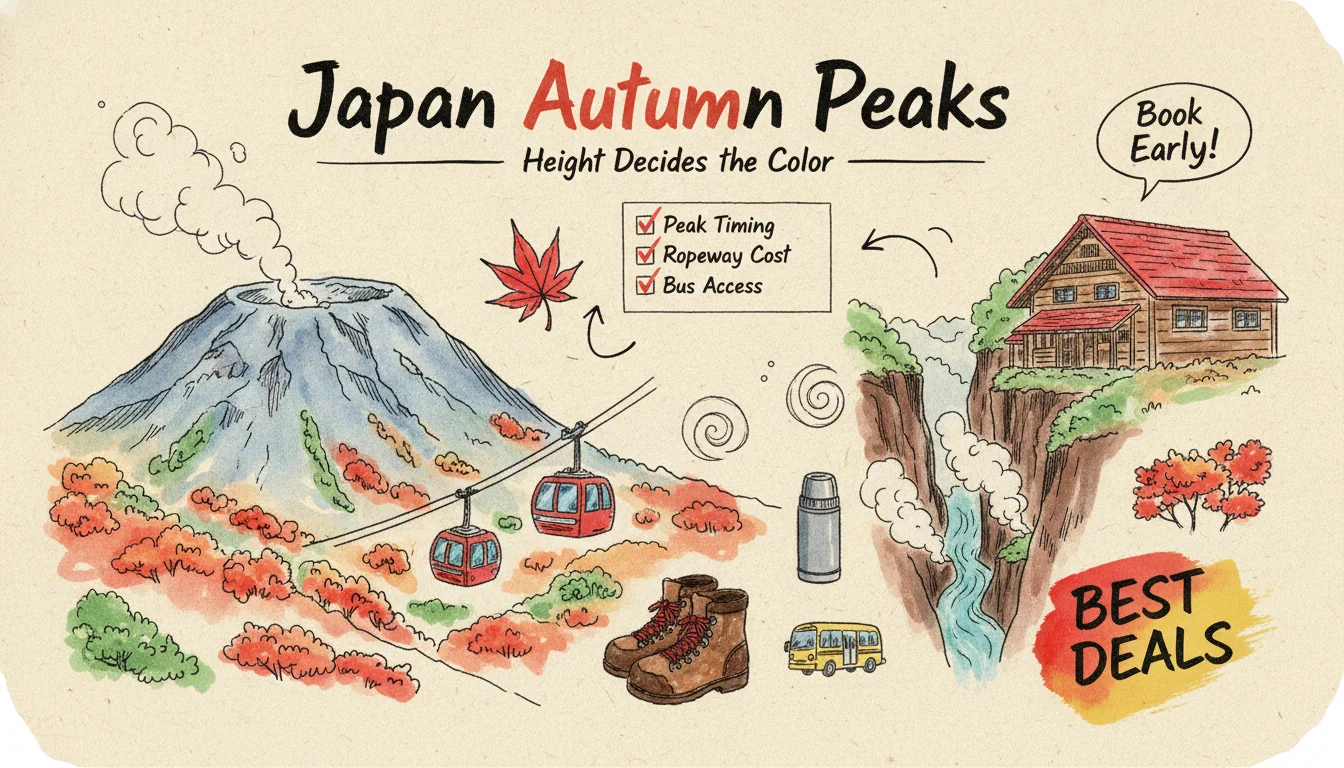
"Hokkaido turns red earlier than Tohoku" only holds if you put both sides at the same altitude first.
Lay it out and it gets clearer. The summit of Asahidake sits at 2,291 meters and usually peaks between mid and late September. Sapporo, at almost the same latitude and in the same central-Hokkaido region, has to wait until after late October. Same island, same line of latitude, and the two dates are almost 40 days apart.
So if you want to see fall color in Japan during the last week of September, the question is not "Hokkaido or Tohoku." It is "how many meters up are you willing to go." What I want to pin down here is where that altitude line falls, and what the September 19-23 Silver Week, the first five-day version in 11 years, does to every position on it.
"Hokkaido is earlier" is only half right
Japan's foliage front moves from high ground to low ground more than it moves north to south. According to observations around the Daisetsuzan range, color starts at the summit and takes roughly 30 days to reach the foothills. On a single mountain, top and bottom can peak 28 days apart.
That is why late-September trips so often come up empty. You search "Hokkaido September autumn leaves," book a Sapporo hotel, add Otaru and Noboribetsu, and what you actually see is late-summer green. Every one of those places sits below 300 meters.
Once you treat altitude as the main variable, the list of options collapses. Most of the Hokkaido tour coupons on 1stCoupon are lowland day trips out of Sapporo. Those are good products, they just do not solve the foliage problem, and I come back to them in the seventh section. To see which ones are live right now, check the Klook coupon roundup.
Everything still turning color is above 1,000 meters
Rank the spots in Hokkaido and Tohoku that can show color in the last week of September and this is all that is left, and each one clears the 1,000-meter line.
| Spot | Location | Approx. altitude | Typical peak |
|---|---|---|---|
| Asahidake (Daisetsuzan) | Hokkaido, Higashikawa | Summit 2,291 m | From mid-September |
| Kurodake (Daisetsuzan) | Hokkaido, Kamikawa | Summit 1,984 m | Summit from mid-September, 7th station slips to early October |
| Ginsendai (Akadake trailhead) | Hokkaido, Kamikawa | 1,490 m | Around mid-September |
| Daisetsu Kogen Onsen ponds | Hokkaido, Kamikawa | Above 1,000 m | Mid to late September |
| Hachimantai summit | Iwate / Akita border | About 1,600 m | Late September to early October |
| Mount Kurikoma | Miyagi / Iwate / Akita border | Summit in the 1,600 m class | Late September to early October |
Of the six, the lowest is Ginsendai at 1,490 meters and the highest is Asahidake at 2,291 meters, a spread of 801 meters, and all of them stand above 1,000 meters. Tohoku is not written off entirely, and that deserves saying plainly. Hachimantai and Mount Kurikoma really do color up in those last days of the month. They also happen to sit at 1,600 meters. What actually gets excluded is not a region, it is low elevation.
Access is awkward at every one of these. Asahidake and Sounkyo, the gateway to Kurodake and Ginsendai, both have to be reached through Asahikawa, and Asahikawa itself is a connection from New Chitose or Sapporo. If your trip covers several legs in northern Hokkaido, a week-long pass like the Klook Have Fun in Hokkaido Pass is worth totaling up before you commit. The real cost of buying bus tickets one at a time is in the sixth section, with numbers.
Oirase and Lake Towada are guaranteed green right now
Lake Towada's surface sits at about 400 meters, and the Oirase Gorge stream, roughly 14 km end to end, runs downhill from the lakeshore. Both typically peak between mid-October and early November.
The gap is not a few days. It is 21 to 28 days. Go at the end of September and you will see a very beautiful green stream.
That is the whole section. There is no workaround and no substitute needed. It simply is not in this window.
You have to book lodging a month before the forecast exists
This is the part of the article that needs action today.
The Japan Weather Association published its first "autumn foliage peak forecast" of 2025 on September 18. Silver Week 2026 begins on September 19. Put those two dates side by side and the problem shows itself. By the time the first official forecast of the year lands, you are already on the plane.
As I write this there are 40 days left until September 19, and that forecast arrives on day 39. Anyone booking rooms in August cannot possibly hold the 2026 forecast. All you get to work with are long-term averages and altitude, which is to say the table above. That is not a flaw, it is the structure of this particular window. Treat it as a flaw and wait for the forecast, and what you get is Sounkyo and Asahidake Onsen fully booked.
Worth noting alongside that: the 2026 autumnal equinox falls on Wednesday, September 23, which the National Astronomical Observatory of Japan announced back in February 2025. The Japanese lodging industry has had 18 months to prepare for this five-day run. You do not have first-mover advantage here.
In practice there are two routes. If you want to push the price down, look at the broad sales. Agoda's International Deals run up to 30% off, and a five-day break naturally lands you at 3 nights or more, so any minimum-stay condition clears itself. Just remember that discounted room types revert to standard rates once they sell out. If you would rather lock the autumn window directly, Trip.com has up to 20% off newly opened hotels, which is another entrance to the same set of dates. Compare the same room type on both before you commit.
Asahidake, Kurodake, Ginsendai: the verdict on three tickets
Fares first. These come from each operator's official notices, not estimates.
| Item | Adult round trip | Adult one way | Elementary round trip | Applies |
|---|---|---|---|---|
| Asahidake Ropeway | ¥3,500 | ¥2,200 | ¥1,750 | Jun 1 to Oct 31 peak season |
| Kurodake Ropeway | ¥3,000 | ¥1,800 | ¥1,500 | Year round |
| Kurodake chairlift | ¥1,200 | ¥800 | ¥600 | Summer mountain season |
| Kurodake ropeway + chairlift set | ¥3,900 | ¥2,400 | ¥1,950 | Summer only |
Operating conditions matter just as much, because they decide how many things fit into one day. Asahidake is 10 minutes one way with a departure every 15 minutes. Kurodake's ropeway is 7 minutes one way every 20 minutes, then the chairlift adds another 15. Going up alone is 22 minutes of riding plus two waits.
| Item | One-way ride | Frequency | Summer hours |
|---|---|---|---|
| Asahidake Ropeway | About 10 min | Every 15 min | Peak season first car 6:00, last 18:00 |
| Kurodake Ropeway | About 7 min | Every 20 min | Jun 27 to Sep 30, 6:00 to 18:00 |
| Kurodake chairlift | About 15 min in summer | Continuous | Jun 27 to Sep 30, 6:30 to 17:30 |
The verdict splits three ways.
Half a day, ordinary fitness, highest hit rate goes to Asahidake. 10 minutes of ropeway drops you around 1,600 meters at the Sugatami Pond area, which has maintained walking paths. What ¥3,500 buys is "step out and the picture is there." It is also the highest spot on the list, so color arrives first, sometimes from mid-September.
Want real elevation and willing to walk goes to Kurodake. The base station is at 670 meters, 7 minutes of ropeway lifts you to the 5th station at 1,300 meters, then a 1,100-meter chairlift takes 15 minutes to reach the 7th station at 1,520 meters, and only then does the trail start. Budget 40 minutes or more for those two legs alone. What you get back is the view over the Sounkyo side.
Want the most iconic shot and can work around the restrictions goes to Ginsendai. The Akadake trailhead at 1,490 meters is the single most famous stretch in Daisetsuzan during foliage season, and the price is that private cars cannot get in. I run that math in the next section.
Here is a mistake I made myself. The first time I built a Kurodake budget, I listed the ropeway and the chairlift as two separate transport legs, ¥3,000 plus ¥1,200 for ¥4,200 total. The actual summer set ticket at the window is ¥3,900. The ¥300 gap is small on its own, but it meant my whole budget sheet was categorized wrong. I saw two things where Rinyu Kanko sells one. At Kurodake, ask for the set ticket out loud. The window will not combine them for you.
On lodging, Sounkyo and Asahidake Onsen are both tiny settlements with very few rooms, and Silver Week leaves almost no room for a walk-in. Discount codes on non-lodging bookings can shave a little off the total, and KKday's Japan listings rotate promo codes fairly often. But no code fixes "there are no rooms." Confirm availability first, then chase the discount. That order does not reverse.
Private-car restrictions: the most expensive stretch of road to drive
The Ginsendai and Kogen Onsen routes go under private-car restrictions during foliage season. While they are in force, cars can only park at the Daisetsu Lakesite temporary lot, roughly 700 spaces, and you transfer to a shuttle bus for the 35-minute ride up.
The shuttle is ¥2,500 round trip for adults, of which ¥2,000 is the fare and ¥500 is a restriction cooperation fee. Elementary students pay ¥1,000 round trip.
The damage scales with headcount. At ¥2,500 each, that is ¥5,000 for 2 people and ¥10,000 for four, which already exceeds a day's car rental plus fuel, and meanwhile that car spends the restriction period sunbathing in a parking lot. If Ginsendai is the center of your trip, the marginal value of driving is negative.
The 2026 restriction schedule has not been published by the Sounkyo Tourist Association yet. Past years have fallen somewhere between mid-September and early October, with some weekdays running no buses at all, but the exact dates are only fixed by each year's announcement. I will fill this section in once I have it. Until then, plan with "restrictions are likely" as your default. Betting the other way is backwards.
If you are not driving, the route bus numbers look like this. Asahikawa Station to Sounkyo on Dohoku Bus is ¥2,140 one way, about 119 minutes. Sounkyo to the Asahidake Onsen entrance on Asahikawa Denki Kidou's "Ideyu-go" is ¥1,800 one way, about 94 minutes. Chaining those two means you can handle exactly 1 mountain per day. Do not schedule two.
There is one more time limit that is easy to miss. One-way uphill tickets on the Asahidake Ropeway have a sales cutoff: 16:00 from June through August, and it moves up to 15:00 from late August through October. The stated reason is avoiding accidents on the mountain. So this line closes earlier in foliage season than it does at the height of summer, and anyone arriving in the afternoon is effectively left with the round-trip ticket only.
If you would rather not deal with mountain logistics at all, a guided day trip out of Sapporo is the other answer. Routes like the Biei and Furano panoramic day tour absorb all the transfers for you. They take you to flower fields rather than fall color, so I place them in the next section instead.
How to lay out five Silver Week days: two on the mountain, three on flat ground
Five days splits neatly into two blocks, and those two blocks want completely different logic.
Days 1-2: the mountain. Pick one peak and keep the other day in reserve. Weather around Daisetsuzan is unstable at the end of September, and fog or rain turns a ropeway ticket into wasted money. Holding a day back for a retry is necessary, not cautious. Choose between Asahidake and Kurodake, and for Ginsendai, confirm that year's restriction notice first.
Days 3-5: flat ground. Stop chasing fall color on these three days. The altitude is wrong and you will not catch it. Spend them on hot springs and lowland routes instead, which is honestly the most comfortable part of this season.
For the lowland stretch there are things already on the shelf.
- Noboribetsu, Lake Toya and Niseko day tour: departs Sapporo and links Mount Yotei, Lake Toya and Noboribetsu Jigokudani in one day, which makes it the best cool-down after the mountain days. Jigokudani's geothermal landscape has nothing to do with foliage, but it is a picture that reliably exists in those last days of the month.
- Asahiyama Zoo and Biei Shirogane Blue Pond day tour: if you are already staying in Asahikawa for Daisetsuzan, this route is geographically natural and saves you a return trip to Sapporo.
Two people's fixed mountain cost, calculated up front
I did not price rooms myself, so I am not going to put a number on lodging. But ropeways and buses are published fares, so the fixed spend for 2 people can be settled right now.
| Approach | Item | Unit | Subtotal for two |
|---|---|---|---|
| A. Both peaks (2 nights) | Asahikawa Station to Sounkyo bus | ¥2,140 | ¥4,280 |
| Kurodake ropeway + chairlift set | ¥3,900 | ¥7,800 | |
| Sounkyo to Asahidake Onsen entrance bus | ¥1,800 | ¥3,600 | |
| Asahidake Ropeway round trip | ¥3,500 | ¥7,000 | |
| Plan A subtotal | ¥22,680 | ||
| B. Kurodake only (day trip from Asahikawa) | Asahikawa to Sounkyo bus, round trip | ¥4,280 | ¥8,560 |
| Kurodake ropeway + chairlift set | ¥3,900 | ¥7,800 | |
| Plan B subtotal | ¥16,360 | ||
| C. Ginsendai only (incl. restriction shuttle) | Asahikawa to Sounkyo bus, round trip | ¥4,280 | ¥8,560 |
| Daisetsu Lakesite shuttle, round trip | ¥2,500 | ¥5,000 | |
| Plan C subtotal | ¥13,560 |
Two things need saying before this table misleads you. First, none of it includes lodging or food. Second, Plan A only counts as far as Asahidake Onsen and leaves out the leg back from Asahidake to Asahikawa (Asahikawa Denki Kidou route 66, and I could not find a published fare so I am not writing one), while Plans B and C count complete round trips. Plan A is short 2 return fares. Which means the real gap for Plan A is wider than the table shows, not narrower.
Put the three numbers next to each other and the conclusion runs against intuition. Saying them out loud helps: Plan A is ¥22,680 for two, Plan B is ¥16,360, Plan C is ¥13,560. Per person that works out to ¥11,340, ¥8,180 and ¥6,780. The expensive thing is not the ropeway, it is the decision to do both peaks. Plan A costs ¥6,320 more than Plan B, and ¥3,600 of that goes purely into that 94-minute sideways move, which is ¥1,800 per person spent on repositioning. Flip it around and Plan C at Ginsendai has no ropeway fare at all, so even with the ¥500 cooperation fee it comes out cheapest. What you take on instead is uncertainty about the restriction schedule.
As for tour coupons, they are actually the cheapest piece of the whole trip. If you want to compress lodging and activities together, go through the current discounts on the 1stCoupon Klook page first, then decide which days deserve a package.
FAQ
Q1: If I go to Hokkaido now and stay only in Sapporo, will I see no fall color at all?
Sapporo's lowland peak is after late October, so the last week of September is green. Higher spots on the outskirts such as the Jozankei area run earlier than the city center, but still far later than Daisetsuzan. To see color across a whole slope, you still have to get above 1,000 meters.
Q2: Do I really have to choose between Asahidake and Kurodake?
Physically you can do both, but I would not schedule them on the same day. The bus from Sounkyo to the Asahidake Onsen entrance alone is 94 minutes and ¥1,800, and once you add queueing at both ends, Silver Week turns it into a day spent entirely in transit. Over five days, picking one peak and keeping one reserve day gives you a better hit rate.
Q3: Should I buy ropeway tickets in advance during Silver Week?
Both are mainly sold on site, but this five-day run colliding with peak color is the busiest combination of the year, and the wait for the first cars stretches out. The practical move is to stay at Asahidake Onsen or Sounkyo and catch the 6:00 first car, rather than making a day trip out of Asahikawa. Both mountains run 6:00 to 18:00 in summer, so the difference in how early you get up is the difference in how long you queue. Also remember that from late August through October, Asahidake stops selling one-way uphill tickets after 3 p.m.
Q4: Will 2026 be earlier or later than average?
Nobody knows yet, myself included. The Weather Association's first forecast historically does not appear until mid-September, so it does not exist while you are booking rooms in August. What you can reference is the 2025 first-round call: because of lingering summer heat, peak color in the mountains of northern Japan was judged "average or later than average." If the summer of 2026 runs similarly hot, weighting your dates toward the back half of the month is slightly safer than the front half. That is inference from a trend, not a forecast.
Further reading
- Don't book Kyoto's autumn leaves for mid-November in 2026: peak slips 3.1 days per decade, and early December rooms cost half: how far low-altitude foliage has shifted later, backed by long-run data.
- Want to see which Japan lodging discounts are live inside this window? The Trip.com coupon roundup updates fairly often.
- For the hotel side of the same dates, the Agoda coupon page is where the international sale codes land.
Sources
- Japan Weather Association, "2025 First Autumn Foliage Peak Forecast" (published September 18, 2025): the basis for the "average or later" call on mountain areas in northern Japan
- Daisetsuzan Asahidake Ropeway official site: June 1 to October 31 peak-season fare table and the one-way ticket sales cutoff
- Rinyu Kanko, "Daisetsuzan Sounkyo and Kurodake Ropeway": official fares for ropeway, chairlift and the summer set ticket
- Kamikawa Town, Hokkaido, "Vehicle traffic restrictions during foliage season": scope of the private-car restrictions, Daisetsu Lakesite parking and shuttle bus fares
- Dohoku Bus route fare table and Asahikawa Denki Kidou route 66 Asahidake line "Ideyu-go": one-way fares and journey times for the Sounkyo and Asahidake lines
- National Astronomical Observatory of Japan, February 2025 announcement: the 2026 autumnal equinox falls on September 23
- Walkerplus foliage listings and Weathernews foliage information: the typical peak ranges shown for each spot
All Deals
[Hokkaido | Noboribetsu, Lake Toya & Niseko Day Tour] Little Fuji Mount Yotei & Takahashi Farm & Lake Toya & Noboribetsu Jigokudani & Bear Farm & Kyogoku Spring Water Park & Winter Lake Shikotsu Ice F
Abuta
No Code RequiredHokkaido Biei Furano Panoramic Day Tour | Farm Tomita & Biei Blue Pond & Shirahige Waterfall & Viral Tree & Shikisai-no-oka (from Sapporo, Multi-language Options) [Free Flower Viewing Ticket + Flower
Furano
No Code RequiredUp to 20% off on New Hotels
Grab New Stays
No Code RequiredInternational Deals - Up to 30% off
Get special rates on international hotels and resorts.
No Code RequiredNoboribetsu & Lake Toya & Bear Ranch or Mount Usu Day Tour
Noboribetsu
No Code RequiredNoboribetsu & Lake Toya Day Tour - from Sapporo (English / Chinese Guide)
Usu District
No Code RequiredHokkaido Lake Toya Observatory & Noboribetsu Jigokudani & Showa Shinzan Bear Park & Mount Usu & Lake Hill Farm Day Tour (Depart from Sapporo)
Usu District
No Code RequiredJapan Hokkaido Noboribetsu Jigokudani + Showa Shinzan + Lake Toya Day Tour (Depart from Sapporo, Lake Toya)
Noboribetsu
No Code RequiredHokkaido Lake Toya Fireworks Festival, Lake Shikotsu & Bear Park & Observatory Day Tour (Boat Cruise Optional)
Usu District
No Code RequiredHokkaido Summer Day Tour: Patchwork Road & Farm Tomita & Shikisai-no-oka & Blue Pond & Shirahige Waterfall (from Sapporo)
Furano
No Code Required(Summer Furano Exclusive) Ningle Terrace & Shikisai-no-Oka & Farm Tomita & Blue Pond & Waterfall Day Tour
Hokkaido
No Code RequiredIllumination Tour: Furano Fairy Terrace & Biei Blue Pond & Shirahige Waterfall Day Tour
Furano
No Code RequiredNoboribetsu Jigokudani & Chikyu Cape Day Tour
Muroran
No Code RequiredHokkaido Popular Photo-Spot Day Tour: Asahiyama Zoo, Biei Shirogane Blue Pond, Instagram-Famous Tree, Shirahige Falls, Forest Fairy Terrace (Departs Sapporo, Multiple Languages Optional)
Asahikawa
No Code RequiredAsahiyama Zoo & Biei Blue Pond & Shirahige Waterfall or Farm Tomita Day Tour (from Sapporo, Hokkaido, Original Souvenir Included)
Asahikawa
No Code Required[11:00 Departure] Blue Pond Illumination & Fairy Terrace & Christmas Tree & Shirahige Waterfall & Shikisai-no-oka Day Tour | from Sapporo
Furano
No Code Required【Hokkaido Summer Exclusive】Furano Farm Tomita & Shikisai-no-Oka & Blue Pond & Waterfall & Patchwork Road Day Tour|Departing from Sapporo
Hokkaido
No Code RequiredHokkaido|Lake Toya Fireworks Festival & Showa Shinzan & Lake Hill Farm Day Tour|Departing from Sapporo
Ishikari City
No Code RequiredFurano & Biei Blue Pond & Shikisai-no-Oka Day Tour | From Sapporo
Hokkaido
No Code Required[Late Departure] Biei Furano Relaxing Day Tour Highlights
Hokkaido
No Code RequiredHokkaido Furano Melon Day Tour: Blue Pond & Shikisai-no-Oka & Farm Tomita & Ningle Terrace (Chinese, English & Cantonese Guide)
Hokkaido
No Code RequiredHokkaido Day Tour: Hoheikyo & Jozankei & Lake Toya & Showa Shinzan & Mount Yotei Spring Water Park (From Sapporo)
Sapporo
No Code RequiredSummer Free Shikisai-no-Oka Ticket + Flower Field Tractor Ride: Hokkaido Biei Furano Flower Fields or Winter Fun Asahiyama Zoo Day Tour | Two Routes Available & Chinese & English Service | Departing f
Hokkaido
No Code RequiredLake Toya Fireworks & Mount Yotei Day Tour (Transfer Included)
Sapporo
No Code RequiredSapporo Lake Toya & Lake Shikotsu Day Tour (with Fireworks)
Chitose
No Code RequiredFarm Tomita, Shikisai-no-Oka, Blue Pond: Furano & Biei Day Tour from Sapporo (All-You-Can-Eat Melon Option)
Hokkaido
No Code RequiredHokkaido Enjoy Pass (1 Week Free Pass)
Asahikawa
No Code Required
Cool
Travel Deal OrganizerTravel deal data nerd. Specializes in early-bird flights, transit passes, and KKday/Klook stacking logic — calculates which ticket is the best deal. Comparison tables, price PKs, and rule breakdowns.
You May Also Like
2026 Hokkaido July Lavender Route: Furano Solo Female Photo Field Test
A solo female trip across 4 Hokkaido lavender farms field-testing golden-hour timing. Compares Farm Tomita, Flower Land, Shikisai-no-Oka, and Tomita's Saiwai-no-Hanabatake at 5:30am, 4:30pm and dusk, with bus routing, honest minshuku prices, and late-night safety notes.
JR Pass 2026: Is It Still Worth It? 5 Summer Route ROI Recalcs
After the JR Pass jumped to ¥50,000, is it still worth buying for summer 2026? I lost ¥20,000 on the wrong pass last year. Here I recalc 5 typical summer routes (Tokyo–Kyoto–Osaka, Hokkaido, Kyushu + Sanyo, Fuji–Kyoto, 7-city wide) against single tickets vs regional passes, plus a 3-rule decision tree and JCB credit-card stacking.
2026 Top 5 Chartered Day Tours: Skip the Rental Car Hassle
Going abroad this summer but don't want to drive? Compare 5 high-value chartered car day tours across Okinawa, Hokkaido, Seoul, Paris, and Switzerland — with Klook/KKday pricing, savings tips, and promo codes.