JR Pass 2026: Is It Still Worth It? 5 Summer Route ROI Recalcs
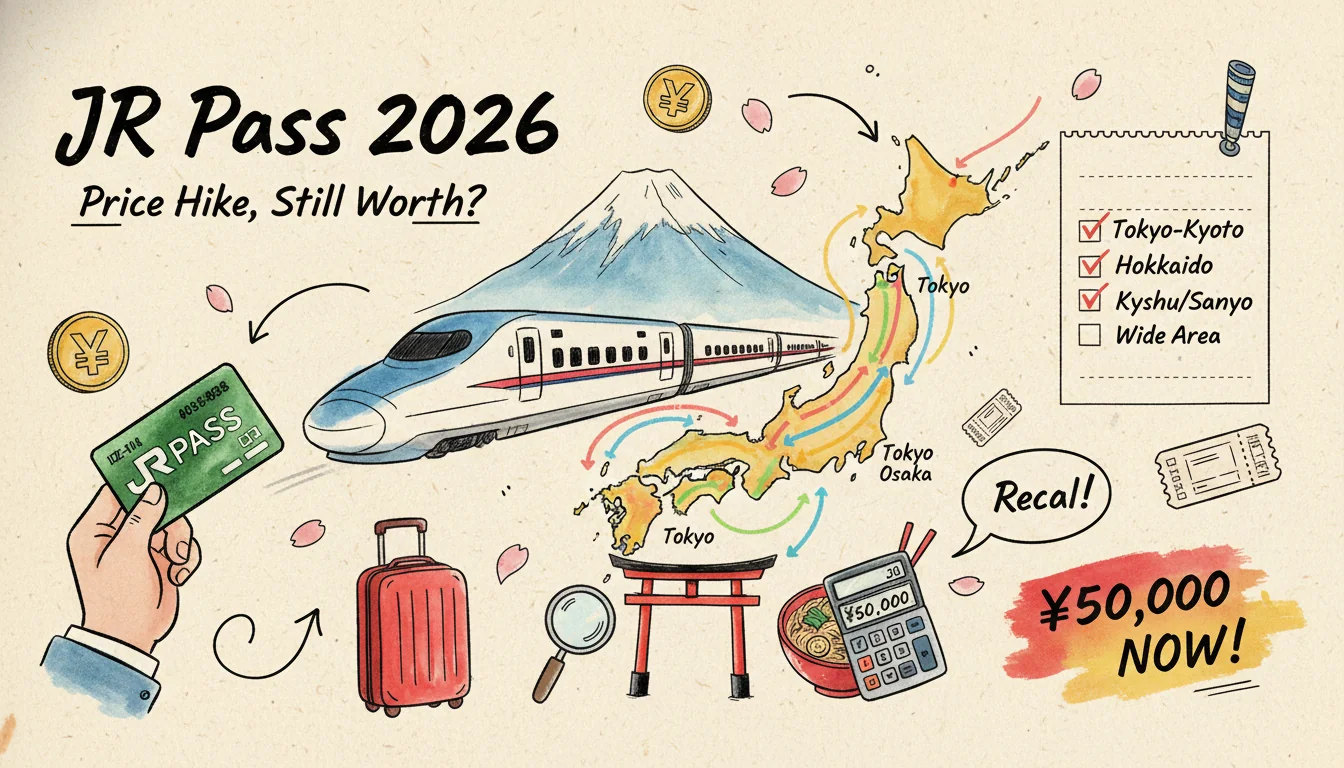
I stood frozen at the Kyoto Station ticket machine for 3 minutes, then bought the wrong 7-day pass and lost ¥20,000
Last July, I was standing in front of the JR Midori-no-Madoguchi at Kyoto Station. The staff slid a form across the counter: "Nationwide 7-day at ¥50,000, or JR West Kansai 5-day at ¥12,000?" I had just flown into Narita, had 5 days planned around Kyoto and Osaka, and was flying back to Taipei from KIX on July 14.
I picked the nationwide pass at ¥50,000. After the trip I ran the numbers. Five individual single tickets plus a JR West Kansai pass would have totalled ¥29,260. I burned ¥20,740, the price of a PS5.
Honestly, the October 2023 JR Pass price hike (the nationwide 7-day jumped from ¥29,650 to ¥50,000, a 69% rise) completely broke my old habit of "when in doubt, just buy the nationwide pass." Before the hike, the ¥29,650 buffer was forgiving, a wrong call only cost ¥5,000. After the hike, ¥50,000 means "didn't run the math = burned a round-trip ticket."
The cost of buying the wrong pass got real, fast.
This article is the homework I redid after 7 trips to Japan over the last 18 months.
Five typical summer routes, ROI calculated one by one. Each compared across single tickets vs regional pass vs nationwide pass. With a 3-rule decision tree, plus a section on stacking overseas credit-card rebates. Total savings: ¥3,000–5,000.
Before researching the pass, I always check whatever campaign is live that week at the Klook JR Pass exchange voucher section. The same pass over there runs ¥1,400–2,000 cheaper than the official site.
The conclusion up front: For summer 2026, there is only 1 scenario where the nationwide 7-day JR Pass is genuinely worth buying. I'll break it down later. For the other 4 scenarios, regional passes or single tickets win outright.
The JR Pass price hike is still rippling through 2026
Let me lay out the numbers first.
The October 1, 2023 price hike was the steepest in Japan rail history:
| Pass type | Pre-Sep 2023 | Post-Oct 2023 | Increase |
|---|---|---|---|
| Nationwide JR Pass 7-day (Ordinary) | ¥29,650 | ¥50,000 | +69% |
| Nationwide JR Pass 14-day | ¥47,250 | ¥80,000 | +69% |
| Nationwide JR Pass 21-day | ¥60,450 | ¥100,000 | +65% |
| Nationwide JR Pass 7-day (Green) | ¥39,600 | ¥70,000 | +77% |
To put it plainly: after the hike, the nationwide pass costs about the same as a round-trip budget flight from Taipei to Tokyo.
The price of a flight. Absurd.
But regional pass hikes were much smaller, mostly in the +5% to +15% range:
| Regional pass | 2026 price | Coverage | Validity |
|---|---|---|---|
| JR East Tohoku Area Pass | ¥30,000 | Tokyo–Sendai–Aomori (5 flex days) | 5 days (within 14) |
| JR West Kansai Area Pass | ¥3,200–¥7,800 | Kyoto–Osaka–Kobe–Nara–Himeji | 1–4 consecutive days |
| JR West Kansai-Wide Area Pass | ¥12,000 | Adds Hiroshima, Okayama | 5 consecutive days |
| JR West Sanyo-San'in Northern Kyushu Pass | ¥22,000 | Osaka–Hiroshima–Hakata–Nagasaki | 7 consecutive days |
| JR Hokkaido Rail Pass | ¥21,000 (5d) / ¥27,000 (7d) | All Hokkaido | Consecutive |
| JR Kyushu All Kyushu Pass | ¥20,500 (3d) / ¥24,500 (5d) | All Kyushu | Consecutive |
| Hokuriku Arch Pass | ¥30,000 | Tokyo–Kanazawa–Osaka (Hokuriku route) | 7 consecutive days |
| Tokyo Wide Pass | ¥15,000 | Tokyo, Fuji, Karuizawa, Nikko | 3 consecutive days |
The key gap is right here: nationwide pass +69%, most regional passes +0–15%. Which means regional passes have actually become relatively more cost-effective after the hike, but only if your itinerary fits inside that region.
The number nearly doubled. The margin for error is gone.
By the way, when I'm buying the exchange voucher I also price-check the KKday JR Pass section. KKday occasionally drops a blog code like BLOGHOTEL88 (mainly for hotels but sometimes tickets qualify too).
5 typical summer routes, ROI recalculated
After 7 Japan trips, these are the 5 most common summer itineraries I've nailed down. For each route, I'll show the real cost across single tickets vs regional pass vs nationwide pass (rail only, no hotel).
Route 1: Tokyo–Kyoto–Osaka 5–7 days (the classic "first trip to Japan" route)
Itinerary: arrive Narita/Haneda, 2 nights Tokyo, 2 nights Kyoto, 2 nights Osaka, depart KIX.
Main rail costs:
| Segment | Hikari Shinkansen (Ordinary Reserved) |
|---|---|
| Tokyo → Kyoto (one-way) | ¥14,170 |
| Kyoto ⇄ Osaka (one trip) | ¥570 |
| Osaka → KIX (HARUKA limited express) | ¥3,490 |
5-day version actual spend: ¥14,170 + ¥570 × 4 + ¥3,490 ≈ ¥19,940.
The 7-day version adds a Tokyo → Osaka round trip. ¥14,170 + ¥14,520 = ¥28,690.
Three-way comparison (5-day version):
| Option | Cost | Verdict |
|---|---|---|
| Single tickets | ¥19,940 | Fully covered, no waste |
| JR West Kansai Area Pass 4-day + Tokyo→Kyoto single | ¥7,800 + ¥14,170 = ¥21,970 | ¥2,030 more, but unlimited Kansai rides |
| Nationwide JR Pass 7-day | ¥50,000 | ¥30,060 wasted, straight loss |
7-day single tickets ¥28,690 vs nationwide pass ¥50,000. Loss: ¥21,310.
A round-trip flight. Gone.
For the Tokyo leg I run a check on the Agoda deals page (~US$255). For the same Shinjuku room type, the price gap vs the official hotel site sometimes exceeds the JR Pass savings entirely.
This is exactly the trip where I bought the wrong nationwide pass. For this route, 99% of the time you should NOT buy the nationwide pass.
When I last bought a Kansai pass, I ordered through the Klook JR Pass exchange voucher section. ¥7,800 ≈ NT$1,650 (~US$51) — still a bowl of ramen cheaper than buying onsite.
Route 2: All Hokkaido 7 days (the summer escape king)
Itinerary: arrive New Chitose, 2 nights Sapporo, 1 night Furano, 1 night Asahikawa, 2 nights Hakodate, depart New Chitose.
Main rail costs (Hokkaido-only):
| Segment | Fare |
|---|---|
| New Chitose → Sapporo | ¥1,150 |
| Sapporo → Furano | ¥4,810 |
| Furano → Asahikawa | ¥1,290 |
| Asahikawa → Hakodate | ¥12,700 |
| Hakodate → New Chitose | ¥9,800 |
Single tickets total: ¥29,750
Three-way comparison:
| Option | Cost | Verdict |
|---|---|---|
| Single tickets | ¥29,750 | No waste |
| JR Hokkaido Rail Pass 7-day | ¥27,000 | Save ¥2,750, covers everything |
| Nationwide JR Pass 7-day | ¥50,000 | ¥20,250 loss (only worth it if entering via Tokyo) |
Answer for this route: JR Hokkaido 7-day pass. The nationwide pass only pays off if you're entering from Tokyo and adding Hokkaido (Tokyo–Sapporo one-way Shinkansen is ¥27,820). That one segment alone earns the nationwide pass back.
¥27,820 in one leg. That's the break-even.
I ran the math again afterwards. Pure Hokkaido vs Tokyo + Hokkaido extension comes down to "do you include the ¥27,820 Tokyo–Sapporo segment?" By the way, for in-city transit after arriving in Sapporo, KKday's Sapporo day-trip section bundles transport into many tours, which beats buying a separate subway day pass. I handled my Otaru day-trip exactly this way.
Route 3: Kyushu + Sanyo 7 days (deep cross-region)
Itinerary: arrive Hakata, 1 night Fukuoka, 2 nights Yufuin, 2 nights Kagoshima, 2 nights Hiroshima, depart Hakata.
Main rail costs:
| Segment | Fare |
|---|---|
| Hakata → Yufuin | ¥5,150 (Yufuin no Mori limited express) |
| Yufuin → Kagoshima-Chuo (with transfer) | ¥13,800 |
| Kagoshima-Chuo → Hiroshima (Sakura Shinkansen) | ¥16,650 |
| Hiroshima → Hakata | ¥8,750 |
Single tickets total: ¥44,350
Three-way comparison:
| Option | Cost | Verdict |
|---|---|---|
| Single tickets | ¥44,350 | No waste |
| JR West Sanyo-San'in Northern Kyushu Pass 7-day | ¥22,000 | Save ¥22,350, massive win |
| Nationwide JR Pass 7-day | ¥50,000 | ¥5,650 loss |
Answer for this route: JR West Sanyo-San'in Northern Kyushu Pass. ¥22,000 covers the entire cross-region trip, ¥28,000 cheaper than the nationwide pass.
I learned this the hard way. My first Kyushu + Sanyo trip, I dumbly bought the nationwide pass. Only after coming home did I find out about the dedicated Sanyo-Northern-Kyushu pass. This is the most easily overlooked sweet spot in the entire JR Pass lineup.
¥22,000 for the whole cross-region run. Yes, it's that cheap.
For Kyushu hotels this time, I booked through the Trip.com hotel deals page. A 5-night stay near Yufuin's Kinrin Lake came to NT$24,000 (~US$750). Platform-wide hotel campaigns stack especially well on Kyushu bookings — check the current terms with your own card issuer.
Route 4: Tokyo–Fuji–Kyoto 5 days (the classic first-timer's plus-version)
Itinerary: arrive Haneda, 2 nights Tokyo, 1 night Kawaguchiko, 2 nights Kyoto, depart KIX.
Main rail costs:
| Segment | Fare |
|---|---|
| Shinjuku → Kawaguchiko (direct bus alternative) | ¥4,500 |
| Kawaguchiko → Tokyo → Kyoto (return Tokyo + Kyoto one-way) | ¥17,420 |
| Kyoto → KIX (HARUKA) | ¥3,490 |
Single tickets total: ¥25,410
Three-way comparison:
| Option | Cost | Verdict |
|---|---|---|
| Single tickets | ¥25,410 | No waste |
| Hokuriku Arch Pass 7-day | ¥30,000 | ¥4,590 more (worth it only if detouring through Kanazawa) |
| Nationwide JR Pass 7-day | ¥50,000 | ¥24,590 loss |
Answer for this route: single tickets. The Hokuriku Arch Pass only earns out if you also want Kanazawa or the Hokuriku coast. A pure Fuji–Kyoto run doesn't need it.
For Mount Fuji area lodging I go straight to the Klook Kawaguchiko onsen ryokan booking page. Credit card stacking there shaves another layer off.
Route 5: 7 cities over 10 days, wide-area (the only sweet spot for the nationwide pass)
Itinerary: arrive Narita, 1 night Tokyo, 2 nights Kyoto, 1 night Osaka, 1 night Hiroshima, 2 nights Hakata, 1 night Kagoshima, return to Narita via Fukuoka.
Main rail costs:
| Segment | Fare |
|---|---|
| Tokyo → Kyoto | ¥14,170 |
| Kyoto → Osaka | ¥570 |
| Osaka → Hiroshima | ¥10,820 |
| Hiroshima → Hakata | ¥8,750 |
| Hakata → Kagoshima-Chuo | ¥10,640 |
| Kagoshima-Chuo → Fukuoka | ¥10,640 |
| Fukuoka → Narita (flight, skipped from JR). Overland equivalent: Hakata → Tokyo | ¥23,810 |
Single tickets total (10 days, 7 cities): ¥79,400
Three-way comparison:
| Option | Cost | Verdict |
|---|---|---|
| Single tickets | ¥79,400 | No waste |
| Regional pass stack (JR West + All Kyushu) | ¥22,000 + ¥24,500 = ¥46,500 | Save ¥32,900, but the two pass date windows need careful planning |
| Nationwide JR Pass 7-day + 3 days of single tickets | ¥50,000 + ¥10,000 = ¥60,000 | Save ¥19,400 vs all-singles |
This is the genuine sweet spot for the nationwide pass. Six or more cities in 7 days, crossing into Kyushu, with Tokyo as both entry and exit. Can't stay only in West Japan. That's the only way to earn back ¥50,000.
Many conditions. Genuinely rare.
To put it plainly: at least 4 Shinkansen segments per trip, every segment crosses regions, total ticket value pushing past ¥60,000, only then consider the nationwide pass.
This kind of itinerary is usually a "first-ever Japan trip, want to see everything at once" long-vacation play. Step back and ask, is it worth dragging luggage through 7 cities over 10 days?
Flights matter just as much for wide-area trips. For long-stay itineraries I book through the Trip.com flight deals page and grab whatever promo code is live that week.
3 rules, the decision tree laid out
After 7 Japan trips over 18 months, these are the 3 rules I've boiled it down to. Work through them in order and you'll know which pass to buy:
Rule 1: Calculate the single-ticket total. Under ¥30,000? Skip the nationwide pass.
Nationwide 7-day pass costs ¥50,000. To earn it back, your single-ticket total needs to clear ¥50,000. If your trip totals under ¥30,000 in singles (Routes 1 and 4 are this tier), just buy the singles. Don't even bother running the rest of the math.
Don't even bother. Yes.
I ran this again. For 5-day trips with singles under ¥30,000, even a regional pass typically doesn't pay off.
Rule 2: 3+ Shinkansen segments crossing regions? Check the regional passes first.
If your itinerary has 3 or more Shinkansen segments (excluding in-city JR), you have to look at regional passes. On the Kyushu + Sanyo route, the Sanyo-Northern-Kyushu pass at ¥22,000 absorbs the entire trip. ¥28,000 cheaper than the nationwide pass.
The most-missed pass in the lineup.
Beginner trap: Most travelers don't realize JR has 8+ regional passes, every one of them cheaper than the nationwide. On my Kansai trip I had no idea the Kansai pass existed, defaulted to the nationwide pass, lost ¥20,000.
Rule 3: Cross-island + 6+ cities into Kyushu + 7 dense days? Then consider the nationwide pass.
Only "Tokyo arrival, Hakata/Nagasaki/Kagoshima departure, 6+ cities in 7 days" qualifies as the genuine wide-area scenario where the nationwide pass earns out. Pure Tokyo–Kansai, pure Hokkaido, pure Kyushu, none of them should buy the nationwide pass.
90% of summer itineraries don't need it. Remember that line.
Real talk from me: Before the hike, I used to buy the nationwide pass with my eyes closed, because at ¥29,650 you couldn't really lose much. After the hike, in 18 months I've only bought the nationwide pass once, on a Route 5-style wide-area Kyushu run, saving ¥19,400. The mindset has to flip from "default to nationwide" to "default to regional, only upgrade to nationwide in special cases." That's the shift summer 2026 demands.
Credit card + JCB Plaza / KOKORO bonus stacking
The JR Pass itself has no discount codes. The price is officially fixed.
But using the right credit card to buy the pass, plus a JCB Plaza point swap, can knock ¥3,000–5,000 off the total cost. Three stacking paths:
Path A: JCB 10% overseas rebate (Tokyo/Osaka/Kyoto JCB Plaza only)
JCB Plaza Lounges in major Japanese cities offer a "show your card for a 10% bonus rebate." Limited to on-site purchases. Meaning: JR Pass can't tap into this directly, but after using the pass, swiping a designated brand at the duty-free shop next to the Plaza triggers the 10% rebate as a direct discount.
10%. You read that right.
Practical example: spend ¥40,000 at the electronics district in Kyoto/Osaka during summer, get ¥4,000 in bonus rebate. That fills back about 1/5 of the JR Pass price hike buffer.
Path B: JCB GOLD 1.5% overseas × Klook voucher stacking
JCB GOLD overseas spending earns 1.5% base rebate (regular cards earn 0.5%).
That's 3x the gap. Pick the right card.
When booking the JR Pass exchange voucher at the Klook overseas travel section, online purchases still count as "overseas channel," so the 1.5% rebate still applies.
Practical example: booking a nationwide JR Pass at ¥50,000 ≈ NT$10,500 (~US$325) this way. The JCB GOLD 1.5% rebate alone puts NT$158 (~US$4.9) (about ¥752) back in your pocket.
Path C: KKday overseas hotel 12% off code BLOGHOTEL88 for stacking hotels
JR Pass trips usually have hotels as the other major budget block. In the same order session at KKday, applying BLOGHOTEL88 knocks 12% off. A 5-night booking at NT$30,000 (~US$940) drops by NT$3,600 (~US$111) straight away. I use this stack on every Japan trip.
On my Kansai 7-day trip, buying the JR Pass through Klook's live deals instead of the official counter saved ¥1,400 (≈ NT$294). Hotels via KKday's 12% off saved NT$2,800 (~US$87). Two stacks combined saved about NT$3,100 (~US$96), covering most of what the JR Pass hike added to the budget.
Half the hike, back in my pocket.
If you want to sweep every available Klook and KKday code in one go, I head to the 1stCoupon Klook store page and the 1stCoupon KKday store page to pull the current weekly codes. Each one averages NT$200–500 (~US$6.2-15). Five stacks add up to NT$2,000 (~US$62)+.
3 timing windows for buying a summer JR Pass
I ran the numbers. When you buy the JR Pass directly affects how much you save. Three timing windows:
- 30+ days before departure: Cheapest from the official site (no platform fees). You wait 5–7 days for the physical pass to arrive in Taiwan.
- 7–14 days before departure: Klook / KKday exchange vouchers. Average ¥500–1,000 more than official. Credit-card stacking + discount codes available.
- Within 3 days of departure: Buy onsite at the JR East Travel Service Center at Narita. The last-resort option, expect a 30–60 minute queue.
For summer peak season I recommend option 1 plus credit-card stacking. Onsite buying is the easiest place to trip on timing. Last July at Narita I queued from 8:30 to 9:30 just to buy the pass. Nearly missed the Narita Express.
Onsite buying genuinely goes wrong. Once is enough.
FAQ
Q: With the nationwide JR Pass at ¥50,000, what scenarios still make it worth buying? A: Only "Tokyo arrival + departure, 7 days, 6+ cities, including Kyushu" wide-area trips. The remaining 90% of summer itineraries, regional passes or single tickets beat the nationwide pass.
Q: How do I figure out which regional pass covers which area? A: The fastest method is "destination lookup." Kyoto/Osaka/Nara → Kansai pass. Hiroshima/Hakata → Sanyo-San'in Northern Kyushu pass. Hokkaido → Hokkaido pass. Kyushu → All Kyushu pass. Around Tokyo → Tokyo Wide pass. Match the destination and you won't buy wrong.
Q: Can JR Pass ride all Shinkansen? A: No. Nozomi and Mizuho, the two fastest Shinkansen, are NOT covered. You have to ride Hikari, Sakura, or Tsubame. This matters for long-distance routes like Tokyo–Hakata. Hikari runs 30–40 minutes longer than Nozomi.
Q: Any catch with the half-price children's pass? A: Children under 12 pay half (¥25,000). The catch is "children under 120cm tall ride Shinkansen free." Which means kids under 5 don't need a pass at all. A family of 4 (2 adults + 2 young kids) only needs to buy 2 adult passes.
Q: Can JR Pass be used on Kyoto city buses? A: No. Kyoto in-city is mainly buses and subway. JR Pass doesn't apply at all. For Kyoto in-city, get the ¥700 1-Day Pass. But that's outside the JR Pass system.
Q: Can I stack two regional passes back-to-back? A: Yes. For example, "Kansai pass 4 days + Sanyo Northern Kyushu pass 7 days" used consecutively covers Osaka–Hiroshima–Hakata–Nagasaki cross-region. Much cheaper than the nationwide pass. But the date windows on the two passes cannot overlap.
Sources
All Deals
JR PASS Hokuriku Area Pass
Kanazawa · 4.8 (209) · 3K+ booked · US$
No Code RequiredJapan JR Pass: Sanyo-San’in Northern Kyushu Pass (Pick-up in Thailand City Central)
Kobe · 5.0 (1) · 25+ booked · US$
No Code RequiredJR Pass – Okayama, Hiroshima & Yamaguchi Area Rail Pass (5-Day)
Yamaguchi City · 4.9 (301) · 3K+ booked · US$
No Code RequiredJR Pass: Tottori-Matsue Pass eMCO E-Ticket | Japan
Matsue Castle · 4.9 (252) · 4K+ booked · US$
No Code RequiredJapan JR Pass | Kansai & Hokuriku Area Rail Pass 7-Day Ticket | eMCO E-Ticket
Kenroku-en · 4.8 (212) · 3K+ booked · US$
No Code RequiredJR Pass All Kyushu, South Kyushu & North Kyushu Rail Pass
Fukuoka
No Code RequiredJR Pass | Discover West Japan Setouchi Area 7-Day Rail Pass (E-Ticket)
Yamaguchi City · 4.9 (170) · 3K+ booked · US$
No Code Required
Pang
Travel & Food Field TesterOn-the-ground travel & food editor. Goes abroad at least 5 times a year — known to camp out at one shop for 3 afternoons or eat the same dish in 3 cities before writing. First-person field testing, ethnographic observation, multiple revisits.
You May Also Like
Japan Autumn Leaves Late September 2026: Altitude, Not Latitude
Silver Week 2026 (Sep 19-23): every Japan spot with real fall color sits above 1,000 m. Peak timing for Asahidake, Kurodake, Hachimantai, plus ¥13,560 for two.
Kyoto Autumn Leaves 2026: Peak Is 22 Days Later, Rooms Half Price
Kyoto's peak colour has slipped 3.1 days per decade since 1953, 22 days in all. Editor Pang lines up 18 spots, the ¥28,686 room rate and how to book in August.
USJ Halloween Horror Nights Turns 15: 2026 Dates + Express Pass ROI
USJ turns 25 as Halloween Horror Nights turns 15 — 9/11 to 11/8 is 2026's window. Express Pass 4 vs 7 by cost-per-minute, plus a 3-platform price check.