2026 Hokkaido July Lavender Route: Furano Solo Female Photo Field Test
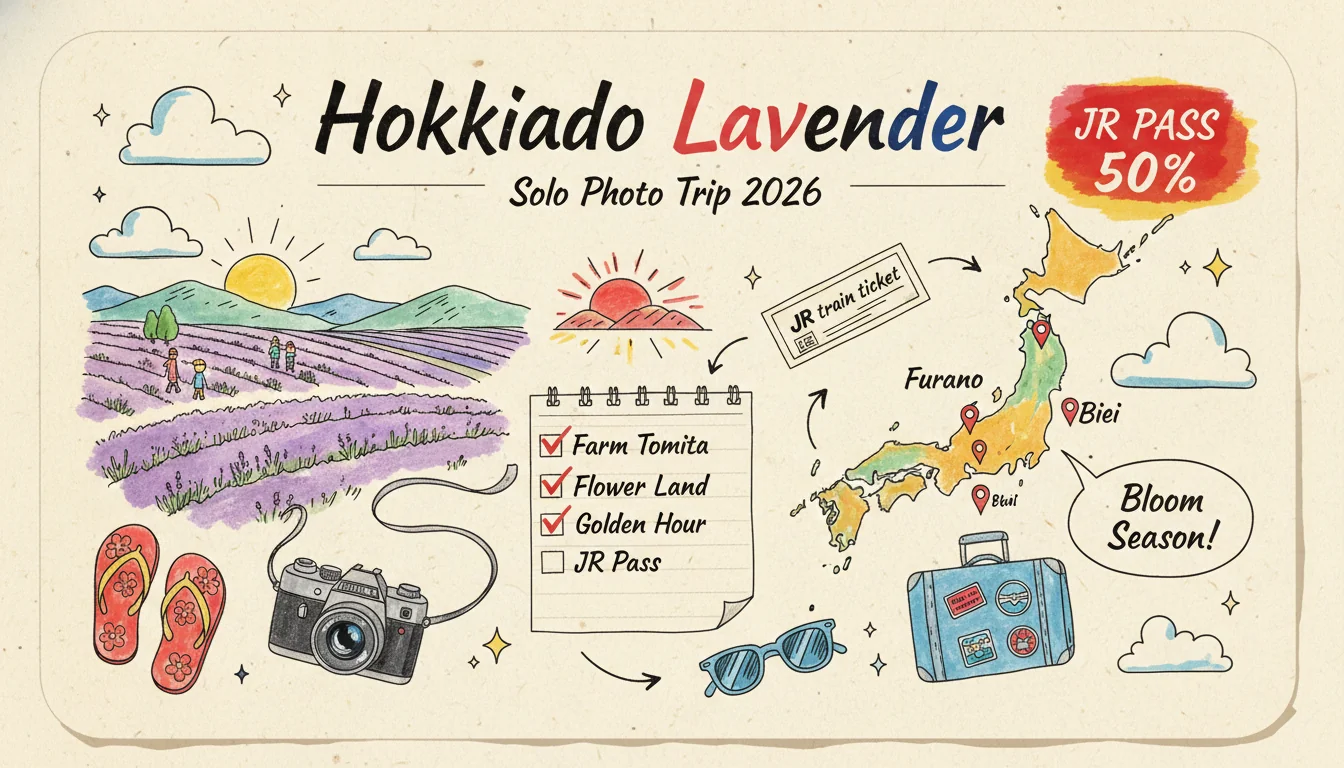
Friday morning, 5:32. I was standing at the Farm Tomita entrance. The wooden sign was lit up empty. Lavender fields not yet open. 3 Japanese photographers had already set up tripods in the parking lot. The convenience-store coffee I had in my hand cost ¥150. The wind was cold. Hokkaido in July at dawn sits around 14°C. Not what I expected.
The closest photographer turned, gave me a quiet nod. "お一人ですか?" I nodded back. "30 minutes early is just about right." He said it in slow Japanese, pointing at the cloud band over the distant ridge.
This trip I flew Hokkaido alone for 6 days and covered 4 lavender farms. Farm Tomita, Furano Flower Land, Biei Shikisai-no-Oka, and Farm Tomita's east-side Saiwai-no-Hanabatake. At each farm I went 3 times: 5:30am, 4:30pm, dusk 7:00pm. The point was to answer one question my girlfriends ask me every year. What time should I go to get the shot?
What follows is what I logged on foot. Prices stay in yen ¥. Lodging numbers come from the 2 minshuku I actually stayed at, taken from the receipts.
Each section is worth your time.
July lavender season real timeline: early bloom vs late bloom vs peak
Lots of people assume "go in July, you're fine". You are not. Lavender breaks down into 4 varieties. Peak windows differ by up to 3 weeks.
Farm Tomita's official page spells it out. The farm grows 4 main varieties: Noushi-zaki (early), Okamurasaki, Yotei, and Hanamoiwa. Early Noushi-zaki opens in late June. Late varieties wait until early August. The biggest patch, Okamurasaki, peaks mid-July to late July.
I went on July 18. Okamurasaki was at 95% bloom. Noushi-zaki had been half-harvested. The whole field showed colour gaps. A Japanese woman next to me pointed her camera at the gaps and said: "If you came 3 weeks earlier you'd have seen full bloom, but the morning light was not this warm." I wrote that line down.
| Variety | Colour | Peak window | Where I shot it |
|---|---|---|---|
| Noushi-zaki | Deep purple | 6/25 to 7/15 | Saiwai-no-Hanabatake north side |
| Okamurasaki | Mid purple | 7/15 to 7/30 | Farm Tomita main, Flower Land |
| Yotei | Pale purple | 7/20 to 8/5 | Saiwai-no-Hanabatake west side |
| Hanamoiwa | Pinkish purple | 7/25 to 8/10 | Farm Tomita colour field |
That 3 weeks gap is the whole game.
Truth is, the most reliable 8 days for "unbroken purple sea" is July 15 to 22. Miss that and you are betting on late varieties. But late varieties come out lighter.
That year I booked flights. Working backwards 4 months, I chose 7/16 departure. The ticket was NT$3,200 (~US$99) cheaper than 7/22. Early-bird matters.
To compare real peak-season hotel pricing, start at Trip.com Japan travel hub and pull Furano and Asahikawa side by side.
Peak season is genuinely tight. Rooms are hard to find.
Farm Tomita vs Flower Land vs Shikisai-no-Oka vs Saiwai-no-Hanabatake, 4 farms compared
I spent over 2 hours at each farm. Below are the field notes.
Farm Tomita (main) sits in Naka-Furano, the most famous and the most crowded. Once the tour buses arrive between 13:00 and 15:00 the colour fields are packed and you can barely compose a shot. But the melon soft serve here is genuinely good — ¥400 per cone, and I had 3 cones. Entry is free, peak hours are 10:00 to 16:00, and from 6:00 to 8:30 there is almost nobody.
Flower Land Kamifurano spans 100,000 square metres, slightly smaller than Farm Tomita. But here is where I felt the ticket earned out. A free tractor-bus tour loops the farm in 15 minutes. The elevation runs higher than Farm Tomita, so you can frame the distant Tokachi mountain range in the background. Handmade lavender pillow workshop runs ¥1,500. About 1 hour. I made 1 pillow. Slept like a stone at the minshuku that night.
Shikisai-no-Oka is in Biei. 40 minutes further by bus from Furano. 15 hectares of flower fields. Not pure lavender. Polychromatic stripe fields. If you want the "baby's breath + poppy + lavender" rainbow stripe shot, this is the only option. Entry ¥500. When I went, visitors stood between the stripes. The frame looked like an oil painting.
Farm Tomita's eastern Saiwai-no-Hanabatake is the satellite farm, 4km drive from the main farm. By bus you have to backtrack to JR Naka-Furano then transfer. The reason to come: 8 hectares of pure lavender, no colour field, no ice cream shop, no souvenirs. Just one solid sheet of purple. The 5:32am photo I took there is my favourite from the trip.
| Farm | Entry | What I think makes it different | Best for |
|---|---|---|---|
| Farm Tomita main | Free | Colour fields + full souvenir lineup | First time, want the IG classic |
| Flower Land Kamifurano | Free | Tractor bus + workshops | Want a souvenir made, have 2 hours |
| Biei Shikisai-no-Oka | ¥500 | Rainbow stripe fields | Tired of pure lavender, want oil-painting frames |
| Saiwai-no-Hanabatake | Free | 8 hectares pure lavender, zero retail | Quiet photography, light crowds, dawn |
My favourite was Saiwai-no-Hanabatake. Light crowds, clean light, one pure sheet of purple. The shot I am happiest with from the whole trip.
Golden hour photo test: 5:30am vs 4:30pm vs dusk 7:00pm
This is the section I cared most about logging. At Farm Tomita main, same shooting spot, 3 days running, 3 windows each day.
Light shifts massively between windows.
5:30am to 7:00am. Light comes in low from the southeast at a slant. The whole purple field gets a "gold rim". Wind has not picked up yet. Flower stalks stand straight. Parking lot holds 5 to 8 photographers. Almost no tourists inside. My favourite shot was taken at 5:47. The sun cleared a distant cloud band at just the right angle and slanted across the field.
4:30pm to 6:00pm. Light is soft but the angle is high, so the colour field reads as deep purple and the red flowers come in saturated. High saturation overall. The IG-rich-colour crowd loves it. Catch is, this window draws crowds. You wait 20 minutes for a clear lavender close-up.
Dusk 7:00pm to 7:45pm. Hokkaido sunset in July hits around 7:15, and 15 minutes before sunset is magic hour. The whole field shifts orange-purple. But the farm closes at 17:00. To get the 7pm light you have to shoot from outside. Or head to a nearby hill with a night view. I climbed the hill next to Flower Land that night and got the orange panorama shot at 7:23.
| Window | Light character | Crowd | My score |
|---|---|---|---|
| 5:30am to 7:00am | Gold rim, warm slant | Almost nobody | 9 / 10 |
| 4:30pm to 6:00pm | Soft high angle, saturated | Packed | 6 / 10 |
| 7:00pm to 7:45pm | Orange-purple magic hour | Outside the farm only | 8 / 10 (do your homework) |
Getting up early actually matters this much.
That first photographer I met told me a line I have not forgotten: "The ones who show up at 5:30 aren't tourists. They're here to work." Felt called out. But the result was that different.
That ¥150 convenience-store coffee was the best money I spent all trip.
To catch the early light, the bus shuttle simply will not get you there in time. You have to sort transport yourself. Look at Klook Japan attraction passes from 1/10 off. Furano rental car or chartered car deals show up there sometimes. Grab one.
Furano / Biei bus routing tested: JR + Lavender + Biyu bus, which is the best value
This is where I got stuck for 2 days. Conclusion first, then why.
Ticket choices vary wildly.
Conclusion: for 3 days 2 nights, the best value is JR Hokkaido conventional line + Furano-Biei NORROCO (summer only). Skip the JR Pass. Buying single fares is cheaper.
This is how I ran it:
| Day | Route | Transport | Cost |
|---|---|---|---|
| Day 1 | New Chitose Airport → Sapporo → Asahikawa | JR Rapid Airport + Limited Express | ¥5,920 |
| Day 2 | Asahikawa → Biei → Furano | NORROCO + Biyu bus | ¥1,840 |
| Day 3 | Furano → Asahikawa → New Chitose | Limited Express + Rapid | ¥7,260 |
Total about ¥15,020. Way under what I expected.
JR Pass 7 days runs ¥50,000 (post-April 2026 hike pricing). Unless you are riding JR from Furano on to Hakodate or Abashiri, single fares are cheaper. I skipped the Pass on this trip. Saved ¥34,980.
Furano-Biei NORROCO is a summer-only sightseeing train. It has open-window observation cars and slows down through the prettiest patchwork-road stretches. ¥640 one way. Add ¥530 for reserved seat. Best-value piece of this trip.
Biyu bus is the loop sightseeing bus from Biei station. Hits Shikisai-no-Oka, Shirogane Blue Pond, Shirahige Falls. 1 day pass ¥2,000. I bought it that day. Honestly only worth it if you skip Shikisai-no-Oka, since a regular one-way bus runs ¥460 anyway.
Furano-go is the Furano bus sightseeing route. ¥6,000 per day, covers Farm Tomita, cheese workshop, wine factory. If you cannot drive and want to do it all in one day, this is the only option. I did not take it. Rather get up at 6:00am and walk to Farm Tomita to shoot for 2 hours.
Pacing on your own feels better.
I check fares straight from Trip.com flight and hotel hub and search local transport at the same time. Full deal sheet lives at 1stCoupon Trip.com page.
Bus logistics is the one thing that will kill you if you do not research. Map your route before you fly.
Staying at a minshuku solo: first night, what solo women keep getting asked
This section I am writing longer. Girlfriends ask me this question most often.
Pick the right minshuku and you can actually relax.
First night I stayed 8 minutes' walk from JR Biei station, 1 night ¥7,800 with breakfast, at a Taiwanese-run Chinese-language minshuku called Slow Hokkaido. I rolled my 22-inch suitcase to the door and the owner's first sentence in Chinese was: "You came alone? Let me put you in a room near the lobby." Whole body relaxed on the spot.
9pm at the minshuku, the lobby puts out cold barley tea. I went down to pour a cup. The owner brought me a slice of lavender pound cake she had baked, the kind that pairs perfectly with cold mugicha. "Are you leaving at 5 tomorrow? I'll leave a breakfast paper bag at your door." That one line was why I made the 5:32 dawn at Farm Tomita.
The cake was also surprisingly good. I asked for another slice.
Second night I shifted to a B&B beside JR Furano station, 1 night ¥9,500, no breakfast. Japanese owner. The moment he opened the door he asked in Japanese: "お一人様でよろしいですか?" Confirmed before handing over the key. Beside the front desk there was a small Chinese-language "solo female guest reminder" card noting which roads after dark have no street lights, and the direction of the nearest 24 hours convenience store. I photographed that card and saved it.
Questions solo women keep asking:
| Question | My honest answer |
|---|---|
| Are Biei / Furano nighttime streets safe? | I think so. Before 9pm very safe, but street lights thin out after 9. |
| Is eating alone awkward? | Izakayas near Furano station have solo counters. Staff naturally do not ask "how many". |
| Do minshuku have women-only floors? | Slow Hokkaido does not partition explicitly, but they put women in 2nd-floor window-side rooms. |
| Is going out at 5am safe? | May to August daylight starts at 4:30am. Safer than you would guess. |
| Will the minshuku call a cab for a solo woman? | Both places I stayed proactively asked "shall I book you a taxi for tomorrow". |
Picking the right minshuku really moves the needle. Go for the small ones that proactively ask about your routing, that offer to call cabs. More practical than a chain hotel's standardised service.
Backstreet coffee vs tourist-strip coffee, the price gap. Quick comparison.
Tourist coffee shop beside Furano station, one latte ¥1,200. I walked in, ordered, sat down. 3 tables of Chinese-speaking tour groups. Tasted like a normal ¥1,200 cup.
The backstreet shop the owner recommended sat down a small lane 6 minutes from Furano station, vibe like a private "Coffee Forest Clock" room. A pour-over single origin ¥500. The shop seats 4 people. The barista said as she brought the cup: "お一人で旅行ですか?素敵ですね." (Travelling alone? That's wonderful.) I sat with that cup for 45 minutes.
Price gap ¥700. Atmosphere gap much wider.
For booking I use Trip.com hub and filter to small minshuku with 9 or better ratings. Prioritise listings whose reviews say "good for solo" or "owner is kind".
On the way back to the inn each night I detour to a 7-11. Buy a ¥150 canned coffee and put it in the fridge. Saves it for the 5am out-the-door run.
Bonus: Japan SIM and KKday ticket discount
This part is for people getting ready to fly. Stacking the next 2 deals still trims a few hundred NT$ off the pre-departure spend.
Japan SIM. I grabbed a SIM-category coupon on KKday the week it was running, then placed the order. 8 days unlimited 5G. Signal in rural Hokkaido tested at: Furano 5 bars, Biei 4 bars, near Shirogane Blue Pond 2 bars. Check the current terms on KKday — the live on-site announcement is what counts.
Ticket discount. KKday's weekly Thursday Japan-product 6% off, I use it for big-ticket items like "Biei one-day chartered car". Cashback around NT$120 (~US$3.7). Order Thursday, ticket Friday. Cross-reference with KKday Japan main page.
Both stacked. The SIM + tickets still shaved a few hundred NT$ off this trip.
Not huge. But enough for a few cups of backstreet coffee. Each one earned.
FAQ
Q1: For a July Hokkaido trip, what date should I book flights to get the lowest fare?
A: I booked in early April. NT$3,200 (~US$99) cheaper than booking in late May. Rule of thumb: book 100 to 120 days before departure. EVA Air, Starlux, Scoot all run early-bird sales in April. Run Trip.com and KKday flight comparisons in parallel. Fare gaps land around NT$1,500 (~US$46).
Q2: Farm Tomita or Flower Land, pick one?
A: First-time, go Farm Tomita main. Best light and full souvenir lineup. Stay in Furano and do Flower Land on day 2. It is smaller, less crowded, and has the workshops if you want to slow down. With only half a day, I would do Farm Tomita 5:30am to 8:30am.
Q3: Is going out alone at night really safe?
A: In Furano and Biei before 9pm I felt very safe. Street lights thin out heavily after 9pm. I would recommend taking a cab back to the inn. Slow Hokkaido and the Furano B&B both proactively offered to book taxis. A ride runs around ¥1,500 to start.
Q4: Is the JR Pass 7 days worth it?
A: Unless you are looping from Furano to Hakodate or Abashiri, single fares are cheaper. My 3 days 2 nights field test was ¥15,020 in single fares. Pass 7 days is ¥50,000. Gap of ¥34,980.
Q5: What day will the 2026 lavender peak hit?
A: Based on Furano Tourism Association and Farm Tomita's official bloom page, the biggest patch Okamurasaki peaks mid-July to late July. My read: 2026 peak should land July 17 to 24. 3 days before flying, recheck Farm Tomita's official bloom report page for the latest colour mosaic.
Colour mosaics shift slightly each year.
Early-bird shaves real money off the trip.
References
- Farm Tomita official: lavender east-side page
- Furano Tourism Association: lavender bloom report
- JR Hokkaido: riding JR to Furano and Biei
- Tabirai: Sapporo to Furano transport
- Lets Go JP: Furano free travel full guide
- vocus: Farm Tomita vs Flower Land
Full Hokkaido deal roundups live at 1stCoupon. Booking 100 days before peak season is where the savings actually land.
All Deals
Furano & Biei Blue Pond & Shikisai-no-Oka Day Tour | From Sapporo
Hokkaido
No Code Required[Late Departure] Biei Furano Relaxing Day Tour Highlights
Hokkaido
No Code RequiredSummer Free Shikisai-no-Oka Ticket + Flower Field Tractor Ride: Hokkaido Biei Furano Flower Fields or Winter Fun Asahiyama Zoo Day Tour | Two Routes Available & Chinese & English Service | Departing f
Hokkaido
No Code RequiredHokkaido Biei Furano Panoramic Day Tour | Farm Tomita & Biei Blue Pond & Shirahige Waterfall & Viral Tree & Shikisai-no-oka (from Sapporo, Multi-language Options) [Free Flower Viewing Ticket + Flower
Furano
No Code RequiredFarm Tomita, Shikisai-no-Oka, Blue Pond: Furano & Biei Day Tour from Sapporo (All-You-Can-Eat Melon Option)
Hokkaido
No Code RequiredHokkaido Fun Day Tour, Two Routes: Winter Asahiyama Zoo Penguin Walk / Biei-Furano Flower Fields | Asahiyama Zoo Ticket Included & Optional Snowmobile Experience | From Sapporo
Hokkaido
No Code RequiredHokkaido Day Tour: Asahiyama Zoo (Ticket Included), Shikisai-no-Oka, Biei Photogenic Trees / Seasonal Blue Pond & Shirahige Falls, Furano Fairy Terrace | From Sapporo, Free Drinks Included
Asahikawa
No Code RequiredSapporo Furano & Biei Lavender Day Tour
Hokkaido
No Code Required[Hokkaido Winter Limited] Asahiyama Zoo, Shikisai-no-Oka, Biei Christmas Tree & Forest Elf Terrace Day Tour (From Sapporo)
Hokkaido
No Code RequiredHokkaido Summer Day Tour: Patchwork Road & Farm Tomita & Shikisai-no-oka & Blue Pond & Shirahige Waterfall (from Sapporo)
Furano
No Code Required(Summer Furano Exclusive) Ningle Terrace & Shikisai-no-Oka & Farm Tomita & Blue Pond & Waterfall Day Tour
Hokkaido
No Code RequiredAsahikawa Car Rental | Drive to Asahiyama Zoo, Biei Trees, Shirahige Falls & Sennyodai
Hokkaido
No Code RequiredIllumination Tour: Furano Fairy Terrace & Biei Blue Pond & Shirahige Waterfall Day Tour
Furano
No Code RequiredHokkaido Popular Photo-Spot Day Tour: Asahiyama Zoo, Biei Shirogane Blue Pond, Instagram-Famous Tree, Shirahige Falls, Forest Fairy Terrace (Departs Sapporo, Multiple Languages Optional)
Asahikawa
No Code RequiredAsahiyama Zoo & Biei Blue Pond & Shirahige Waterfall or Farm Tomita Day Tour (from Sapporo, Hokkaido, Original Souvenir Included)
Asahikawa
No Code Required【Hokkaido Summer Exclusive】Furano Farm Tomita & Shikisai-no-Oka & Blue Pond & Waterfall & Patchwork Road Day Tour|Departing from Sapporo
Hokkaido
No Code RequiredHokkaido Furano Melon Day Tour: Blue Pond & Shikisai-no-Oka & Farm Tomita & Ningle Terrace (Chinese, English & Cantonese Guide)
Hokkaido
No Code RequiredOptional Snowmobile Experience: Hokkaido Winter Illumination Tour - Biei Christmas Tree, Shikisai-no-Oka, Shirogane Blue Pond Illumination & Forest Elf Terrace
Hokkaido
No Code RequiredHokkaido Asahiyama Zoo, Shikisai-no-Oka, Biei Christmas Tree & Elf Terrace Day Tour: From Sapporo (Winter Snowmobile Option Available)
Asahikawa
No Code RequiredAsahiyama Zoo Penguin Walk & Forest Elf Terrace Night Tour
Hokkaido
No Code Required[Hokkaido | Noboribetsu, Lake Toya & Niseko Day Tour] Little Fuji Mount Yotei & Takahashi Farm & Lake Toya & Noboribetsu Jigokudani & Bear Farm & Kyogoku Spring Water Park & Winter Lake Shikotsu Ice F
Abuta
No Code RequiredHokkaido Otaru & Cape Kamui Small-Group Day Tour
Shakotan
No Code RequiredHokkaido Lake Toya Fireworks Festival, Lake Shikotsu & Bear Park & Observatory Day Tour (Boat Cruise Optional)
Usu District
No Code RequiredSapporo Okhotsk Ice-Breaker Cruise & Sounkyo Ice Fall Festival Tour
Hokkaido
No Code RequiredJapan Hokkaido Sapporo Cape Kamui + Otaru + Shiroi Koibito Park Day Tour
Shakotan
No Code RequiredDeparts Sapporo | International Ski Resort All-Inclusive Day Tour | Hokkaido Tourism Organization (HTO) Official Member Certified
Sapporo
No Code RequiredHokkaido Lake Toya Observatory & Noboribetsu Jigokudani & Showa Shinzan Bear Park & Mount Usu & Lake Hill Farm Day Tour (Depart from Sapporo)
Usu District
No Code RequiredJapan Hokkaido Noboribetsu Jigokudani + Showa Shinzan + Lake Toya Day Tour (Depart from Sapporo, Lake Toya)
Noboribetsu
No Code RequiredFurano Ski Resort Chinese/English-Speaking Private Ski Instructor & Photography Service
Furano
No Code RequiredSapporo Hagoromo Falls & Mt. Daisetsuzan Ropeway Day Tour
Hokkaido
No Code Required[11:00 Departure] Blue Pond Illumination & Fairy Terrace & Christmas Tree & Shirahige Waterfall & Shikisai-no-oka Day Tour | from Sapporo
Furano
No Code RequiredHokkaido Shikisai-no-Oka & Farm Tomita Small-Group Day Tour Adventure
Hokkaido
No Code RequiredHokkaido|Lake Toya Fireworks Festival & Showa Shinzan & Lake Hill Farm Day Tour|Departing from Sapporo
Ishikari City
No Code RequiredHokkaido Noboribetsu Popular Spots Day Tour: Lake Toya Observation Deck, Lake Toya Onsen Pier, Lake Hill Farm, Showa Shinzan Bear Ranch & Noboribetsu Jigokudani
Noboribetsu
No Code RequiredHokkaido: Otaru, Cape Kamui, Yoichi Distillery, Shimamui Coast & Cape Kogane Summer Day Tour
Shakotan
No Code RequiredHokkaido | Shakotan Sea Urchin, Yoichi Whisky Distillery Fruit Picking | Cape Kamui, Otaru Mount Tengu Scenic Day Tour
Shakotan
No Code Required[Hokkaido Winter Limited] Asahiyama Zoo, Famous Christmas Tree, Shirahige Falls & Elf Terrace Day Tour | From Sapporo
Asahikawa
No Code Required[Summer 11am Departure] Shikisai-no-Oka & Tomita Farm & Blue Pond & Waterfall & Fairy Terrace Illumination Day Tour
Hokkaido
No Code RequiredFrom Sapporo | Teine Ski Resort All-Inclusive Day Tour | Hokkaido Tourism Organization (HTO) Official Member Certified
Sapporo
No Code RequiredHokkaido Otaru Cape Kamui Day Tour | Cape Kamui, Otaru Canal, Blue Cave Boat Ride, Shiroi Koibito Park | Depart from Sapporo
Otaru
No Code RequiredHokkaido Day Tour: Hoheikyo & Jozankei & Lake Toya & Showa Shinzan & Mount Yotei Spring Water Park (From Sapporo)
Sapporo
No Code RequiredHokkaido Flower Sea Tour: Blue Pond, Farm Tomita, Shikisai-no-Oka & Elf Terrace Day Tour (Optional Buffet Lunch/All-You-Can-Eat Melon)
Hokkaido
No Code RequiredHokkaido Noboribetsu Must-See Spots Day Tour | Lake Toya Observation Deck, Lake Toya Onsen Pier, Lake Hill Farm, Showa Shinzan Bear Ranch & Noboribetsu Jigokudani (From Sapporo)
Noboribetsu
No Code RequiredHokkaido Otaru Cape Kamui Summer Views: Cape Kamui + Blue Cave Seagull Feeding + Otaru Canal + Shiroi Koibito Park (Chinese/English Guide)
Shakotan
No Code RequiredHokkaido Niseko Chinese/English-Speaking Private Snowboard/Ski Instructor & Photography Service
Abuta District, Hokkaido
No Code RequiredOtaru Asarigawa Onsen Ski Resort Day Tour: Professional Chinese/English-Speaking Instructor, Solo-Friendly, Free Photography Service (From Sapporo, Hokkaido)
Otaru
No Code RequiredHokkaido Sounkyo Autumn Foliage Day Tour: Sounkyo Onsen Town, Ginga Falls, Ryusei Falls, Mt. Kurodake Ropeway & Obako Gorge (From Sapporo)
Hokkaido
No Code Required[Hokkaido Summer Flower Viewing] Shikisai-no-oka & Farm Tomita & Blue Pond & Waterfall & Patchwork Road Day Tour | from Sapporo
Hokkaido
No Code RequiredHokkaido Enjoy Pass (1 Week Free Pass)
Asahikawa
No Code Required
Nana
Solo Female Travel EditorSolo travel + women's-route editor. Has flown alone to 12 cities — writes 'safe routes', 'photo vibes', and 'one cup of coffee price points' into every guide. Loves alley cafes, design hotels, golden-hour street corners, and women-friendly spots.
You May Also Like
Moraine Lake Has No Car Access: 2026 Banff Shuttle Timings
Moraine Lake Road is closed to private cars all year. Shuttle seats drop in two waves, entry is free only through Sept 7, and I ran the ticket maths for going solo.
Japan Autumn Leaves Late September 2026: Altitude, Not Latitude
Silver Week 2026 (Sep 19-23): every Japan spot with real fall color sits above 1,000 m. Peak timing for Asahidake, Kurodake, Hachimantai, plus ¥13,560 for two.
BIGBANG Seoul 2026: A Solo Female Fan's Goyang Trip Guide
BIGBANG's 20th anniversary tour opens in August at Goyang, outside Seoul. Not a ticket-buying post: how I flew in alone as a woman and made three days work, from flight timing and a safe place to sleep to eSIM picks and getting out when 40,000 people hail at once.