Kyoto Autumn Leaves 2026: Peak Is 22 Days Later, Rooms Half Price
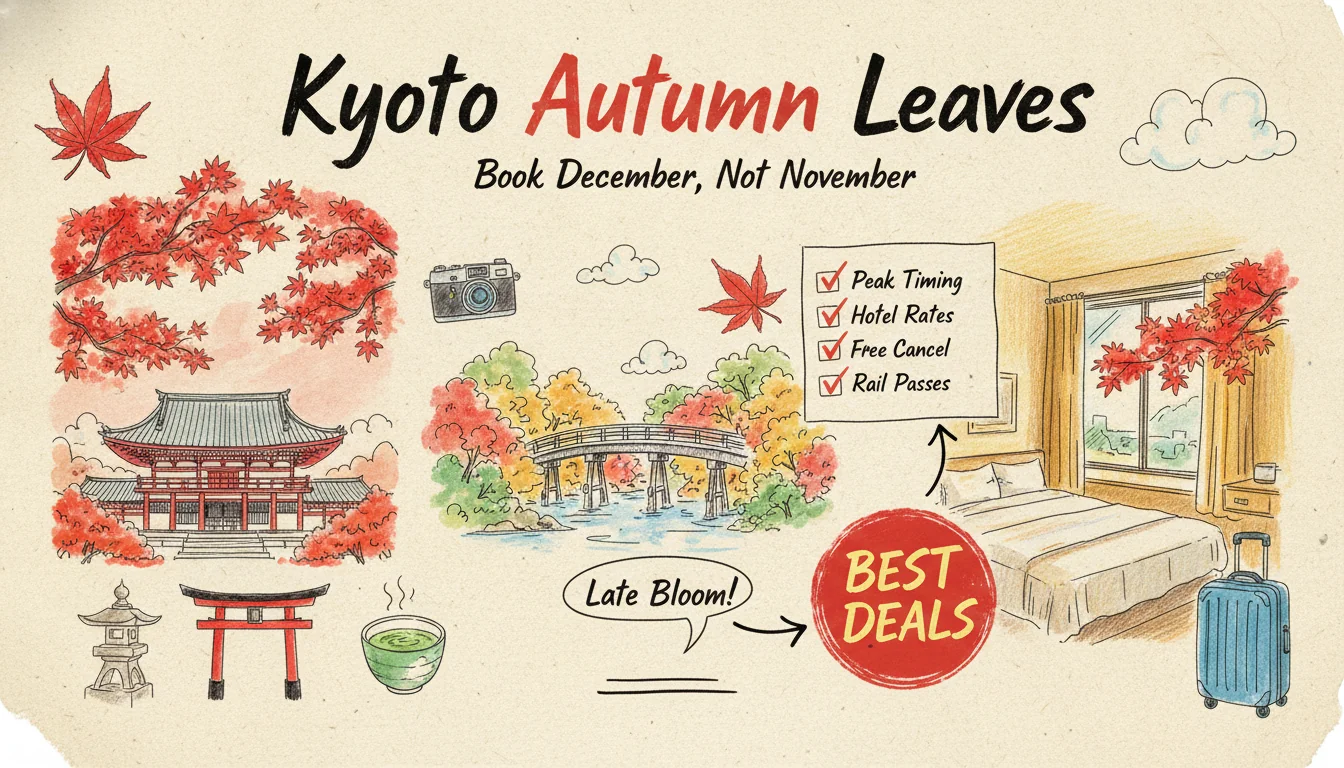
"Go to Kyoto in mid-November for the maple leaves" is advice still running on a 1950s calendar. The Kyoto Local Meteorological Observatory has been logging the dates the maples redden and the ginkgos yellow since 1953, and the long-run trend has those dates sliding about 3.1 days later every decade — 22 days across 72 years, a full three weeks. The itineraries the travel press keeps reprinting have not moved a single one of those days.
The first habit I broke a few years ago was taking "typically mid-November" off a travel site at face value. These days I open the observatory's raw statistics first, and the gap between what they say and what the guides say is much wider than you would guess.
Kyoto's Autumn Colour Slips 3.1 Days Every Decade — That Is a Statistic, Not a Feeling
The Kyoto Local Meteorological Observatory's own paper, Changes in Flowering, Full Bloom, Autumn Colour and Other Phenological Phenomena in Kyoto, shows that while the maple and ginkgo colour-change dates bounce around from year to year, the trend since 1953 has been roughly 3.1 days later per decade, with long-term warming and urbanisation named as the drivers. Flattened out across a single year, that is 0.31 days of drift.
The number only makes sense against a bigger backdrop. Japan Meteorological Agency figures put the rise in Japan's annual mean temperature between 1898 and 2024 at 1.40°C when expressed on a per-century basis. Weathernews, summarising the same body of research, says it far more bluntly: Kyoto's peak foliage has already moved out of November and into December.
Divide 3.1 by 10, multiply by 72 years, and the answer is 22.3 days. Over one 30-year generation it works out at 9.3 days — meaning the leaf-peeping week your parents remember and the week you should actually be booking are nearly 10 days apart. That is not a feeling. It is a statistic.
So the question was never "will it be late this year". It is "which years of data was that mid-November recommendation written from". When travel media says "typically", it usually means an average of the last 10 to 20 years, already far later than the 1950s baseline — but also a moving target that falls another three days behind every decade.
"Typically Mid-November" — Typical of Which Years? The Peak Table for 18 Famous Spots
Weathernews publishes a typical-peak calendar for Kyoto that lists the major spots district by district. Here it is, transcribed with the original districts intact:
| District | Famous spots | Typical peak |
|---|---|---|
| Arashiyama · Sagano · Takao | Arashiyama, Tenryu-ji, Jojakko-ji, Gio-ji, Hokyo-in, Takao | Mid to late November |
| Kyoto Station area · Uzumasa | Ninna-ji, Ryoan-ji | Mid to late November |
| Kyoto Station area · Uzumasa | Kitano Tenmangu, To-ji | Late November |
| Kurama · Kibune · Shimogamo | Nanzen-ji, Eikando Zenrin-ji, Enko-ji | Mid to late November |
| Gion · Kiyomizu-dera | Tofuku-ji, Kiyomizu-dera | Mid to late November |
| Gion · Kiyomizu-dera | Kodai-ji | Mid November to early December |
| Fushimi · Uji | Byodo-in | Mid to late November |
| Fushimi · Uji | Daigo-ji | Mid November to early December |
Of the 18 spots on that calendar, 2 already carry early December inside their peak window and another 2 are simply marked late November, which leaves 14 sitting at mid to late November. On this table "mid-November" is not the median at all — it is the earliest edge of the entire range. That is a considerable difference.
And peak is a window, not a point. A single maple holds its best state for only so long; 7 to 10 days is the realistic working figure, after which the leaves start dropping. Book yourself into Kyoto on 15 November and you land at the very start of that window, when most spots are still at irozuki-hajime, the first tinge of colour, rather than full flame. Anyone who wants a whole hillside in red should be leaning later. I would slot the Arashiyama night-train run into the back half of a trip in particular: on an illumination itinerary like the Kinkaku-ji & Arashiyama Night Train Illumination Autumn Foliage Day Tour, going before the leaves have fully turned means the floodlights pick out only half the colour.
The 2026 Forecast Lands in September, but You Have to Book in August
This is the most awkward part of the whole exercise, and the part every foliage guide I have read treats far too lightly.
According to the Japan Weather Association (tenki.jp), its 2026 autumn-colour peak information is scheduled to start appearing around September. Which is to say that right now, in August, the first official read on this year does not exist at all. Meanwhile the popular room types in Kyoto for November — three months out, today — are already being swept up.
Last year's rhythm makes the squeeze clearer still. The Japan Weather Association's third foliage forecast of 2025, issued that November, was updated on 6 November, and its conclusion was that the season was running late nationwide, with the plains of eastern Japan and most of western Japan not reaching peak until after late November. If a call like that only firms up 2 to 3 weeks before check-in, there is no version of August in which you could have known it.
So the correct question is not "which date do I go this year". It is "how much room to change my mind does the booking I place in August have to leave for the September and November forecasts". That decides which room type you pick, not which hotel you pick. On Trip.com's Japan autumn-foliage hotel page, up to 40% off, the discount has never been the column I read first — I read whether that exact room comes with a free-cancellation option.
Late November vs Early December Room Rates, With the Numbers Side by Side
Start with the figure that stings most: statistics on Japan's accommodation market put the average room rate at major hotels inside Kyoto city in November 2024 at ¥28,686 a night. That is the average, not the peak.
Japanese travel media covering the accommodation squeeze has cited harder examples still: a business hotel that normally goes for ¥5,000 a night asking upwards of ¥30,000 during foliage season. ¥5,000 turning into ¥30,000 is six times the price for the same bed. Ridiculous, and entirely real.
Push the dates two weeks later and the picture changes completely. In autumn 2025 a hotel manager near Kyoto Station told reporters that from November onwards they were being visibly forced to cut rates, with some stretches falling to roughly half of what the same period had fetched a year earlier.
| Window | Where the rate sits | Odds of hitting peak colour | Who it suits |
|---|---|---|---|
| Mid-November | Already climbing | Most spots only at irozuki-hajime | People locked to a public holiday |
| Late November | The year's high-water mark, ¥28,686-a-night territory | Highest | Unlimited budget, buying insurance |
| Early December | A clear drop; the market still treats it as off-season | Kodai-ji, Daigo-ji and others are still inside their peak window | Anyone happy to trade 20–30% of the odds for 40–50% off the room |
I ran the arithmetic once at a rough ¥150 to the US dollar. At ¥28,686 a night, or about US$191, four nights comes to ¥114,744 — roughly US$765. Take the same four nights in a window that has genuinely fallen to half price and you are at ¥14,343 a night, about US$96, so ¥57,372 or about US$382 for the stay. The gap is ¥57,372. That is the size of number that decides whether you bring another person along.
For two people it gets sillier. Over the same four nights, sharing one room saves you that ¥57,372; booking two rooms saves ¥114,744, roughly US$765. Set against that, the ¥14,000-odd — about US$95 — airfare difference most people agonise over stops being the point entirely.
Agoda's Stay Longer deal, up to 20% off stays of three nights or more is built for exactly this pattern, and almost nobody does a foliage trip in two nights anyway.
Put plainly: the travel press files early December as "the tail end of the season, off-peak", a label stapled on well over a decade ago, while the observatory's curve has spent that same decade-plus running in precisely that direction. The label has not changed. The prices have not changed. Only the leaves have.
Warming Does Not Only Delay the Peak, It Also Fades the Colour
Reading this study changed the way I lay out an entire itinerary, because it moves the question from "which week" to "which slope", and those are not answered by the same booking.
Research published jointly by the National Institute for Environmental Studies, the Forestry and Forest Products Research Institute and Shinshu University finds that global warming affects not only the timing of autumn colour but the colouring itself. The key variable is the spring leaf-out date: in years when the snow melts late and the leaves emerge late, that autumn's colour comes in deeper and more vivid. Turn it around, and a mild winter that melts the snow early and pushes the leaves out early gives you a weak autumn, because by then the leaves are simply too old and both the synthesis and the breakdown of the pigments run less efficiently.
The same work models the future as well. Under the harshest warming scenario — RCP8.5, with roughly 4°C of warming by the end of this century — the intensity of autumn colour weakens by about 15% across most regions, and low-elevation areas take the worst of it.
Low elevation is the phrase worth underlining here, because it is what sorts Kyoto's map into the places that keep their colour and the places that fade to a washed-out orange.
Almost every famous spot inside Kyoto city sits at low elevation, which means "I got the timing right and the colour still was not deep enough" is going to be a more common complaint with each passing year. My own workaround is to keep at least 1 day of every trip for higher ground: Takao, Kurama and Kibune, the 3 districts with some altitude to them, usually run a full shade deeper than the city centre in the same week. The same logic applies to transport, where a fixed-price ticket like the Kansai Kintetsu Rail Pass at 25% off takes you out towards Nara and Yoshino — spreading the bet across elevations instead of putting all of it on three temples in central Kyoto.
How I Book It: Free Cancellation Held in August, One Amendment in September and One in November
This is the three-stage routine I have settled into over the past few years, and it is quicker to just walk you through it.
Stage 1, August: hold the slot, do not commit. Pick 1 set of dates in late November and 1 in early December, and book only room types with free cancellation. Paying a little premium here is entirely rational, because what you are buying is not a room, it is an option. Hotels usually set the free-cancellation deadline at 7 to 14 days before check-in, so confirm that before you hit the button.
Stage 2, September: read the first outlook. Once the Japan Weather Association's first forecast is out, set it against what the summer's heat has been doing. If the read is "late", shift your weight onto the early-December set and cancel the other one.
Stage 3, late October to early November: read the third forecast. In 2025 the third edition was updated on 6 November, and that version was already quite accurate. Your free-cancellation deadline will usually not have landed by then, which makes it exactly the right moment to commit.
The entire cost of this approach is that you carry 2 live bookings for a month or so. Run it once and you will see it beats "bet on a date and then stand there looking at green leaves" by a wide margin. I booked 17 November one year, and Eikando was still mostly green. Got it wrong. The only consolation on that trip was the thinner crowds.
If this is your first time running the two-booking approach, a first-timer threshold like KKday's 8% off global accommodation for new customers, up to NT$300 (~US$9) off fits neatly onto one of the two — the other one was always going to be cancelled anyway.
Trip.com's Japan travel page is where the booking sites separate from one another here. For the very same room, some platforms list only the non-refundable version, while others let you choose either one. Holding two sets of dates needs the latter.
Matching the Transport Passes: What Keihan, Kintetsu and Haruka Each Cover
The last time I went to Kyoto in foliage season, city traffic was worse than usual: a bus scheduled every 20 minutes took nearly 50 minutes to arrive, and buses were effectively unusable for planning purposes. My rule is a simple one. If rails will do it, take the rails.
| Pass | Discount | Main coverage | When it is worth buying |
|---|---|---|---|
| Keihan Railway 1/2-Day Pass | 20% off | Tofuku-ji, Kiyomizu-Gojo and the Fushimi Inari line | Basing yourself around Gion and the Higashiyama side |
| Kansai Kintetsu Rail Pass | 25% off | Towards Nara and Yoshino | Wanting to leave the city and change elevation |
| Kansai Airport Express Haruka Ticket | From 35% off | Kansai Airport into Kyoto | Landing and heading straight to Kyoto, skipping Osaka |
| Kansai ICOCA Card | 2% off | A stored-value wallet for the whole region | Everybody should carry one |
Tofuku-ji deserves a specific warning. It is reachable on both the Keihan line and the JR Nara line, which is exactly why it is one of the most brutal crowd points in all of Kyoto during foliage season, and in recent peak seasons it has run one-way visitor flow control. For anyone who wants a photograph from the Tsutenkyo bridge, arriving before 8:30 in the morning and arriving at 10:00 are two completely different experiences, and the 1.5 hours between them can decide whether you come home with the shot at all.
The discounts read more clearly stacked together: Keihan 20% off, Kintetsu 25% off, Haruka from 35% off, ICOCA 2% off. Of the 4, the one with real money in it is the Kintetsu pass, because the base fare is high to begin with.
To compare what every platform is running at once, go straight to the Klook deals round-up.
Frequently Asked Questions
Q1: So should I book late November or early December? If this is your only trip and you cannot accept coming up empty, book late November, and the price of that certainty is the ¥28,686 average room rate — roughly US$191 a night. If you can accept 70–80% odds in exchange for cutting 40–50% off the accommodation bill, early December is the better deal, and Kodai-ji and Daigo-ji, the 2 spots whose typical peak already extends into early December, give you decent odds. The catch is that if the year runs unusually early, you will arrive to a carpet of fallen leaves; this route is not for anyone who gets one trip and absolutely must see full colour.
Q2: Is August too early to book? On price, it is not early at all. On information, it is far too early, because the official announcement says the Japan Weather Association's first 2026 peak forecast will not appear until around September. The compromise is the routine in the sixth section above: in August, book only room types with free cancellation, then amend in September, so you are holding the extra booking for a month at most.
Q3: Why does every website give a different "typical peak"? Because each one averages a different span of years. The Kyoto Local Meteorological Observatory's long-run statistics start in 1953, while travel sites usually take only the last 10 to 20 years, and with the curve moving 3.1 days later every decade, a 20-year difference in sampling window produces a 6.2-day difference in the answer. When you look at a peak table, ask first which years it was calculated from.
Q4: Are there still cheap places to stay in Kyoto during foliage season? In the city centre, barely. Look instead at surrounding towns like Otsu and Uji, within 30 minutes on the JR or Keihan lines, where the rate gap is usually worth more than the commute costs you. Pair that with a fixed-price ticket such as the Keihan Railway 1/2-Day Pass at 20% off and two round trips a day will not eat the accommodation savings.
Further Reading
- Kyoto 2026 Independent Travel Guide: Six Days and Five Nights in the Old Capital: this article only settles which week to go; that one covers how the six days actually run.
- Japan Sakura 2026 Guide: Bloom Forecast, Viewing Spots, Cheaper Rooms: spring has exactly the same forecast-timing gap, and the two fixes read well against each other.
- Silver Week Meets Mid-Autumn Festival: What Flying to Japan Two Days Later Costs in September 2026: September's Japanese holidays sit just ahead of foliage season, so the trips join up neatly.
Sources
- Kyoto Local Meteorological Observatory, Changes in Flowering, Full Bloom, Autumn Colour and Other Phenological Phenomena in Kyoto (long-run trend statistics from 1953)
- Japan Weather Association tenki.jp autumn foliage peak forecast (third 2025 edition, updated 6 November 2025)
- Weathernews, "Global warming affects not just the timing of autumn colour but the colouring itself!?" (National Institute for Environmental Studies, Forestry and Forest Products Research Institute, Shinshu University)
- Weathernews Kyoto typical autumn foliage peak calendar
- Japan Weather Association third 2025 autumn foliage forecast release (eastern and western Japan at peak after late November)
All Deals
Kyoto Arashiyama Sagano Romantic Train & Hozugawa River Boat Ride Day Tour (from Osaka / Kyoto)
Kyoto
No Code Required[Kyoto Culture & Scenery Day Tour] Katsuo-ji Blessing & Arashiyama Bamboo Grove & Tenryu-ji & Nonomiya Shrine & Kinkaku-ji Tour (Departing from Osaka or Kyoto)
Minoo
No Code RequiredKinkaku-ji & Arashiyama Night Train Illumination Autumn Foliage Day Tour
Kyoto
No Code Required[Kyoto & Nara Day Tour] Arashiyama Romantic Train, Nara Park, Fushimi Inari Taisha Thousand Torii Gates, Togetsukyo Bridge, Bamboo Grove & Kimono Forest (from Osaka)
Kyoto
No Code RequiredKyoto Small-Group Day Tour: Kifune Shrine & Nanzen-ji/Eikando & Sanzen-in & Eizan Railway Experience (Departing from Osaka/Kyoto)
Kyoto
No Code Required【Kyoto Arashiyama & Katsuo-ji Instagram Views】Arashiyama Sagano Romantic Train & Fushimi Inari Taisha Senbon Torii & Instagram-Famous Katsuo-ji Little Daruma Day Tour | Depart from Osaka or Kyoto
Kyoto
No Code RequiredShiga | Lake Biwa Shirahige Shrine & Observation Deck / Kyoto Arashiyama Sanzen-in & Mangetsu-ji Ukimido & Omihachiman Day Tour | Departing from Osaka/Kyoto
Otsu
No Code RequiredKyoto Day Tour|Kifune Shrine & Arashiyama Bamboo Grove Path & Sanzen-in|Strolling Through Kyoto|Group of 4 to Depart (Departing from Osaka/Kyoto)
Kyoto
No Code RequiredArashiyama Bamboo Grove & Nara Park Deer & Fushimi Inari Taisha Torii Day Tour (from Osaka/Kyoto)
Kyoto
No Code RequiredKyoto & Nara Classic Day Tour: Katsuoji Daruma Wall & Arashiyama Bamboo Grove & Nara Park Deer Feeding (From Osaka)
Minoh
No Code RequiredKyoto & Nara Sightseeing Day Tour: Kiyomizu-dera, Fushimi Inari Taisha, Nara Park, Todai-ji, Arashiyama, Kyoto Nishiki Market (From Osaka / 1 Person Guaranteed Departure)
Kyoto
No Code Required【Osaka & Kyoto Highlights Day Tour】Katsuo-ji Prayer & Kinkaku-ji Visit & Arashiyama Togetsukyo Bridge & Kimono Forest & Bamboo Grove Path & Nonomiya Shrine (Depart from Osaka or Kyoto)
Minoo
No Code RequiredKatsuo-ji Blessing Daruma, Kyoto Arashiyama, Kiyomizu-dera: Lunch Upgradeable to A5 Kuroge Wagyu "Kobe Beef" (Free Matcha Experience)
Minoo
No Code RequiredShiga: Mitsui Outlet Park Shiga Ryuo, Mentaiko Park, Lake Biwa Observation Deck / Arashiyama Sanzen-in
Kyoto
No Code RequiredKyoto Tango Spirited Away Same-Style Sea Train & Amanohashidate & Ine no Funaya Day Tour (Sea Train Ticket Included)|Departing from Osaka
Maizuru
No Code RequiredKyoto Amanohashidate & Miyama Thatched-Roof Village: Includes Sightseeing Boat + Cable Car + Crab Lunch (Osaka/Kyoto Pickup & Drop-off Optional)
Miyazu
No Code RequiredHiroshima and Miyajima 1 Day Bus Tour from Osaka and Kyoto
Yodogawa · US$ · 258.21 · from
No Code RequiredSea of Kyoto Amanohashidate & Ine Boathouses & Miyama Thatched Village Day Tour (from Osaka or Kyoto)
Kyoto
No Code RequiredKyoto Kimono Rental Experience & Japanese Makeup & Photography (Provided by Ookini Arashiyama Store)
Kyoto
No Code RequiredKyoto Tango Coast Hidden Gem [Free Seagull Feed] Amanohashidate & Ine no Funaya Day Tour (from Osaka/Kyoto)
Miyazu
No Code RequiredKyoto Nara Day Tour | Kiyomizu-dera + Fushimi Inari Taisha + Nara Park (from Osaka/Kyoto)
Kyoto
No Code RequiredKyoto Japanese-Style Tour | Kinkaku-ji & Kiyomizu-dera & Fushimi Inari Taisha Day Tour | Departing from Osaka/Kyoto
Kyoto
No Code RequiredKyoto Amanohashidate, Ine Boat Houses & Ine Bay Scenic Day Tour (from Osaka or Kyoto)
Kyoto
No Code RequiredKyoto - Tango Sea Train & Amanohashidate Cable Car & Ine no Funaya Boat Ride Day Tour (from Osaka)
Miyazu
No Code RequiredKyoto Seaside Hidden Gems and Mountain Fairy Tale | Amanohashidate, Ine Boat Houses, Miyama Thatched Cottages Day Tour | Departs Osaka
Miyazu
No Code RequiredKyoto Car Rental | Drive to Fushimi Inari Taisha, Kiyomizu-dera, Kinkaku-ji, Osaka International Airport
Kyoto
No Code Required[Kyoto Classic In-Depth Tour] Kinkaku-ji & Kiyomizu-dera & Ninenzaka & Gion Hanamikoji & Yasaka Shrine & Fushimi Inari Taisha In-Depth Leisurely Day Tour (from Osaka/Kyoto)
Kyoto
No Code RequiredAmanohashidate, One of Japan's Three Views & Ine Boat Houses & Ine Bay Day Tour (Depart from Osaka or Kyoto)
Miyazu
No Code RequiredKyoto Arashiyama, Nijo Castle and Fushimi Inari Day Tour
Kyoto
No Code RequiredKyoto Miyama Ancient Gassho Village Tour: Ine Funaya & Amanohashidate & Chion-ji & Miyama Thatched Gassho Village Day Tour (Departing from Osaka)
Miyazu
No Code RequiredKyoto Arashiyama | Popular Kimono Rental Experience | Kimono, Yukata, Furisode, Makeup, Outdoor Photography Service | MOCOMOCO Kimono Arashiyama Main Store
Kyoto
No Code Required[Kyoto Amanohashidate & Ine Boat Houses] Amanohashidate & Ine Boat Houses Hidden-Gem Sea Village Day Tour (Departing from Osaka)
Miyazu
No Code RequiredAbeno Harukas 300 Observatory Ticket
Osaka
No Code RequiredteamLab Botanical Garden Osaka (Nagai Botanical Garden) Ticket
Osaka
No Code RequiredAwaji Island Flower Corridor & Ladybug Trail & Happy Pancake & All-You-Can-Eat Fruit Day Tour (Departing from Osaka)
Minamiawaji
No Code RequiredKyoto Fushimi Inari|Popular Kimono Rental Experience|Kimono, Yukata, Furisode, Makeup, Outdoor Photography Service|MOCOMOCO Kimono Fushimi Inari Store
Kyoto
No Code RequiredTottori Sand Dunes & Kinosaki Onsen Bus One-Day Tour | Departing from Osaka
Tottori Sand Dunes · 4.4 (161) · 500+ booked · US$
No Code RequiredKyoto: Ine no Funaya & Amanohashidate & Miyama Gassho Village Day Tour (Departing from Kyoto)
Miyazu
No Code RequiredKyoto Kimono Rental Experience & Japanese Makeup & Photo Shoot (Ookini Fushimi Inari Store)
Kyoto
No Code RequiredOsaka Dotonbori Naniwa Sightseeing Boat
Cruises • Osaka
No Code RequiredNagasaki City, Nagasaki Prefecture | Steak Osaka Ya(大阪屋 本店)| Seat Reservation Only
Nagasaki City · 4.2 (8) · US$ · 2.77
No Code RequiredOsaka: Castle Keep Ticket / Guided Walking Tour
Osaka
No Code Required【Kyoto・Kurama】KURAMA Onsen Bathing Ticket
Kyoto
No Code RequiredOsaka: Food Walking Tour, Tasting 12 Dishes at 4 Local Restaurants
Osaka
No Code RequiredOsaka Solaniwa Onsen Ticket - OSAKA BAY TOWER
Osaka
No Code RequiredKyoto & Nara Day Tour: Nara Park, Kiyomizu-dera, Fushimi Inari Taisha, Todai-ji, Ishibei-koji, Gion Hanamikoji, Yasaka Shrine
Nara
No Code RequiredMount Ikoma & Nara Fun | Sky Bikes + Nara Park Deer Feeding + Todaiji Temple + Wakakusa Mountain Overlook Day Tour | From Osaka (Ikomasanjo Amusement Park or Hirakata Park Option)
Nara Prefecture
No Code RequiredKyoto Kimono Rental - Traditional Kimono Experience & Japanese Makeup & Photography Service (Provided by Okimono-ya Kiyomizu Store)
Kyoto
No Code RequiredKyoto Nijo Castle Ticket / World Heritage Guided Tour
Kyoto
No Code RequiredWorld Heritage Himeji Castle, Japan's Three Ancient Hot Springs Arima Onsen, Mount Rokko Observatory Day Tour (Departing from Osaka)
Himeji
No Code Required
Pang
Travel & Food Field TesterOn-the-ground travel & food editor. Goes abroad at least 5 times a year — known to camp out at one shop for 3 afternoons or eat the same dish in 3 cities before writing. First-person field testing, ethnographic observation, multiple revisits.
You May Also Like
JR Pass 2026: Is It Still Worth It? 5 Summer Route ROI Recalcs
After the JR Pass jumped to ¥50,000, is it still worth buying for summer 2026? I lost ¥20,000 on the wrong pass last year. Here I recalc 5 typical summer routes (Tokyo–Kyoto–Osaka, Hokkaido, Kyushu + Sanyo, Fuji–Kyoto, 7-city wide) against single tickets vs regional passes, plus a 3-rule decision tree and JCB credit-card stacking.
Kyoto Travel Guide 2026: 6-Day Deep Dive into Temples, Food & Hidden Gems
Tested 2026 Kyoto guide — 6-day, 5-night itinerary, 10 must-visit temples, 10 hidden food picks, bus + subway pass tips, and Klook / KKday / Agoda promo codes that save up to about US$160.
Three Real Klook Orders, Tested: What the Codes Actually Saved
Three Klook bookings priced with and without codes, the Credits rules that decide when to redeem, and the strategies that failed. Card stacking included.