Osaka Art Fireworks 2026: Paid Seats Only, 1 Stop from KIX
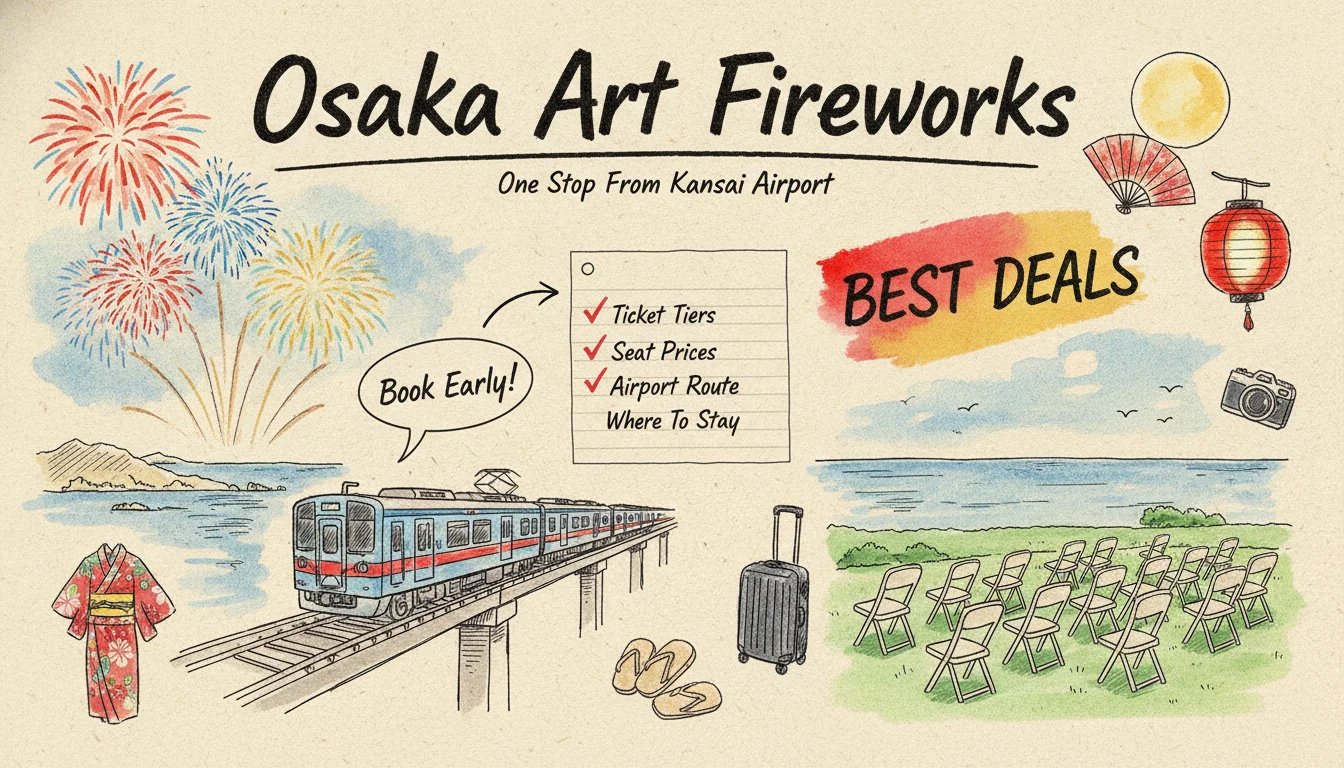
"I'm in Osaka in late October — is there one thing I shouldn't miss at night?" If you're holding a late-October Kansai itinerary, that's the question this article answers. The answer isn't the Dotonbori sign. It's a fireworks festival you can't walk into without a ticket.
Osaka Art Fireworks 2026 takes place on Saturday, 31 October 2026 at Rinku Park in Izumisano, Osaka Prefecture. The official site is blunt about it: 「「大阪芸術花火2026」は全席有料の花火大会です」 — every seat is paid, and there is no free general-admission area on site. That makes it a different animal from the summer fireworks most visitors picture. The Sumida River or Omagari approach, where you spread a mat on the riverbank hours early and claim a spot, does not work here.
I didn't get it at first either. Why pay forty dollars up front to watch fireworks? What changed my mind was looking at how you actually get there. This venue sits somewhere no other Japanese fireworks festival can match — at least for anyone flying into Kansai International.
The short answer: three kinds of visitor, three ways to buy
I condensed the official sales pages into one table. If you only want to know which button to press, this is enough. Prices are tax-inclusive yen; US dollar figures use the 26 August 2026 rate of ¥1 ≈ US$0.00628 (exchangerate-api.com).
| Your situation | Seat to pick | Now (super early bird) | After 8/31 |
|---|---|---|---|
| Two people or fewer, keeping costs down | Beach chair seat | ¥6,000 (~US$38) | ¥6,500 from 9/1, ¥7,000 from 10/18 |
| Outlet side, a bit more room | Promenade chair seat | ¥7,000 (~US$44) | ¥7,500 from 9/1, ¥8,000 from 10/18 |
| A couple | Pair seat | ¥18,000 (~US$57 per person) | No tiered discount |
| Family of five or a group of friends | Stepped BOX seat (per 5) | ¥35,000 (~US$44 per person) | No tiered discount |
| Bringing a tripod and shooting seriously | Photographer ticket | ¥11,000 (~US$69) | No tiered discount |
The short version: only the two chair-seat categories have early-bird tiers. Everything else costs the same from start to finish. If a chair seat is what you want, 31 August is the cheapest day of the year to buy one.
If you'd rather scan what else is on offer around Kansai first, Klook's full coupon list on 1stCoupon is a good sweep before you come back here.
Three sales tiers: wait past 8/31 and the same chair costs ¥1,000 more
Rakuten Ticket, the official sales channel, splits the sales window cleanly into three:
- Super early bird: from Saturday 27 June 2026, 12:00, until Monday 31 August 2026, 23:59
- Early bird: from Tuesday 1 September 2026, 00:00, until Saturday 17 October 2026, 23:59
- General sale: from Sunday 18 October 2026, 00:00, until Saturday 31 October 2026, 16:00
Take the beach chair seat: those three tiers are ¥6,000, ¥6,500 and ¥7,000. Drag your feet from super early bird all the way to general sale and you pay ¥1,000 (~US$6.30) more for the same chair — 14.3% of the general-sale price. The promenade chair seat moves in the same ¥1,000 step, ¥7,000 to ¥8,000; because it starts higher, that works out to 12.5%.
One thing to note before you plan around the deadline: all of these times are Japan Standard Time (JST, UTC+9). Convert them to your own time zone before you set a reminder, and give yourself an hour of margin rather than aiming at the exact cutoff.
In fairness, though, the absolute saving isn't large. ¥1,000 is takoyaki and a drink. The line worth worrying about is a different one, from the official Q&A: 「前売り券が完売した場合、当日券はございません」 — if advance tickets sell out, there are no day-of tickets, and the organiser states outright that 「完売が予想されます」, a sellout is expected. Whether you save the ¥1,000 matters far less than whether you get a seat at all.
What I found halfway through: the official price page can't be trusted
This section wasn't in my outline. I planned to quote prices straight from the official site's TICKET page — it's the organiser's own page, so it ought to be the most authoritative source there is.
Opening it told a different story. The body text starts with 「大阪芸術花火2024は全席指定有料の花火大会です」, and the special-experience ticket window stops at 「2024/9/2〜2024/10/31」. The page still carries a "Kansai International Airport 30th anniversary special discount" running 「10/19(土)23:00〜10/31(木)23:00」.
So I checked a calendar. A year where 19 October falls on a Saturday and 31 October on a Thursday is 2024. In 2026, 31 October is a Saturday — which matches the 「2026年10月31日(土)」 on the home page. In other words, the official site swapped the page title to 2026 and left the body on last year's edition, right down to five of the seven seat types being marked 「売り切れ」 as of 2024.
That's why every price and sales date in this article comes from Rakuten Ticket's 2026 page instead. It's the official sales channel the organiser itself lists, and its event dates match the home page. If you check the official site yourself and hit a wall of "sold out" seat types, don't panic — most of that is leftover from the previous edition. Go straight to the sales channel page.
All eight seat types, broken down per person
There are eight seat categories for 2026. Several are sold as a group, so the headline number can be alarming until you divide it.
| Seat type | Area | Price (tax incl.) | Per person |
|---|---|---|---|
| Beach chair seat | Marble Beach side | ¥6,000 (super early bird) | ~US$38 |
| Stepped BOX seat (5) | Marble Beach side | ¥35,000 | ~US$44 |
| Photographer ticket | Marble Beach side | ¥11,000 | ~US$69 |
| Promenade chair seat | Outlet side | ¥7,000 (super early bird) | ~US$44 |
| Pair seat (2) | Outlet side | ¥18,000 | ~US$57 |
| Table seat (4) | Outlet side | ¥50,000 | ~US$79 |
| Hilltop table seat (4) | Outlet side | ¥50,000 | ~US$79 |
| Private bungalow | Outlet side / premier area | ¥150,000 | Split by headcount |
Laid out like this, something slightly counter-intuitive shows up: the five-person stepped BOX seat works out to ¥7,000 a head — exactly what one promenade chair seat costs at the super early bird price. If you can find five people, that row is the best value on the whole table, and it's a self-contained stepped block. The organiser also says a dedicated cushion is handed out on site.
One more thing before you buy. The official Q&A is explicit: 「お席の位置はすべて機械的にこちらで決めさせていただきます」 — seat positions are assigned by the system and you cannot choose. Within the same category, the same money buys you a viewing angle decided by luck. If you want to compare what other Kansai tickets cost, the Japan deals hub collects them in one place.
One stop from Kansai Airport: what actually makes this festival unusual
This is the part that matters most to readers coming from outside Japan, and the part Japanese-language guides have no particular reason to emphasise.
Rinku Park sits at 7-1 Rinku Orai Minami, Izumisano, Osaka Prefecture. The official site lists it as 「JR・南海『りんくうタウン駅』から徒歩約 10 分」, about a ten-minute walk from Rinku Town Station. And Rinku Town Station happens to be the very next stop out of Kansai Airport Station. Both JR and Nankai run through it: roughly 5 to 6 minutes, 6.9 km, ¥370 (~US$2.30), no transfer.
That makes a day possible here that no other Japanese fireworks festival allows: land at Kansai Airport in the afternoon, drop your bags, ride one stop to the venue, watch the show, and fly out of KIX the next morning. Official timings are gates at 14:00, fireworks from 18:00, finishing around 19:00, running about 50 minutes without a break. If your flight is on the ground before 3pm, you have room to spare.
Seen that way the pricing makes more sense. This isn't a fireworks show you drop in on along the way — it's a venue where the airport, the outlet mall and the beach are compressed into one stop. What US$38 buys is less the seat than the location.
You can sort your transport tickets in advance. If you're heading into central Osaka or Kyoto after landing, the JR Haruka airport express ticket bundle is the usual pick. If you're only shuttling between KIX and Rinku and then riding the subway for a few days, a stored-value card like the Kansai ICOCA card saves you buying single tickets each time.
There is one easy mistake here, and I checked it specifically. The JR Haruka limited express does not stop at Rinku Town. It runs straight through after leaving Kansai Airport. The JR service that does stop there is the Kansai Airport Rapid. So a Haruka bundle is for getting into the city or to Kyoto — not for getting to the venue. Don't find that out as the train goes past.
Nankai is the opposite. The Airport Express stops there, and the Rapi:t limited express stops at Rinku Town in both its α and β formations. If you'd rather skip the transfer and ride from the airport to the venue's doorstep in one seat, the Nankai Rapi:t limited express ticket is the most comfortable option on that line, with wider seats than the commuter-style Airport Express.
Stay near KIX or in central Osaka? The hour after the show decides
The fireworks end at 19:00, and then the entire venue heads for the same station at once. Where you sleep is what magnifies or absorbs that.
Staying near KIX — Rinku Town or the Izumisano area — has an obvious upside: your room is a walk or one stop away, you don't have to squeeze onto a city-bound train with everyone else, and if you're flying the next day that's one stop too. The trade-off is a thin selection, restaurants that close early, and room rates that get pushed up on the night of the show.
There aren't many rooms in this pocket to begin with. The Hotel VESSEL Kansai Airport Izumisano sits in Izumisano itself, the same city as the venue, and is one of the few places that is both close to the venue and close to the airport. On a date like 31 October, rooms like that go first. If you've decided on the KIX-side plan, book the room right after the fireworks ticket and before anything else on the itinerary.
Central Osaka — Namba, Shinsaibashi — is the mirror image. Daytime shopping and food are easy and there are far more rooms, but after the show you're riding 40 to 60 minutes back into the city at peak crush, arriving somewhere past 8:30pm. Rakuten Ticket's notes state 「会場周辺には交通規制がございます」, that traffic restrictions apply around the venue, so both foot and vehicle routes get redirected.
My rule of thumb is headcount. Two people or fewer, light luggage, flying the next day: stay near KIX. Three or more, or several more days in Kansai: the city still wins on overall convenience. If you're staying three nights or more, a tiered scheme like Agoda's longer-stay discount often beats booking night by night. To compare hotel discounts across platforms before deciding, KKday's hotel deals page is worth a look too.
There's one more practical constraint: there is no parking at the venue. The official Q&A says 「花火大会専用駐車場は一部(車イス席)を除き、設置はございません」 — apart from a small allocation for wheelchair seats, none is provided. Nearby paid lots are expected to fill up and snarl, and the organiser explicitly recommends the train. Driving to this one is the option I'd recommend least in this whole article.
What's left after the super early bird closes
If 31 August has already passed by the time you read this, you haven't lost much. From 1 September to 17 October the early-bird tier still takes ¥500 (~US$3.10) off a chair seat, about 6 to 7% of the general-sale price. The date that actually matters is 18 October, when general sale begins: prices return to list, and once it sells out there are no day-of tickets.
There's an upside to buying in the early-bird window, too. By then your flights and rooms are usually settled, so you're less likely to end up holding a ticket you can't use. Fireworks tickets are non-refundable — the organiser states plainly that cancellations and refunds for personal reasons are not accepted at all. Only an organiser-side cancellation triggers a refund.
On that call: the event runs in rain and is cancelled only in severe weather, with the decision published on the official home page and social accounts by 12:00 noon on the day. That matters most if you're arriving on the day itself — if you're still travelling past midday, you'll be moving before the verdict is out.
And if it doesn't work out at all, Kansai has plenty of other ticketed options. When you pick one, check whether it's sold year-round or only during a campaign window: Universal Studios Japan tickets, for instance, are available year-round and hold up as a last-minute substitute, whereas limited-run promo pages often don't survive until your departure date.
Nine beginner traps: what I pulled out of the official Q&A
This is the part I think is worth the most time, because the rules here differ from a typical Japanese summer festival in a lot of small ways.
- No umbrellas. Using one in the seating area is explicitly banned because it blocks the people behind you. Bring a light rain poncho instead.
- It gets cold. Late October, seaside, after dark. The organiser recommends a jacket or something to throw on; the sea breeze is noticeably stronger than in the city.
- Bring a torch. The venue is an open park with no buildings around it. There is floodlighting, but a light for your own feet earns its place.
- Firework debris can fall. The official site warns it depends on wind direction and suggests a hat or glasses. If something gets in your eye, don't rub it — rinse with clean water and go to the first-aid tent.
- You can't choose your seat. The system assigns it.
- A tripod requires the photographer ticket. General seats are handheld only, and selfie sticks and drones are banned outright.
- You may bring your own food. Food stalls are planned on site too, in a dining area the organiser calls 「ちぬうみダイニング」. Barbecuing is not allowed.
- Strollers can't come into the chair seating. Tag them and leave them at the venue service counter. Pets aren't allowed at all.
- Preschool children are free only if held on a lap. If the child occupies a seat, a ticket is required regardless of age.
It looks like a lot of rules, but most of them are the "pack the right thing and you're fine" variety. Only two are unrecoverable: not getting a ticket, and buying the wrong ticket for your tripod.
Beyond the fireworks: building two Kansai days around your tickets
Having come all this way, most people won't stop at one show. On Sunday 1 November the organiser is running a beach clean-up it calls 「世界一たのしいゴミ拾い」 — if you're not rushing off, it's an unusual bit of local participation.
Here's how I'd sequence the rest: the day after the fireworks, head north from Rinku into central Osaka; on day three, decide by energy level whether to push on to Kyoto or Nara. Single tickets add up awkwardly on a route like that, so a pass is usually simpler. The Keihan Railway 1-day / 2-day pass suits people bouncing between Osaka and Kyoto; if your route stretches towards Nara or Ise, the Kintetsu Rail Pass covers more of it.
Worth adding: Osaka Art Fireworks 2026 is the fifth edition, and the organiser says it is being held this year as a supporting event for the 「第45回全国豊かな海づくり大会」, the 45th National Convention for the Development of a Rich Sea. GREAT SKY ART, the team behind the show, represented Japan at the Montreal International Fireworks Competition in July 2025 and took a technical-division award at the International Illumination Award 2025 that same year. Marble Beach, where the venue sits, is itself on Japan's list of 100 best sunset spots — which is why gates open at 14:00, giving you time to watch the sunset before the fireworks.
Frequently asked questions
Q: Is there really no free viewing area at all?
The official home page says 「全席有料の花火大会です」 and explains that you can't enter the venue area without a ticket. Rinku Park itself is an open park, so in theory public space remains nearby — but the organiser neither provides nor acknowledges any free viewing zone, and crowd routing plus traffic restrictions affect the surrounding area too. I wouldn't gamble on it.
Q: If a typhoon or heavy rain cancels it, do I get my money back?
The official Q&A states that the event runs in rain and is cancelled in severe weather, and that a cancellation is refunded. If the display is interrupted after it has already started, however, there is no refund. Whether it goes ahead is announced on the official home page by 12:00 noon on the day.
Q: Can I land at KIX on the day and still make it that night?
By the official timings, yes. Gates open at 14:00 and the fireworks start at 18:00, and Rinku Town Station is one stop from Kansai Airport — about 5 to 6 minutes, plus a 10-minute walk from the station to the venue. If your flight is on the ground before 3pm, there's a comfortable margin even after immigration and baggage. The thing to plan for is luggage: there's no large-item storage at the venue, so use a coin locker at the airport or the station first.
Sources
- Osaka Art Fireworks 2026 official site: event date, timings, venue address, distance from the station, the all-seats-paid statement, fifth-edition and supporting-event details
- Osaka Art Fireworks 2026 official Q&A: weather calls and refund rules, day-of ticket policy, seat assignment, what you may bring, parking and stroller rules
- Rakuten Ticket — Osaka Art Fireworks 2026 sales page: the three sales windows, prices for all eight seat types, traffic restrictions and parking notes
- Ekitan — Kansai Airport to Rinku Town fare lookup: ¥370 fare, 6.9 km, journey time and operators
- Related reading: Are Japan Fireworks Paid Seats Worth It? I Tested Sumida River Both Ways (2026)
All Deals
Japan Kansai Kintetsu Rail Pass (1-Day / 2-Day / 5-Day / 5-Day Plus)
Osaka
No Code RequiredOsaka Sagano Scenic Railway & Hozugawa River Boat Ride Day Tour
Kyoto
No Code RequiredKyoto Tango Spirited Away Same-Style Sea Train & Amanohashidate & Ine no Funaya Day Tour (Sea Train Ticket Included)|Departing from Osaka
Maizuru
No Code RequiredKintetsu Railway: Osaka-Nara Round-Trip Express Train Ticket
Nara
No Code RequiredKansai Enjoy Pass 1 Week Free Pass
Osaka
No Code RequiredWakayama Kishi Station Cat Stationmaster Train Experience, Kuroshio Market & Rinku Premium Outlets Day Tour (Drop-off at Kansai Airport Available)
Wakayama
No Code RequiredJR Kansai & Hiroshima Area Rail Pass 5 Days
Hiroshima City · 4.8 (565) · 8K+ booked · US$
No Code RequiredJR Kansai WIDE Area Pass 5 Days
Kansai International Airport · 4.8 (2062) · 30K+ booked · US$
No Code Required[Japan Kansai 3 Ancient Capitals Day Tour] World Heritage Todai-ji Temple, Byodo-in Temple, Fushimi Inari Senbon Torii, Nara Park Deer & Uji Matcha Food Street (From Osaka/Kyoto)
Nara
No Code RequiredJapan JR Pass | Kansai & Hokuriku Area Rail Pass 7-Day Ticket | eMCO E-Ticket
Kenroku-en · 4.8 (212) · 3K+ booked · US$
No Code RequiredKansai Enjoy Pass Deluxe (Includes Universal Studios Japan)
Osaka
No Code Required
Yi
Budget Travel EditorBudget traveler. Even on a NT$30K monthly salary you can travel well — treats every trip as a budgeting puzzle, breaking down flights, hotels, transit, and meals line by line. Specializes in total trip budgets, first-time-abroad prep, and overseas card / FX comparisons — helping you dodge overspend traps and save up for the next trip.
You May Also Like
Are Japan Fireworks Paid Seats Worth It? I Tested Sumida River Both Ways (2026)
Are 2026 paid reserved seats at the Sumida River, Nagaoka, and Omagari fireworks festivals worth buying? I have sat in both, with a ticket-price breakdown, a July sold-out status update with the remaining channels, and a real exit-survival plan to help you figure out exactly where that money goes.
One Bowl, Half a Day Left: Taiwan Beef Noodles by County, Paired With an Afternoon Ticket
Taipei, Taichung, Kaohsiung, Tainan, Yilan, Hualien, Taitung — Taiwan's beef noodle shops are spread evenly across the island, so let the bowl pick your county and the afternoon follows. Opening hours, closing days, and the attraction ticket that fills the rest of the day.
Sapporo Before the Snow Sticks: What 3 Days Cost in November 2026
Sapporo gets 30cm of snow in a normal November, 113cm in December. That gap is a booking window — it shuts when Niseko opens 28 Nov 2026. Full 3-day cost sheet.