Are Japan Fireworks Paid Seats Worth It? I Tested Sumida River Both Ways (2026)
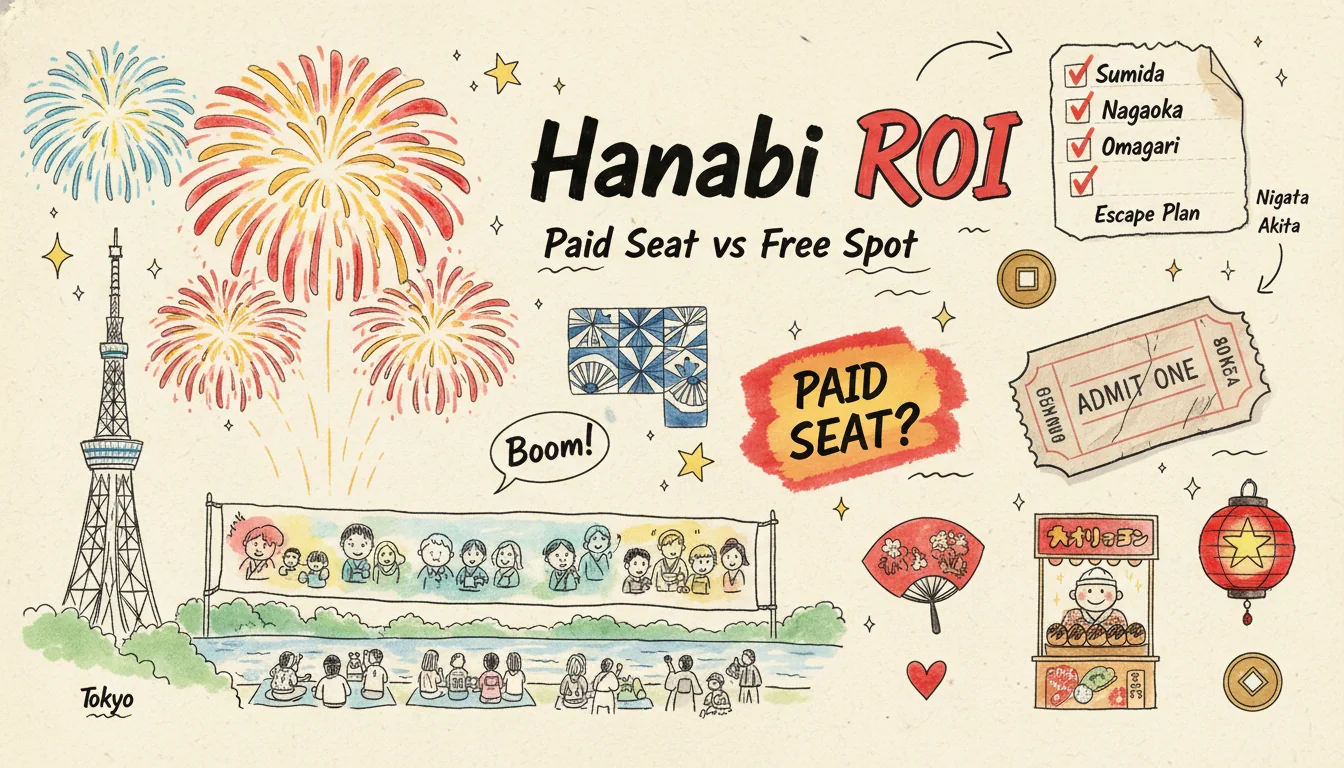
Six in the evening on July 25, the walkway beside the Sumida River had no space left to sit. I was crouched against a railing about 800 meters from the launch point, sweat running down to my waist, my phone reading 34 degrees. Across one closed-off road, the paid section had people sitting in folding chairs drinking cold beer, with a temporary toilet 30 meters from their feet. One question filled my head. That price gap, what exactly did it buy?
That year I went for the free spot. The next year I gritted my teeth and bought a ¥7,000 (~US$47) paid seat. I have done both, once each.
When I got home I ran the numbers.
A paid seat is not as simple as "more comfortable." What it buys is those 3 hours you will never see on an event listing. This article lays out the numbers from both years, the traps I stepped in, and the 2026 on-sale timeline for the three biggest fireworks festivals, all in one go.
Paid Seat vs Free Spot: Look at This Ledger First
Put the feelings aside, look at the numbers. Below is my real record from two years, converting at roughly NT$0.22 (~US$0) per yen.
| Item | Free spot (2024 Sumida) | Paid chair seat (2025 Sumida) |
|---|---|---|
| Seat cost | NT$0 | About NT$1,540 / ¥7,000 (~US$47) |
| Entry/spot-claiming | Arrived 14:40, waited 4 hours 20 minutes | Entered 17:50, waited 1 hour 10 minutes |
| View obstruction | About 30% blocked when people stood | Zero obstruction throughout |
| Nearest toilet | 12-minute walk, 25-minute queue | Inside the zone, 2 minutes |
| Post-show boarding | 1 hour 50 minutes from finish to boarding | About 40 minutes |
| Leaving mid-event | Almost impossible | Wristband, free in and out |
Per the venue notes from Japanese travel media Walker+, at a festival on the scale of Sumida you have to claim an unobstructed free spot before 16:00. I arrived at 14:40 and that already counted as late.
The most brutal column on this table is not the money column.
It is 4 hours 20 minutes against 1 hour 10 minutes.
That NT$1,540 (~US$47) bought back the 3 hours I would have wasted, plus 1 hour less stuck in the exit crush. Worth it or not depends on what your 3 hours that day are worth.
That is really all there is to it.
Before I leave I always check the 1stCoupon Klook deals page for current add-ons, confirm the transit-ticket discounts first, then go back and decide how much to spend on seating.
Sumida River Field Test: When I Arrived, Where I Got Pushed
My plan that time was naive. I figured arriving at 16:00 should be enough.
Turns out 16:00 was way too late.
I walked out of Asakusa Station. The whole road was body to body. Security staff were shouting "tachidomaranai de kudasai" through megaphones. The riverbank spot I had my eye on was already carpeted with blue picnic mats before 15:00. Mat after mat. Not even a gap. The crowd pushed me nearly 1 km downstream, and I stopped at a bridge pier with only 50% of the view left. The fireworks started at 19:00. Half the prettiest low-altitude shells were blocked by trees. Doing the math afterward, that day was 4 hours 20 minutes of moving and spot-claiming, and only 50 minutes of actually watching complete fireworks.
Free is not really free, it pays the bill with your time.
That trip had 3 lessons. First, the good free spots are decided before 15:00, so arriving at 16:00 just makes you part of the human wall. Second, when tens of thousands of people pour into one station at exit time, I queued nearly 60 minutes at Asakusa Station just to get through the gate. Third, toilets are a nightmare. I held it nearly 3 hours, finally queued at a convenience store, and the clerk politely said "osaki ni douzo" and let me go first. I still remember that misery.
Never underestimate the toilets.
That was also when I learned not to bake outside in 34-degree heat all day.
The next year, on the afternoon of the fireworks, I took the heat off in air conditioning, played at Klook's Tokyo Joypolis 1-day pass at 18% off, entered the venue only at 18:00, and my energy was night and day better.
What a Paid Seat Actually Buys: Three Seat-Type Price Tiers
A lot of people stall at "paid seats sound expensive" and give up. The truth is the price gap between seat types is huge. There is not just one price.
Combining Walker+ and the official pages of each festival, the typical price for common seat types looks roughly like this:
| Seat type | Typical price | Who it suits |
|---|---|---|
| Chair seat (isu-seki) | About ¥3,000–¥4,000 (~US$20–27) | One person, no spot-claiming |
| Sheet seat (1.8m x 1.8m) | About ¥7,000 (~US$47) | 2–4 sharing, cheap split |
| Pair table seat | About ¥12,000 (~US$80) | Couples, want to drink and watch slowly |
That said, actual 2026 pricing at all three festivals runs well above the general going rate above. Sumida's official seats are ¥8,000 on the Sumida side, ¥9,000 on the Taito side, and ¥25,000 for a 5-person sheet seat at the baseball ground. Nagaoka has switched entirely to fully individualized reserved seating this year, starting at ¥4,000 for a free-standing seat and going up to ¥48,000 for a box seat. Omagari runs ¥8,000 for a chair seat and ¥38,000 for a 4-person table seat. Do not budget assuming ¥3,000 is still the floor.
In 2025 I bought a ¥7,000 (~US$47) sheet seat. There were 3 people sharing, so split per person was about ¥2,333, roughly NT$513 (~US$16). Using NT$513 (~US$16) to wipe out "go fight the crowd at 14:00" was a profit for me.
Split down, it really is not expensive.
This is not for people with more money, it is for people whose time costs more than their money.
If you are a backpacking student on an extremely tight budget, with so much time that day you do not know what to do with it, the free zone is honestly not that bad. The key is 3 things you must pull off: arrive before 15:00, survive the toilet situation, and accept 1 to 2 extra hours at exit time. Do all 3 and the free zone is yours.
2026 Ticket Timeline for the Three Big Fireworks Festivals
This is the section to save from this article. The three big fireworks festivals go on sale far earlier than you think, and each has different rules. Below is the 2026 official timeline I compiled.
| Festival | 2026 date | Key ticket/application date | 7/10 status | Free zone |
|---|---|---|---|---|
| Sumida River Fireworks (Tokyo) | 7/25 (Sat) 19:00–20:30 | Citizen sponsor seat WEB application opens 5/10 12:00, first come first served | Officially announced sold out on 7/6, no restock | Yes, extremely packed |
| Nagaoka Festival Grand Fireworks (Niigata) | 8/2–8/3, 19:20–21:10 | First lottery 5/25 12:00–6/8 17:00, sold out instantly | Official resale 7/6–7/20, Japan residents only | None, all paid |
| Omagari National Fireworks Competition (Akita) | 8/29 (Sat) | Online ticket first round 6/12 10:00–6/23 23:59 | Second sale window 7/21 10:00–7/31 23:59 | Limited |
See that Nagaoka row? Zero free seats inside the venue. Miss the ticket and you simply cannot get in.
No Nagaoka lottery, no Nagaoka show.
This is the point a lot of people only check in June and then go pale over. The 2026 first lottery opened at noon on 5/25, and demand was so hot the first round sold out completely. The organizers even cancelled the planned second lottery round.
7/10 status update: where each of the three still has an opening
I am adding this section from a July check-in, written against each official announcement as of today (7/10). Re-verify against the source when you read this:
- Sumida (7/25): Citizen sponsor seats were officially announced sold out on 7/6, with no restock. The Skytree special viewing option (¥13,000) sold out too. If you still want a seated view, your remaining options are package tours (Club Tourism, Hato Bus, and similar operators — some are still taking bookings) that include a boat or bus viewing spot. Otherwise, fall back to the free zone and follow the 15:00 discipline further down.
- Nagaoka (8/2–8/3): An official-price resale (via the Ticket Pia resale system) runs 7/6 to noon on 7/20, but it is limited to Japan residents. For overseas travelers (Taiwan, Hong Kong, or elsewhere), the practical route in is Omagari's second sale window instead — unofficial resale for Nagaoka is priced unpredictably and entirely at your own risk. I would not stake the whole trip on getting into Nagaoka this way.
- Omagari (8/29): Second sale window 7/21 10:00–7/31 23:59. Of the three festivals, this is the one overseas readers still have a legitimate channel into, so put 7/21 morning on your calendar now.
I got serious too late that time. Missed the first lottery, did not win the second, and ended up buying a resale ticket with a mediocre view, paying nearly 40% extra. Booking early and locking the transit tickets along with it is the least sexy but most money-saving move.
I make a habit of placing the Klook Kansai Have Fun pass at 20% off order the same day, because rail-pass windows often close 2 to 3 weeks earlier than fireworks tickets.
The Tsuchiura one is scheduled for 11/7 in 2026, already autumn, outside this summer window. If you want to chase that, note it for next year.
The Exit Is the Real Hell: Do Not Buy a Ticket on the Last Train
That cheer when the fireworks end is not the climax for a veteran. That cheer is the starting gun.
The biggest trap I stepped in at Nagaoka was booking a Shinkansen back to Tokyo 1 hour after the finish. Sounds plenty, right? In reality about 80,000 people along the Shinano River bank walk toward Nagaoka Station at the same time. It took me 55 minutes to get from my seat to the station front. That train just left without me. The platform was full of travelers with dead expressions. I ended up booking an unplanned extra night, and that roughly NT$3,500 (~US$108) hurt more than the seat fee I saved.
That time I really did get burned.
Remember one line. The exit needs more planning than the fireworks themselves, and I paid for that lesson with one night of hotel money. Combining the crowd-dispersal advice from each festival, there are 3 moves that can save you:
- Either leave in the last 10 minutes, or wait until 40 minutes after the finish to move. Exiting dead in the middle means jamming up with everyone.
- Pad your return-trip ticket time by 2 more hours than you think. For a Shinkansen reserved seat, take the later one.
- Walk the back streets in the opposite direction and catch the next station down where it is less crowded, often faster than forcing your way into the nearest station.
After that year I wised up.
At the Sumida exit, I deliberately sat in a cafe by the venue for another 30 minutes. I waited until the crowd thinned before moving. The result was I boarded in 40 minutes. I also locked my next-day Tokyo daytime tickets early, and running them through whatever code was live on the KKday coupon hub got that Tokyo leg at a discounted price too. Completely two different worlds.
Transit and Tickets: How Much You Save by Stringing the Fireworks Trip Together
Having covered the most important free vs paid question, this section is the deals part. My rule is simple. Fireworks is just one of the nights, so lock the trip's tickets first, and what you save is often more than the seat fee.
Lock the tickets first, that is the rule.
On daytime hours other than the fireworks day, I make a habit of scheduling indoor or low-crowd extensions. That 34-degree Sumida lesson cut too deep.
If you are going all the way to Kansai, the Klook Universal Studios Osaka Express Pass cuts the queue down by a large chunk, and last time I saved about 3 hours of line. If you can fit it in on the Tokyo end, the Klook Warner Bros. Studio Tour Tokyo Harry Potter ticket at 15% off is the top rainy-day backup, since an outdoor thing like fireworks is most afraid of rain.
The money these tickets save is often more than the seat fee you agonize over for half a day.
One reminder: every promo code and discount has an expiry. Reconfirm before you leave whether it is still valid. Do not copy my figures, both exchange rates and promo windows change.
Who This Article Is Not For
Honestly, a paid seat is not a cure-all.
If you only have that one night and want to wander freely looking for photo angles, a fixed seat actually ties your hands and the free zone is more flexible. People bringing toddlers or elderly relatives should also think it through: paid seats often run a 60-minute fixed entry-and-exit system, your time is nailed down, and leaving suddenly is a hassle. For students on a very tight budget with lots of time, I honestly think the free zone works, just follow that arrive-before-15:00 discipline from earlier. And then there is Nagaoka, all paid plus a lottery, so if you do not win you cannot get in, do not stake the whole trip on one ticket you are not sure of.
Check yourself against this first. This is written for people whose time costs more than their money. If that is not you, saving that money is the right call.
Frequently Asked Questions
Q1: What date is the 2026 Sumida River Fireworks? Do I need a ticket? July 25, 2026 (Sat), 19:00–20:30. The free zone needs no ticket but requires extremely early spot-claiming. Citizen sponsor seats went on sale 5/10 and were officially announced sold out on 7/6 with no restock; if you still want a seated view, your remaining options are boat or bus package tours.
Q2: I do not want to pay any seat fee at all, is it possible to watch comfortably? Yes, but the price is time. You must arrive before 15:00, handle the toilet situation yourself, and accept 1 to 2 extra hours at exit. It works if you have lots of time that day; if you only have that one night, a paid seat is usually the better deal.
Q3: Does Nagaoka fireworks really have no free seats? Correct. Per JR East's guide, the Nagaoka Festival Grand Fireworks has zero free viewing seats inside the venue, and without a paid ticket you cannot enter, which is also the festival most people find out about too late and then cannot get tickets for.
Q4: When do paid seats go on sale? Which one is hardest? As of 7/10: regular seating at both Sumida and Nagaoka is sold out (Nagaoka's official resale is Japan-residents-only), leaving Omagari's second sale window, 7/21 10:00–7/31, as the only one still open. For next year's planning, the three windows are: Sumida in early May, Nagaoka lottery in late May, Omagari in mid-June. Nagaoka is all paid plus a lottery, widely considered the hardest, so handle it earliest.
Q5: How do I arrange exit transport so I do not get stranded? Pad your return-ticket time by 2 hours more than your estimate, and for a Shinkansen take the later train. At exit either leave 10 minutes early or wait until 40 minutes after the finish, do not get stuck at the exit peak.
Further Reading
- Field-Tested Comparison of 5 Fireworks Festivals: Which One to Prioritize: this article only digs into the seat economics of Sumida, Nagaoka, and Omagari — read that one for how the experience compares across five major venues.
- 2026 Fireworks Ticket Calendar + Hotel-Booking Countdown Timing: the ticket and hotel timeline for 6 major Kanto/Kansai festivals, complementing this article's ticket timeline.
- Yukata, Bon Odori, and Festival Stalls: How to Work a Summer Matsuri: fireworks are only half of a summer matsuri — this covers what to do from daytime through dusk.
References
- Sumida River Fireworks official site (2026 schedule and citizen sponsor seat application)
- JR East JRE MALL fireworks feature (Nagaoka 2026 lottery timeline, all-paid explanation)
- Nagaoka Fireworks official ticket info (first lottery sold out, official resale 7/6–7/20 announcement)
- Omagari Fireworks official ticket page (second sale window 7/21–7/31 timeline)
- Omagari National Fireworks Competition official site (2026 ticket timeline)
- Walker+ Fireworks Festivals 2026 (venues, paid seat types, and spot-claiming time advice)
- Personal 2024 and 2025 on-site experience and expense logs from Sumida and Nagaoka
All Deals
Atami Seaside Fireworks Festival & Mount Omuro or Hakone Shrine | Departing from Tokyo or Atami (Exclusive Private Boat Fireworks Viewing)
Ito
No Code RequiredFireworks Limited | Atami Kamakura / Atami Hakone Fireworks Festival Day Tour | from Tokyo
Atami
No Code Required[Atami Fireworks Limited] Shizuoka Izu Atami Fireworks Festival & Izu Omuroyama with Cable Car & Kamakura Kokomae Day Tour | from Tokyo
Atami
No Code Required[Hakone & Atami Fireworks Day Tour] Mount Fuji Hakone Shrine & Lakeside Torii & Lake Ashi Lakeside Walk & Atami Sun Beach & Atami Fireworks Festival (From Tokyo)
Atami
No Code RequiredAtami Fireworks Day Tour: Optional Hakone, Mt. Omuro & Kamakura Route (Optional Hotel Pickup)
Kamakura
No Code RequiredOptional Fireworks Cruise: Tokyo Atami Sea Fireworks Festival Day Tour - Kamakura/Enoshima or Hakone Lake Ashi Route Available (From Tokyo, Chinese/English Service)
Hakone
No Code RequiredAtami Fireworks Festival Day Tour: Hakone Boat Cruise / Mt. Omuro Ropeway / Kamakura Enoden (Multiple Routes, From Tokyo)
Atami
No Code Required2026 Hakone & Atami Fireworks Exclusive - Day Trip Onsen or Hakone Shrine & Atami Sun Beach & Atami Port Fireworks Festival Day Tour (from Tokyo)
Tokyo
No Code RequiredHokkaido Lake Toya Fireworks Festival, Lake Shikotsu & Bear Park & Observatory Day Tour (Boat Cruise Optional)
Usu District
No Code Required2026 Penghu Fireworks Festival Ocean Fireworks Boat Ticket
Penghu
No Code RequiredWings of Time Fireworks Symphony: Sentosa's Award-Winning Multi-Sensory Night Show | Singapore
South West Singapore · 4.6 (508) · 10K+ booked · US$
No Code RequiredJR PASS Hokuriku Area Pass
Kanazawa · 4.8 (209) · 3K+ booked · US$
No Code RequiredAutumn Fireworks Festival Day Tour: Tsuchiura Fireworks Competition (Ticket Included) / Kinugawa Fireworks (Ticket Included) / Oarai Sea Fireworks / Tone River Fireworks
Tokyo
No Code RequiredHokkaido|Lake Toya Fireworks Festival & Showa Shinzan & Lake Hill Farm Day Tour|Departing from Sapporo
Ishikari City
No Code RequiredAtami · Ito | Mount Omuro (with Cable Car) · Sunshine Beach Line · Jogasaki Coast · Marine Town Day Tour | Depart from Shinjuku
Ito
No Code RequiredJR Pass All Kyushu, South Kyushu & North Kyushu Rail Pass
Fukuoka
No Code RequiredWings of Time Fireworks Symphony: Sentosa's Award-Winning Multi-Sensory Night Show | Singapore
South West Singapore · 4.6 (508) · 10K+ booked · US$
No Code RequiredIbaraki Fireworks Limited: Oarai Sea Fireworks Festival (with Ticket), Cosplay Carnival & Air Show Day Tour
Higashiibaraki District, Ibaraki
No Code RequiredKyushu Summer Exclusive: Kanmon Strait Fireworks Festival Day Tour (Optional Japanese Yukata Experience)
Shimonoseki
No Code RequiredJapan JR Pass: Sanyo-San’in Northern Kyushu Pass (Pick-up in Thailand City Central)
Kobe · 5.0 (1) · 25+ booked · US$
No Code RequiredJR Pass – Okayama, Hiroshima & Yamaguchi Area Rail Pass (5-Day)
Yamaguchi City · 4.9 (301) · 3K+ booked · US$
No Code RequiredJR Pass: Tottori-Matsue Pass eMCO E-Ticket | Japan
Matsue Castle · 4.9 (252) · 4K+ booked · US$
No Code RequiredJapan JR Pass | Kansai & Hokuriku Area Rail Pass 7-Day Ticket | eMCO E-Ticket
Kenroku-en · 4.8 (212) · 3K+ booked · US$
No Code RequiredOne of Japan's Three Major Fireworks Competitions: 2026 Tsuchiura National Fireworks Competition, Official Group Reserved Seating (From Tokyo/Shinjuku)
Tsuchiura
No Code RequiredIzu Mount Omuro Day Tour: Stunning Atami Coastline / Sea-View Train Option & Mount Omuro Cable Car & Jogasaki Coast Hidden Gem Adventure & Ito Marine Town Stroll
Ito
No Code Required2026 Penghu Fireworks Festival Exclusive Fireworks Boat - Fireworks at Sea Experience (Seat Guaranteed)
Penghu
No Code RequiredLake Toya Fireworks & Mount Yotei Day Tour (Transfer Included)
Sapporo
No Code RequiredJR Pass | Discover West Japan Setouchi Area 7-Day Rail Pass (E-Ticket)
Yamaguchi City · 4.9 (170) · 3K+ booked · US$
No Code RequiredSapporo Lake Toya & Lake Shikotsu Day Tour (with Fireworks)
Chitose
No Code RequiredTsuchiura Fireworks Competition Day Tour (with Ticket)
Tsuchiura
No Code Required
Pang
Travel & Food Field TesterOn-the-ground travel & food editor. Goes abroad at least 5 times a year — known to camp out at one shop for 3 afternoons or eat the same dish in 3 cities before writing. First-person field testing, ethnographic observation, multiple revisits.
You May Also Like
Osaka Art Fireworks 2026: Paid Seats Only, 1 Stop from KIX
Osaka Art Fireworks 2026 is on 10/31 at Rinku Park, Izumisano: every seat is paid and there is no free area. Editor Yi maps the three price tiers, the per-person cost of all eight seat types, and the one-stop ride from Kansai Airport.
2026 Japan Summer Fireworks: 6 Festivals + Hotel Countdown
Sumida River is 19 days out. On July 6 I refreshed Asakusa/Oshiage/Kinshicho hotel stock and live ticket status for all 6 fireworks, plus the Ueno/Omiya/Chiba 30-minute Shinkansen fallback ring and the latest Trip.com/Klook/Agoda promo codes. This is your last peak-season booking window.
Gangwon in 48 Hours 2026: the KTX vs the Bus to Seoraksan
Seoul to Gangneung is ₩27,600 and 1h40 on the KTX. But Seoraksan is in Sokcho, which has no railway until 2029. I costed all three weekend shapes.