Gangwon in 48 Hours 2026: the KTX vs the Bus to Seoraksan
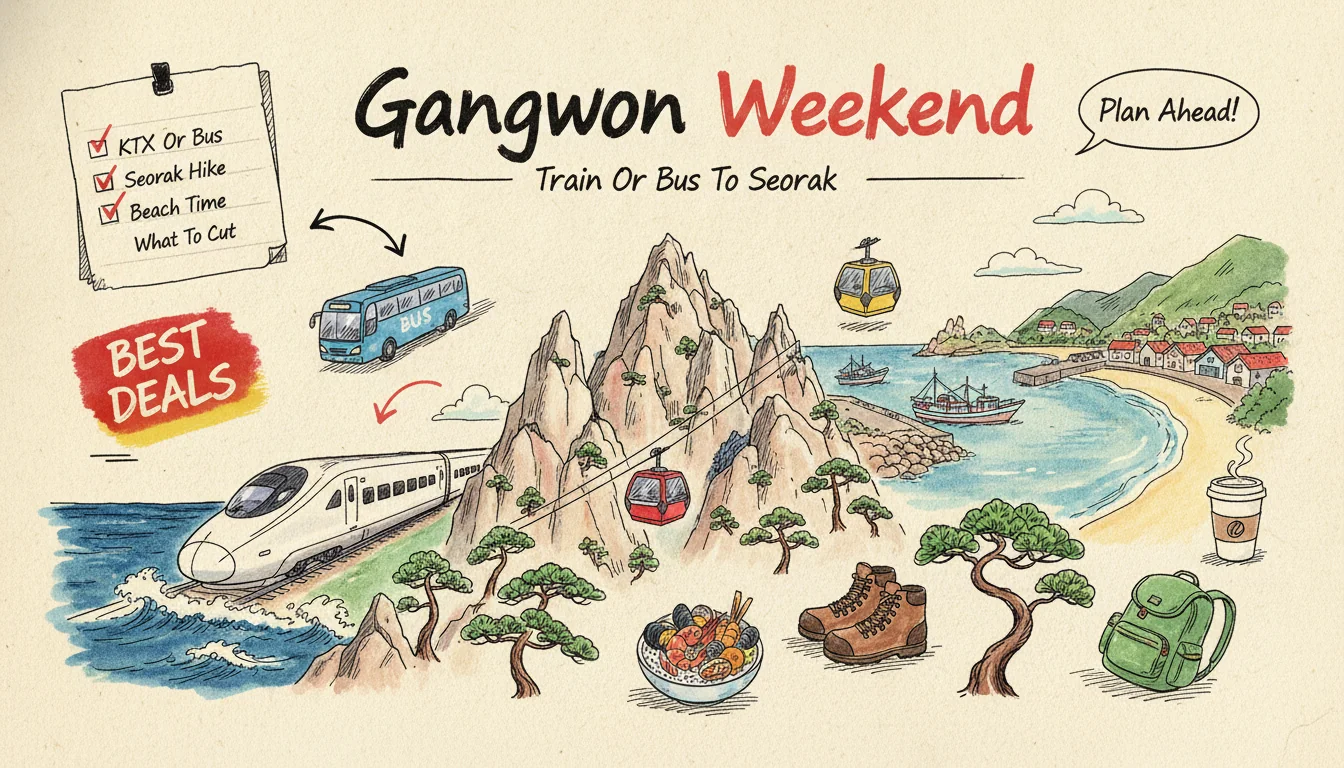
₩27,600 and one hour forty minutes is what the KTX asks to put you on the east coast, and it is genuinely a good deal. I booked it the first time I tried to do Gangwon over a weekend, felt clever about it, and then discovered at Gangneung Station that the mountain I had come for was still two buses away.
That is the part the itineraries leave out. Gangwon-do is not one destination with one station. It is a province with two anchor towns about 70 kilometres apart, and the fast train only serves one of them.
₩27,600 gets you to Gangneung, and Gangneung is not Seoraksan
The Gyeonggang line opened in December 2017, built for the PyeongChang Olympics, and it runs KTX-Eum sets from Seoul Station to Gangneung Station in about 1 hour 30 minutes to 1 hour 50 minutes for ₩27,600 one way. Korea by Train counts roughly 14-plus departures a day, with more of them leaving from Cheongnyangni in eastern Seoul than from Seoul Station itself. Fares are regulated and fixed. Booking a month out and booking an hour out cost exactly the same, which means advance booking buys you a seat and nothing else — worth knowing if you have brought Shinkansen habits with you and are waiting for a price to move.
So far so good. Here is the geography nobody puts on the same page as that fare.
Seoraksan National Park, the thing most people actually mean when they say "Gangwon", sits behind Sokcho, which is up the coast north of Gangneung. Gangneung is the coffee, the beaches, the Gyeongpo lakefront and the Jeongdongjin station that holds a Guinness record for sitting closest to the sea, roughly 50 metres from the water. Two different trips. The KTX serves the second one.
There is no train to Sokcho until 2029, and that reshapes the whole plan
I want to be precise about this because I have seen people search for it, find nothing, and assume they searched wrong. There is no direct rail service to Sokcho in 2026. The Chuncheon–Sokcho railway is under construction, and HeySeorak's rail tracker puts public planning at 2029. Until then, every road to Seoraksan is literally a road.
That single fact is what makes Gangwon weekends go sideways. Travellers plan around the train because the train is the thing with a timetable and a seat number, then bolt a bus onto the end of it, and only discover the seam once they are standing in the wrong bus terminal with a backpack.
There is one way to make the seam disappear, and it is to pay someone to drive. Klook's Seoul private charter that covers Gangwon-do including Sokcho is the only shape of this trip where the transfer problem simply does not exist, because there is no transfer. For two or three people splitting it, run the numbers against ₩70,600 of tickets plus taxis before dismissing it — that is roughly what the two-city public-transport version costs per person, and I will show that arithmetic in a moment.
The express bus is the direct route, not the budget fallback
This is where I had my assumption reversed, and I would rather you had it reversed by reading than by standing on a platform.
From Seoul Express Bus Terminal — the Gyeongbu side, bookable on KOBUS — the listed route time to Sokcho is 140 minutes. Adult standard is ₩17,200, deluxe ₩22,300, premium ₩28,900, with late-night standard at ₩20,600. HeySeorak logged 40 departures on a sample weekday, first at 06:00 and last at 23:30.
Dong Seoul Terminal, at Gangbyeon on Line 2, is the other option: fast services around 2 hours 10 minutes, standard ₩16,400 to ₩16,700, deluxe ₩21,300, premium ₩26,800, 34 departures, running 06:05 to 21:00. Book that one through T-money TxBus, searching 동서울. Watch the routing, though — the slower Dong Seoul services run 3 hours to 3 hours 30 minutes, and the fare does not warn you.
Now hold the two side by side, for Seoraksan specifically. The bus is ₩17,200 and 2 hours 20 minutes, direct. The train is ₩27,600 and 1 hour 40 minutes to a city that is not Sokcho, after which you still need the intercity bus. The train costs more and, once the connection is in, arrives later. That is not a budget-versus-comfort trade. The cheaper option is also the faster one, which almost never happens and is exactly why people get it wrong.
The deluxe seat is a different question and a fair one. ₩5,100 over standard buys three-across recliners for two and a bit hours. It buys zero minutes.
The ₩7,700 hour between the two cities that nobody budgets
Say you want both towns anyway. The link is the Gangneung–Sokcho intercity bus, which runs about every 30 minutes, first departure 07:14 and last at 21:00. As of April 2026 the fare sits between ₩7,200 and ₩9,900 depending on whether you get the direct highway service or the coastal one that stops more; one published timetable lists ₩7,700. Journey time is around 1 hour 10 minutes to 1 hour 30 minutes, and the coastal routing can stretch toward 1 hour 40.
The cost is not the problem. ₩7,700 is a sandwich. The problem is the seam.
Gangneung Intercity Bus Terminal is at 27 Hasla-ro in Hongje-dong. Gangneung KTX Station is not. You arrive by train and then take a taxi across town to catch a bus, and Korea by Train puts in-city Gangneung taxi rides in the ₩5,000 to ₩10,000 band. I want to flag clearly that the transfer time itself is my estimate, not a published figure: allow 20 to 30 minutes door to door including the wait, and more on a Saturday. Nobody publishes that number because nobody sells that leg.
If that seam is the part you would rather not own, Klook's Seoraksan and Naksansa Temple day tour absorbs it entirely — Naksansa sits in Yangyang, between the two towns, which is precisely the stretch that is annoying to reach on your own.
I ran the clock over a real Saturday-to-Sunday
"48 hours" is a phrase, not a schedule. Here is my actual window, the one I keep re-using: out of Seoul Saturday 08:00, back in Seoul Sunday 21:00. That is 37 hours, not 48, and the eleven-hour gap between those two numbers is where most weekend plans quietly break.
Against those 37 hours, three shapes:
Gangneung only, KTX both ways, is ₩55,200 and 3 hours 20 minutes on rails — 9 percent of the window. Local movement is genuinely easy: city buses 202 and 300 run from the station toward Gyeongpo and Anmok in 20 to 35 minutes at ₩1,300 on a T-money card, or a taxi does Anmok in about 6 minutes.
Sokcho only, express bus both ways, is ₩34,400 standard and 4 hours 40 minutes on the road — 12.6 percent. In town, buses 7 and 7-1 reach the Seorakdong park entrance every 17 to 20 minutes, and the 7-1 also calls at the Intercity Bus Terminal. The Abai Village ferry across the channel is ₩500 for adults, ₩300 for children, five minutes.
Both towns, out and back through the same end, is ₩70,600 in tickets and about 6 hours 20 minutes including the two Gangneung terminal transfers — 17 percent of the weekend spent moving. That is nearly a fifth of your trip, and it is the shape most people accidentally book. If you would rather hand that whole day to a driver and keep the coast, Klook's Gangneung day tour hitting the K-drama and K-pop filming locations does the round trip from Seoul in one bite and is honest about being a day, not a weekend.
The cable car closes at 17:30 and does not take reservations
Here is the constraint that decides the whole thing, and it is not a transport constraint.
The Gwongeumseong cable car at Seoraksan is ₩16,000 round trip for adults in 2026, ₩12,000 for children from 36 months through elementary school, free under 36 months, with a ₩14,000 senior fare outside the official peak blackout periods. September through November it runs 09:00 to 18:00 with the last ride at 17:30. There is no advance reservation — tickets are on-site only, and operating hours get announced one day ahead on the official site because wind, weather and safety inspections all move them.
Read that again with a two-city itinerary in your hand. You cannot pre-book the single time-sensitive thing in the plan, you have to be physically at the ticket window during a window that closes at 17:30, and if it is a windy day you may not ride at all. Meanwhile the last bus back toward Gangneung leaves at 21:00.
The park itself is free, incidentally. The old ₩3,500 charge people still mention was Sinheungsa's cultural heritage fee, and Korea abolished those at national-park temples in May 2023, with public funds now covering temple upkeep. So the ₩16,000 is the only gate.
I got caught by the 17:30 on my second attempt. Came up from Gangneung on the late-morning bus, ate too well in Sokcho, reached Seorakdong at 16:40 and watched the queue. Did not ride. If your window is the autumn colour rather than the summer coast, Klook's Seoraksan autumn foliage day tour from Seoul at least puts a guide in charge of that clock instead of you.
What I cut, and what cutting it bought back
My first Gangwon list had nine things on it. Seven of them were fine. The list was the problem.
Here is what a 37-hour window actually holds, timed rather than wished at. Seoraksan with the cable car is not a half day, it is a day: 40 to 50 minutes each way on bus 7 or 7-1 from the Sokcho terminals, a queue at the cable car with no reservation to shorten it, and the Sinheungsa and Biryong Falls walks are the reason you came, not filler. Gangneung's coast is a genuine half day if you stay on the 202 corridor — Anmok, the coffee street, Gyeongpo — and stops being one the moment you add anything south of the city.
The four that did not survive, and why:
- Jeongdongjin sunrise. The station-by-the-sea is real and the record is real, but it is south of Gangneung and the whole point is being there at first light. That is a pre-dawn taxi in a weekend that already starts at 08:00 on a Saturday. It belongs to a Gangneung-only trip.
- Jumunjin fish market. North of Gangneung, brilliant, and about 90 minutes of your life once you factor the getting there and the eating. It is a direct competitor with the Sokcho leg for the same block of Sunday.
- Naksansa. It sits in Yangyang, on the road between the two towns, which sounds efficient and is not — the intercity bus does not stop where you want, so you end up paying for it twice in local transfers. This one I would genuinely rather buy than solve, and it is the reason the packaged Seoraksan-and-Naksansa run exists.
- A second Seoraksan trail. I wanted Ulsanbawi. Ulsanbawi is four to five hours round trip on top of everything else. In a two-town weekend it is a fantasy.
Cutting those four bought back roughly six hours, which is almost exactly what the two-city transit bill costs. That is not a coincidence — it is the same weekend, spent two ways. You either move between towns or you see things. Pick.
The verdict: three shapes, and the one I would actually book
The shape I would book is not among the three obvious ones, so let me build it before naming it.
Bus out of Seoul Express Bus Terminal to Sokcho, ₩17,200, 2 hours 20 minutes. Do Seoraksan on a full unhurried day, cable car included, with the 17:30 deadline no longer a threat. Next morning, ride the intercity bus down the coast to Gangneung, ₩7,700, about an hour and a quarter — a one-way leg through new scenery, not a round trip through the same scenery twice. Then the KTX home from Gangneung, ₩27,600, 1 hour 40 minutes.
That is ₩52,500 against ₩70,600 for the out-and-back version. ₩18,100 saved, a hair over a quarter, and roughly 65 minutes back on top. One terminal transfer instead of two. Zero backtracking. Each mode used on the leg where it is genuinely the best mode: the bus where there is no rail, the train where there is. It needs a second night, which is the price, and I think it is a fair one.
Two caveats on that shape before anyone books it on my say-so. The KTX leg is the one that sells out — Korea by Train warns that summer weekends and holidays genuinely go days ahead, and since the fare never moves, there is no reason not to lock the Sunday train the moment you know your dates. The bus leg is the opposite: fares are fixed, departures are frequent, and you can walk up. So book the return train early and the outbound bus whenever. And the ₩7,700 middle leg only works if you are moving in the morning, because the coastal service can run 1 hour 40 rather than 1 hour 15, and you do not want that eating the front of your Gangneung afternoon.
All four side by side:
| Shape | Tickets | Moving time | Share of a 37h weekend | Book it when |
|---|---|---|---|---|
| Gangneung only, KTX return | ₩55,200 | 3h 20m | 9% | Coffee, beaches, Jeongdongjin sunrise. You want a slow weekend. |
| Sokcho only, express bus return | ₩34,400 | 4h 40m | 12.6% | Seoraksan is the whole point. Cheapest and most direct despite feeling like the fallback. |
| Both towns, out and back one end | ₩70,600 | ~6h 20m | 17% | Almost never. Two terminal transfers, and the cable car window gets squeezed. |
| Land open-jaw over 3 days | ₩52,500 | 5h 15m | — | You genuinely want both and can find a second night. |
So the honest answer to "can I do Sokcho and Gangneung in 48 hours" is no, not well. In 37 real hours you can do one of them properly, and the choice is Seoraksan or the coast. If both are non-negotiable, the fix is not a tighter schedule — it is a third day and a route that never doubles back. If you want to browse what is currently ticketed across the province before you commit to a shape, the Korea deals page and the Klook store page are the two places I check first.
FAQ
Is there really no KTX to Sokcho?
Correct, not in 2026. The Chuncheon–Sokcho railway is under construction and public planning points to 2029. Anything you find advertising a "KTX to Sokcho" is selling you a train to Gangneung plus a bus, or a train to Chuncheon plus a longer bus.
Which Seoul terminal should I leave from for Sokcho?
Seoul Express Bus Terminal if you are anywhere near Gangnam, Banpo, Seocho or Jamsil: 140 minutes listed, ₩17,200 standard, 40 departures, running until 23:30, booked on KOBUS. Dong Seoul at Gangbyeon on Line 2 is marginally cheaper at ₩16,400 to ₩16,700 and marginally faster at 2 hours 10 minutes on its quick services, but its last departure is 21:00 and some of its routings take over three hours. Check the routing, not just the price.
Can I get to Seoraksan and back to Seoul in one day by public transport?
Yes, but tightly. Leave on an early bus, allow 40 to 50 minutes from the Sokcho terminals to the Seorakdong entrance on bus 7 or 7-1, and remember the cable car's last ride is 17:30 between September and November with no way to pre-book. If the day is windy the cable car may not run, which is why the packaged day tours exist — they do not fix the wind, but they fix the timing.
Is the deluxe bus seat worth ₩5,100?
For two hours and twenty minutes, that is your call on comfort, but be clear it buys no time at all — deluxe and standard run the same schedule. My rule is that I pay for deluxe on the leg where I want to arrive functional, which for me is the outbound Saturday morning, and take standard coming home when it does not matter.
Related reading
- Seoul or Busan? Korea's 2026 Fall Foliage Week by Week: if your Gangwon trip is specifically a leaf-chasing trip, the highland band runs earlier than Seoul's and that piece has the week-by-week table.
Sources
- Korea by Train, "Seoul to Gangneung by KTX: The Complete Beach Day-Trip Guide (2026)" — KTX journey time, ₩27,600 fare, departure count, Gangneung Station to Anmok and Gyeongpo transfer options and taxi band, Jeongdongjin and Jumunjin notes
- HeySeorak, "Seoul to Sokcho Bus 2026: Time, Price & Return Tips" — Seoul Express Bus Terminal and Dong Seoul fares by seat class, route times, departure counts and first/last times, Chuncheon–Sokcho railway status
- HeySeorak, "Gangneung to Sokcho Bus 2026" — intercity bus journey time between the two towns
- HeySeorak, "Seoraksan Cable Car Tickets 2026: Price, Hours & Rules" — Gwongeumseong cable car fares, seasonal operating hours, on-site-only ticketing
- Gangneung City official transportation information — Gangneung Intercity Bus Terminal location and city bus routes
All Deals
Seoul Private Charter to Seoul City / Seoul Suburbs / Gangwon-do (Nami Island / Alpaca World / Sokcho)
Seoul
No Code RequiredSeoraksan National Park & Naksansa Temple Day Tour
Gangwon
No Code RequiredGangneung Day Tour | K-Pop & K-Drama Filming Locations (from Seoul)
Gangwon
No Code RequiredSeoraksan National Park Autumn Foliage Day Tour (From Seoul)
Gangwon-do
No Code RequiredNami Island, Seoraksan & Alpaca Seasonal Limited Tour
Gangwon
No Code RequiredSeoraksan National Park & Nami Island Day Tour
Gangwon
No Code RequiredSeoraksan Mountain Tour from Seoul | Scenic Trails and Colorful Mountain Views
Gangwon-do
No Code Required[Summer/Autumn] Seoraksan National Park & Sinheungsa Temple
Gangwon-do
No Code RequiredKorea Legoland (Shuttle Bus & Ticket Included) / Rail Bike Day Tour from Seoul
Gangwon
No Code Required[Seasonal Flower Festival] Crape Myrtle Garden, Nami Island, Jara Island, Rail Bike & Alpaca World Day Tour
Gangwon
No Code Required[Early Bird] High1 Resort Ski & Ice World Day Tour (From Seoul)
Gangwon-do
No Code RequiredWinter Day Tour: Seoraksan Ice Village, Strawberry Picking & Sledding Experience
Gyeonggi-do
No Code RequiredCrape Myrtle Bird Garden / Nami Island / Gangchon Rail Bike / Garden of Morning Calm / Petite France
Gangwon
No Code RequiredSeoul Nami Island Hidden Gem Day Tour
Gangwon
No Code RequiredNami Island + Petite France & Italian Village + Gangchon Rail Bike Day Tour
Gangwon-do
No Code RequiredNami Island, Samaksan Cable Car, Alpaca World, Gangchon Rail Bike (from Seoul)
Gangwon
No Code Required[Official] Phoenix Snow Park Ski Resort & Snow Park Day Tour (From Seoul)
Gangwon-do
No Code Required[Autumn Foliage] Seoraksan / Naejangsan Day Tour (From Seoul)
Jeongeup
No Code RequiredNami Island All-Inclusive Tour: Alpaca World, Rail Bike, Garden of Morning Calm & More
Gangwon
No Code RequiredKorea Family Day Tour | Legoland, Rail Bike, Alpacas, Peach Picking
Gangwon
No Code RequiredEobi Ice Valley, Light Festival, Alpaca World, Nami Island & More
Gangwon-do
No Code RequiredNami Island Tour from Seoul: Alpacas, Rail Bike & Garden of Morning Calm
Gangwon
No Code RequiredHwacheon Sancheoneo Ice Fishing / Eobi or Guguk Ice Valley Day Tour
Gangwon-do
No Code RequiredNami Island / Alpaca / Hanbok / Rail Bike / Garden of Morning Calm / Petite France
Gangwon
No Code RequiredNami Island / Alpaca World / Rail Bike / Petite France / Garden of Morning Calm Day Tour
Gangwon
No Code Required[Early Bird Offer] Elysian Winter Ski, Snowboard & Sledding Tour from Seoul
Gangwon-do
No Code Required[From Seoul] Hwacheon Sancheoneo Ice Festival & Eobi Ice Valley Tour
Gangwon-do
No Code RequiredPyeongchang Trout Festival Day Tour (Guide Included)
Gangwon-do
No Code Required
Pang
Travel & Food Field TesterOn-the-ground travel & food editor. Goes abroad at least 5 times a year — known to camp out at one shop for 3 afternoons or eat the same dish in 3 cities before writing. First-person field testing, ethnographic observation, multiple revisits.
You May Also Like
Hakone From Tokyo: The Free Pass Needs ¥4,578 of Riding Before It Pays
The Hakone Free Pass went to ¥7,100 on 1 October 2025. Subtract the Odakyu round trip and it owes you ¥4,578 of Hakone riding. Three routes in, priced.
48 Hours in Saigon 2026: What to Book Before You Land
A weekend in Ho Chi Minh City is a scheduling problem, not a sightseeing one. Editor Yi works through entry permission, the arrival hour at Tan Son Nhat, connectivity, cash versus card, and the two bookings that must exist before wheels-down.
Osaka Art Fireworks 2026: Paid Seats Only, 1 Stop from KIX
Osaka Art Fireworks 2026 is on 10/31 at Rinku Park, Izumisano: every seat is paid and there is no free area. Editor Yi maps the three price tiers, the per-person cost of all eight seat types, and the one-stop ride from Kansai Airport.