That Street Portrait You Paid For in Japan: A 2026 Guide to Posting It
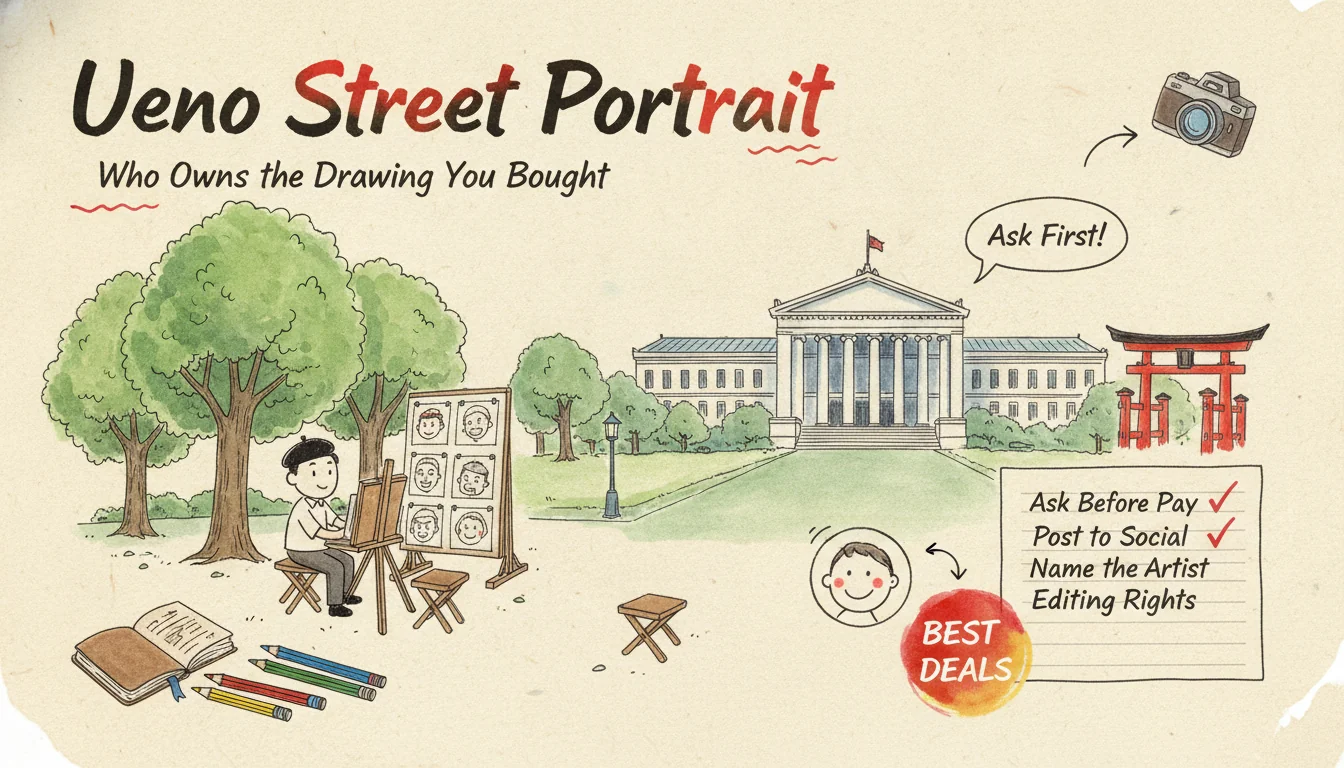
On the stretch of Ueno Park between the fountain plaza and the Tokyo National Museum, a good afternoon usually produces a few folding chairs, a few upright easels, and a wire rack pinned with a dozen sample portraits, every face smiling a little too hard. I stop and look every time I walk past. It took me until the third or fourth time to notice something: I had never once thought about who owns the drawing after it is finished.
There has been a round of public discussion lately about paying for a picture on the street and who it belongs to afterwards. This piece is not about that incident.
What it is about is a very concrete traveller's problem. You sit down in a Japanese street, you pay, you receive a sheet of paper with your own face — or your child's — on it. Then what? Photographing it for your phone, posting it to a story, cropping it into a profile picture, and feeding it to an AI to generate something "in this style" are four different questions with four different answers. And the reason they differ has nothing to do with how much you paid.
The stalls in Ueno Park are not all the same kind of operator
Tokyo does run a street-performance licence, called Heaven Artist (ヘブンアーティスト). This is not folklore — it is an official programme of the Tokyo Metropolitan Government's Bureau of Citizens, Culture and Sports. There is one screening round per year; people who pass receive a licence and may then perform at designated metropolitan sites, in slots booked in advance. The eligibility terms are explicit: no residency requirement, no nationality requirement (foreign applicants need valid status of residence), and applicants must be 16 or older as of 1 November of the following year. The designated sites include Ueno Onshi Park and Inokashira Onshi Park.
I had assumed the stalls in the park were all inside that programme. They are not. That one I got wrong.
Tokyo's rules for the programme state two things that matter here: money offered voluntarily by spectators may be accepted, but must not be solicited; and sales of goods such as DVDs, CDs or tickets are not permitted. In other words, the licence covers performance plus tips. It does not cover selling at a listed price. An artist with a board reading "¥2,000 per person" is taking payment for goods, not accepting a tip — which puts that transaction outside what this licence covers.
So a stall you see in Ueno may be a licensed performer, may be an independent operating under a different permission, or may be neither. That finding changed the advice I had originally planned to write: stop using "does he have a licence" as your test.
Staying next to the park makes all of this much easier. Street stalls appear entirely according to weather and time of day, so what you need is the ability to walk back and check, rather than betting everything on one visit. Candeo Hotels Ueno Park sits on the west side of the park, within a five-minute walk of a full loop around the fountain plaza.
Osaka has its own equivalent, the Osaka Performer Licence (大阪パフォーマーライセンス), run since April 2006 by a committee formed of Osaka City, the Osaka Convention & Tourism Bureau and the Osaka Chamber of Commerce and Industry. The venues it lists are places like Osaka Castle Park, Tennoji Park, Nagai Park, Tsurumi Ryokuchi, ATC and JO-TERRACE OSAKA — not shopping streets like Dotonbori. If you want street performance with institutional backing behind it, head for parks rather than nightlife districts.
What "does he have a permit" actually means for you
Performing to a crowd on a road in Japan requires a road-use permit from the local police station, under Article 77 of the Road Traffic Act. The Verybest Law Offices column puts the consequence plainly: doing it without one falls under Article 119-2 of the same Act, punishable by up to three months' imprisonment or a fine of up to ¥50,000. Parks and shop frontages are not "roads" — those run on the facility manager's consent or a park-use permit instead.
For you as the buyer, the practical effect is exactly one thing: an unpermitted stall can be moved on at any moment. Halfway through your portrait, the artist is asked to leave, you have paid, and there is no picture. That is the worst version of this transaction.
What ¥2,000 buys is fifteen minutes
Japanese calls this on-the-spot format sekigaki (席描き), literally "drawing at the seat". According to the rate summary compiled by Nigaoe Graphics, the going rate for sekigaki is ¥2,000, and at events some artists finish a piece in ten to fifteen minutes. More people or larger paper pushes the price up.
The comparison case is tsuhan — mail order, where you send a photo online and the artist works at home and ships it to you. The same source puts that at ¥6,000 to ¥10,000 and above, with its own entry price at ¥7,800.
I worked out that gap afterwards: ¥2,000 against ¥7,800 is a difference of ¥5,800, making mail order 3.9 times the street price. That multiple does not mean the street is better value, because the two are not selling the same thing. One sells fifteen minutes of craft and a sheet of paper. The other sells a commissioned work whose permitted uses can be specified. The second usually comes with a price sheet stating whether commercial use is allowed and whether you may modify it. The street has no such page. You have to ask for it.
If what you want is to bring an image of yourself home, the Asakusa kimono and yukata rental with souvenir photos is a different shape of the same idea. A studio package lists how the finished files are delivered and what you may do with them, and you can read that before booking. The chair on the street has no product page. To scan the price range of Japanese experiences in one go, the Klook deals on 1stCoupon are a reasonable overview.
After you pay, what exactly is the thing in your hand
Here I want to lean on a source that will not go stale: the Agency for Cultural Affairs' Copyright Textbook, Reiwa 7 edition.
First: Japan applies the no-formalities principle. The textbook states that copyright arises "without any application or registration procedure, automatically at the moment the work is created". The instant the artist's pen leaves the paper, the right is already theirs. Nothing needs signing.
Second: that right comes in two bundles. Moral rights — the right of publication, the right of attribution, and the right of integrity — protect the creator's personal interests, and the textbook's own table notes that they "belong exclusively to the author and therefore cannot be transferred (Article 59)". Copyright as an economic right can be transferred and inherited like property (Article 61).
Third, and the one most often misunderstood: transfer requires a contract. Even with a transfer contract there is a trap in Article 61(2). The rights under Article 27 (translation, adaptation and so on) and Article 28 are presumed to remain with the transferor unless the contract specifically enumerates them. In practice the wording has to read something like "transfers all copyright (including the rights under Articles 27 and 28 of the Copyright Act)" to be complete.
Does the street transaction have a contract? Yes — a verbal, minimal sales contract: you draw, I pay ¥2,000, the paper is mine. You have bought ownership of that physical object. The copyright in the image stays with the artist unless they explicitly say otherwise.
The structure is not unfamiliar. Buying a teamLab Planets TOKYO ticket buys admission, not a licence to use imagery from inside however you like; what you may photograph and what you may do with it is written in the ticket terms. The only difference is that a ticket has a terms page to read and the street does not, so that part you have to obtain by asking.
Photographing, posting, filtering: three actions, three answers
Separate the three and the answers really do diverge.
Photographing it yourself, keeping it on your phone, printing one for your wall. This lands under Article 30, reproduction for private use. The Agency lists two conditions: the purpose must be use within a limited circle such as personal or family use (work purposes do not count), and the reproduction must be made by the user themselves. The same section carries a line that gets overlooked: translation, arrangement, transformation and adaptation are also permitted within private use.
Uploading to social media. This leaves Article 30 and lands on Article 23, the right of public transmission. The Agency's explanation flags a detail many people do not know: putting something on a server where others can access it — "making transmittable", i.e. uploading — is itself automatic public transmission, so "even before anyone has received it, uploading without permission constitutes infringement". It is not counted from the moment someone views it. It counts the moment you post. This is the one most people get wrong.
Cropping, colour-grading, filtering, then posting. Article 20, the right of integrity, reads that the author has the right to preserve the integrity of the work and its title, and that it may not be altered, cut, or otherwise modified against their will. That right cannot be transferred, under Article 59. Which means that even if the economic rights were sold to you, this one stays with the artist. The same textbook warns directly in its limitations chapter that an exception permitting reproduction does not automatically permit alteration or the omission of attribution.
Article 19, the right of attribution, is worth remembering too. The author decides whether their name appears on the work and whether it appears as a real name or a pseudonym, both on the original and when the work is presented to the public. Tagging the artist when you post is not only good manners; it maps onto an actual provision.
There is one more situation that is easy to miss: the face on that paper belongs to your five-year-old. Alongside the artist's rights sits the subject's side — their likeness is about to appear somewhere public. A child cannot make that decision; you make it for them. That runs parallel to copyright, and both lines need thinking about.
To be clear: what the provisions say is not the same as "you will be sued if you post it". Most artists I have met are happy to be shared, and some have an Instagram QR code taped to the stall. But "he probably will not mind" and "I asked and he said yes" are worth very different amounts later, when you want to use the picture more freely.
What about feeding it to an AI to make something "in this style"
This is the greyest part, and the one most worth settling in advance. Two provisions get touched.
Article 27, the rights of translation and adaptation, is defined by the Agency as creatively "processing" an original work through translation, arrangement, transformation, dramatisation, filming and similar, thereby creating a derivative work. Using an existing drawing as an input to generate a derived image has that shape. Article 28 adds a layer: when a derivative work is used by a third party, the original author still holds rights in it.
Stack Article 20's non-transferable right of integrity on top of those.
Taken together, the practical dividing line sits roughly between private and public. Article 30's exception explicitly covers adaptation, so playing with it at home and keeping it there falls inside the exception; the moment you upload, public transmission becomes a separate question.
I am not going to pretend this line is crisp. How generative tools fit into Japanese copyright law is still moving, and the official textbook I found does not give a point-by-point answer for "take a commissioned drawing and generate a new image from it". So what this article can offer is not a ruling but a very practical substitute: ask one more question on the spot, and you will not need to guess where the line is afterwards.
The creator side's own conventions are worth reading too. Illustration-commission practice guides set out several points. Copyright in principle arises with the illustrator who made the work, and paying does not automatically transfer it. How much the client may do is set by the price list, terms of use, quotation, and whatever was agreed in messages. The permitted scope of edits such as cropping and colour changes should be confirmed in the contract. And presenting the work as your own creation runs into moral rights. The same guides give a pre-order checklist: which media it will appear in, whether commercial use is intended, what edits are planned, how attribution should be written, whether it may be passed to third parties, and whether copyright is being transferred.
That checklist is the one I use on the street — it just has to compress into three sentences.
So before you sit down, ask these three things
A Japanese street artist will not hand you a contract, so the answers you get verbally are your contract. Three questions, in this order:
- 「この絵、SNSに載せてもいいですか?」 (May I post this picture on social media?) Settle the most common use first.
- 「お名前をどう書けばいいですか?」 (How should I write your name?) This does two jobs at once: it maps onto the Article 19 right of attribution, and it lets the artist know you intend to credit them. Some will hand you a card or point at their Instagram at this point.
- 「あとで加工してもいいですか?」 (May I edit it afterwards?) Cropping, colour changes and AI processing all sit inside this one. To be explicit, add 「AIで作り直してもいいですか?」
There is one question I would avoid, or at least not open with: 「著作権をもらえますか?」 — may I have the copyright. In a ¥2,000 transaction that is a heavy ask, and it usually produces a defensive no to everything. What you want is scope of use, not the right itself.
If you want to rehearse the "may I photograph this" conversation somewhere low-pressure first, the Asakusa chopstick-making workshop is a good warm-up. Same setup: a craftsperson making something in front of you, and the same need to ask before you film.
Three ways to take a picture of your own face home
The difference between the three is not how good the likeness is. It is where the answer to "what may I do with this afterwards" is written down.
Route one: street sekigaki
Its advantage is that there is almost no barrier. You walk over, sit down, wait fifteen minutes. At ¥2,000 the decision is light enough that "shall we?" does not need much thought, which is exactly its pull.
Its disadvantage is that every term stays in the air. No product page, no consent form, no confirmation email — the only record between you and the artist is that thirty-second conversation. If their English and your Japanese are both shaky, those thirty seconds get harder. What I do is type the three Japanese sentences into my phone's notes beforehand and simply turn the screen around.
There is one more variable you only meet on site: whether the artist signs or stamps your sheet. Some do, some do not. This connects directly to the Article 19 right of attribution — once it is signed, who to credit is obvious — so I ask before they start drawing.
Route two: a studio package
Kimono photo packages sell an arranged sequence: dressing, hair and make-up, shooting, selection, delivery. The price covers the space, the equipment and the staff, so it climbs, and you should budget half a day.
Its real value for a traveller is legibility. The product page states how many images, in what format, and when you receive them, and there is usually a consent form on site. None of that exists beside a chair on the street.
The nature of what you get is different, though. A photograph is the photographer's work and a drawing is the artist's work; structurally they are the same under the law. The difference is only that the studio prints the terms and has you sign them. Do not read "there is a consent form" as "so I can do whatever I like" — the form covers exactly the scope it states.
Route three: online mail-order portraits
For this one you do not need to be in Japan. Send a photo, discuss what you want, wait for delivery. In exchange, you lose the part where you watch yourself being drawn — and honestly, that process is what the ¥2,000 on the street is really selling.
It is also the least transparent on price. The range quoted above is ¥6,000 to ¥10,000 and above, and "and above" is the operative part. Number of people, size, background, commercial licensing — each adds. The lowest figure you see is usually one person, head and shoulders, white background, personal use only.
What you get in return is a complete set of commission terms. That earlier checklist — media, commercial use, planned edits, attribution, third-party transfer, copyright assignment — appears as fields you are asked about before ordering, rather than as questions you have to work up the nerve to raise.
Laying the three side by side makes it clearer. The price and time columns come from the Nigaoe Graphics rate summary cited above; the rights column maps to the structure in the Agency for Cultural Affairs textbook.
| Route | On-the-day price | Time needed | Who holds what | How usage scope is set |
|---|---|---|---|---|
| Street sekigaki | From ¥2,000 per person | 10–15 minutes | You take the paper; copyright in principle stays with the artist | Verbal questions on the spot only, nothing written |
| Studio package (kimono photos etc.) | Per package, listed on the product page | Half a day including dressing | Digital files delivered per the package | Stated on the product page and consent form |
| Online mail-order portrait | ¥6,000–10,000 and above | Days to weeks | Delivered per the commission terms | Stated in the price list and terms of use; commercial licence purchasable |
Reading that table, "the street is cheapest" needs a discount applied. What is cheap is the fifteen minutes, not the freedom. If you already know the picture is going on a company page or onto merchandise, part of what the ¥7,800 buys on the mail-order route is having it in writing.
To string Ueno and Asakusa together, KKday's 5% off Japan rail tickets has no minimum spend and is worth a look; for accommodation, if you plan to stay a couple of extra nights waiting for good weather, Trip.com's Japan hotel deals and Agoda's extra 15% off popular Japanese stays are worth comparing in adjacent tabs.
How I would plan this half-day in Ueno
Weather is the biggest variable here. Street stalls will not appear to suit your itinerary, so my approach is to treat them as a bonus rather than the spine of the plan.
- 13:30 — start indoors at the Tokyo National Museum or a neighbouring gallery. Weather-proof, two hours passes easily, and it takes the hottest stretch of the day out of play.
- 15:30 — come out and walk the loop around the fountain plaza. The light and the crowds are both up by then, which is when stalls are most likely to be out.
- 15:45 — if there is a stall, sit down, but ask the three questions first. The drawing takes fifteen minutes; asking takes thirty seconds. Do not reverse the order.
- 16:30 — walk on towards Ameyoko for food. If no stall appeared, this simply follows on and the afternoon has no gap in it.
The Osaka side works on the same logic, transplanted to Osaka Castle Park or Tennoji Park. For getting around, 20% off the Have Fun in Kansai pass and 20% off the Keihan one- and two-day pass are the two I reach for most when moving between Osaka and Kyoto; the first bundles Osaka subway and bus travel, the second runs on the Keihan main line. For everything else discounted in Kansai, the 1stCoupon Japan deals page covers it in one sweep.
Honestly, what I most want to leave you with is not the itinerary. It is those thirty seconds. For a ¥2,000 object, is it worth three extra questions? If you intend to put that picture anywhere public, those three questions are the cheapest part of the whole transaction.
FAQ
Q1: Can I film the artist while they are drawing?
Filming and what you later do with the footage are two separate things, and both are worth asking about. The drawing itself is protected, and publishing on-site footage later also raises the question of the work appearing in it. One 「撮ってもいいですか?」 on the spot settles it; most will agree, and some will ask you not to film the unfinished stages.
Q2: If I am only keeping it for myself and hanging it at home, do I still need to ask?
Under the Agency for Cultural Affairs textbook, use within a limited personal or family circle, reproduced by the user themselves, falls under the Article 30 exception for private use — and that exception explicitly includes adaptation. Purely private use is relatively simple. What genuinely needs asking about is the moment you plan to step outside that circle.
Q3: I paid for it, so doesn't the copyright become mine?
Not automatically. The official explanation is that copyright as an economic right can be transferred by contract, but a contract is required; moral rights belong exclusively to the author under Article 59 and cannot be transferred at all. The street transaction buys you ownership of the sheet of paper. Rights in the image itself have to be negotiated separately.
Q4: How do I tell whether the stall in front of me is operating legally?
"Does he have a licence" is a less useful test than it sounds. Tokyo's Heaven Artist rules prohibit selling goods, so a stall selling drawings at a listed price is outside what that licence covers in the first place. The more practical approach is to look at the location: Tokyo's designated sites (Ueno Onshi Park, Inokashira Onshi Park and others) and the Osaka Performer Licence venues (Osaka Castle Park, Tennoji Park and others) are steadier ground than a roadside, because performing to a crowd on a road requires a separate road-use permit from the police.
References
- Tokyo Metropolitan Government: Heaven Artist official site — programme overview, designated sites
- Tokyo Metropolitan Government: Heaven Artist screening panel — eligibility, rules on tips and goods sales, prohibited conduct
- Osaka Performer Licence official site — approved performance venues
- Agency for Cultural Affairs, Copyright Textbook, Reiwa 7 edition — the no-formalities principle, the distinction between moral rights and economic rights, and Articles 19, 20, 23, 27, 28, 30, 59 and 61
- Verybest Law Offices: "Are street performances illegal?" — Road Traffic Act Article 77, Article 119-2 penalties, park-use permits
- Nigaoe Graphics: "What is the going rate for a portrait?" — sekigaki rates, time required, mail-order price band
- Eshi Navi: "Who owns the copyright in a commissioned illustration?" — commission practice, pre-order checklist
All Deals
JR PASS Hokuriku Area Pass
Kanazawa · 4.8 (209) · 3K+ booked · US$
No Code RequiredTokyo Asakusa Kimono/Yukata Rental & Souvenir Photo
Tokyo
No Code RequiredteamLab Planets TOKYO Toyosu Admission Ticket
Tokyo
No Code RequiredTokyo Asakusa Chopstick Making Experience: Craft Your Own Chopsticks
Tokyo
No Code RequiredTokyo Asakusa: Vintage Coin Ring Hands-On Experience
Tokyo
No Code RequiredAsakusa Kimono & Yukata Rental (Asakusa Kimono Miyabi)
Tokyo
No Code RequiredTokyo Kimono, Furisode & Yukata Rental Experience | Elegant Hairstyling & Japanese Makeup & Photography (Ookini Asakusa Kaminarimon Store)
Tokyo
No Code RequiredTokyo Asakusa Kimono & Furisode Rental Experience
Tokyo
No Code RequiredChopstick Craft Workshop in Asakusa, Tokyo: Traditional Japanese Art
Tokyo
No Code RequiredAuthentic Japanese Tea Ceremony & Kimono Experience in Asakusa
Tokyo
No Code RequiredAsakusa Kimono & Furisode Rental Experience (Tokyo / by Wasou Komachi Kanon)
Tokyo
No Code RequiredWakayama Kishi Station Cat Stationmaster Train Experience, Kuroshio Market & Rinku Premium Outlets Day Tour (Drop-off at Kansai Airport Available)
Wakayama
No Code RequiredJR Kansai & Hiroshima Area Rail Pass 5 Days
Hiroshima City · 4.8 (565) · 8K+ booked · US$
No Code RequiredJR Kansai WIDE Area Pass 5 Days
Kansai International Airport · 4.8 (2062) · 30K+ booked · US$
No Code RequiredTokyo Asakusa Kimono Memorial Photo Shoot (by HANAYAKA)
Tokyo
No Code RequiredYAHKART Tokyo Go-Kart Street Experience (Akihabara / Asakusa)
Tokyo
No Code RequiredKansai Enjoy Pass 1 Week Free Pass
Osaka
No Code Required[Japan Kansai 3 Ancient Capitals Day Tour] World Heritage Todai-ji Temple, Byodo-in Temple, Fushimi Inari Senbon Torii, Nara Park Deer & Uji Matcha Food Street (From Osaka/Kyoto)
Nara
No Code RequiredJapan JR Pass | Kansai & Hokuriku Area Rail Pass 7-Day Ticket | eMCO E-Ticket
Kenroku-en · 4.8 (212) · 3K+ booked · US$
No Code RequiredTokyo Asakusa Kimono & Yukata Experience Asakusa Station Store (by Wasou Koubou Miyabi)
Tokyo
No Code RequiredTokyo Asakusa Kimono & Tea Ceremony Experience
Tokyo
No Code RequiredKansai Enjoy Pass Deluxe (Includes Universal Studios Japan)
Osaka
No Code RequiredAsakusa Kimono Rental Experience (Tokyo / by Rental Kimono First)
Tokyo
No Code RequiredJapan Kansai Kintetsu Rail Pass (1-Day / 2-Day / 5-Day / 5-Day Plus)
Osaka
No Code RequiredAsakusa Tokyo Sushi-Making Experience: Sake Barrel Toast and Matcha Whisking
Tokyo
No Code RequiredKintsugi Art: Traditional Gold Repair in Asakusa, Tokyo
Tokyo
No Code RequiredTokyo: Asakusa Japanese Knife Making & Sharpening Experience Workshop
Tokyo
No Code Required
Pang
Travel & Food Field TesterOn-the-ground travel & food editor. Goes abroad at least 5 times a year — known to camp out at one shop for 3 afternoons or eat the same dish in 3 cities before writing. First-person field testing, ethnographic observation, multiple revisits.
You May Also Like
One Bowl, Half a Day Left: Taiwan Beef Noodles by County, Paired With an Afternoon Ticket
Taipei, Taichung, Kaohsiung, Tainan, Yilan, Hualien, Taitung — Taiwan's beef noodle shops are spread evenly across the island, so let the bowl pick your county and the afternoon follows. Opening hours, closing days, and the attraction ticket that fills the rest of the day.
Sapporo Before the Snow Sticks: What 3 Days Cost in November 2026
Sapporo gets 30cm of snow in a normal November, 113cm in December. That gap is a booking window — it shuts when Niseko opens 28 Nov 2026. Full 3-day cost sheet.
Moraine Lake Has No Car Access: 2026 Banff Shuttle Timings
Moraine Lake Road is closed to private cars all year. Shuttle seats drop in two waves, entry is free only through Sept 7, and I ran the ticket maths for going solo.