Japan's New 30 km/h Limit 2026: A 3-Second Roadside Check
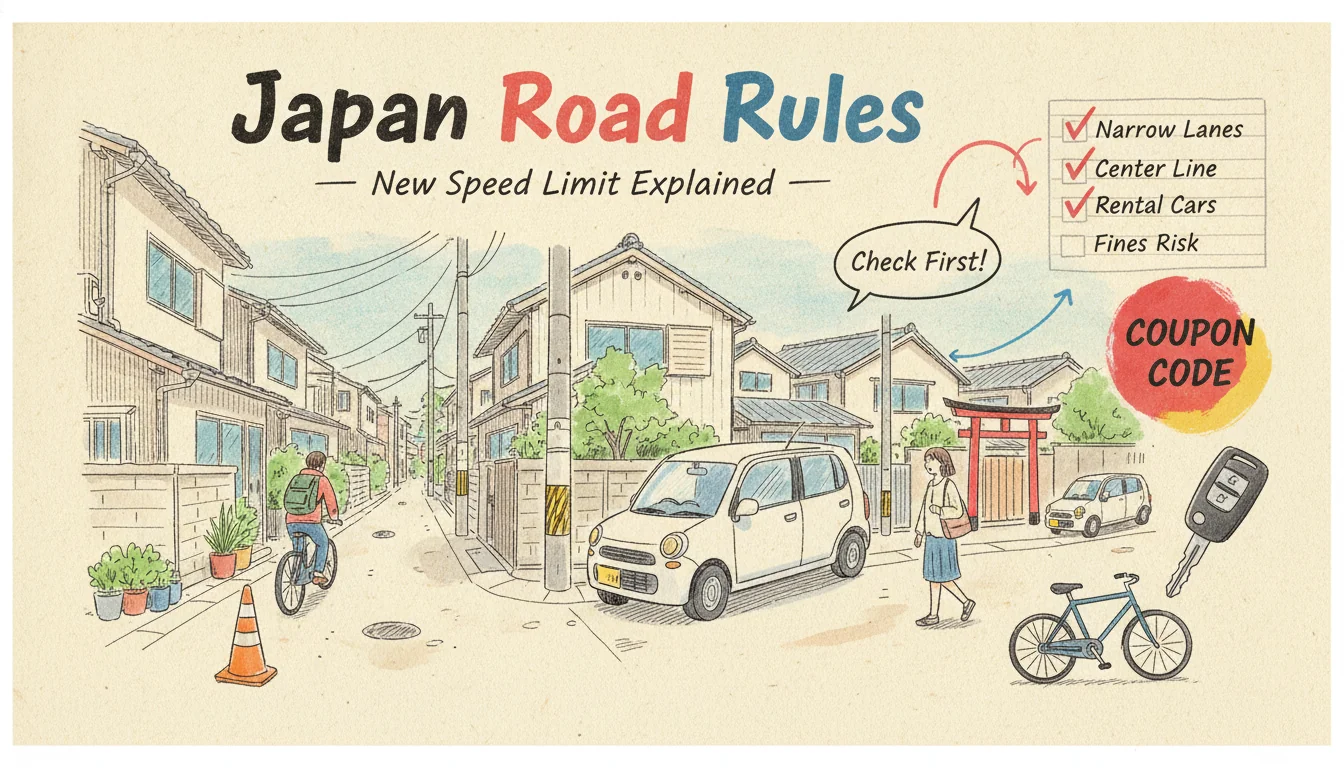
No speed limit sign at the roadside used to mean one thing in Japan: this road runs at 60. From today, that exact same view means 30. What changed is the default value that applies when no sign exists, not the signs themselves, so nothing out on the road is going to remind you.
Not many people in Japan know about this either. Mitsui Sumitomo Insurance ran a survey on awareness of the September road traffic law revision, covering drivers aged 20 to 60 who drive at least once a week, and only 40.7% knew the change was coming. A separate survey by Tokio Marine's direct arm (東京海上 direct) added up "never heard of it" and "heard of it but unclear on the details" and got roughly 60%. If more than half of local drivers are not up to speed, it is fair to assume the rental counter will not walk you through it in English either.
What a visiting driver actually needs is not a translation of the statute. It is knowing what to look at during the three seconds you sit at that intersection. Read the clauses closely and they compress into one table.
Exactly Which Rule Took Effect Today
Per the National Police Agency (警察庁) announcement, the revised enforcement order of the Road Traffic Act takes effect on September 1, 2026 (Reiwa 8), and the statutory speed limit for cars on residential roads drops from 60 km/h to 30 km/h.
Read the clauses and you notice they are written backwards: instead of listing which roads become 30, they list which roads stay at 60. The National Police Agency and the Tokyo Metropolitan Police (警視庁) use the same wording on their pages. Two categories of ordinary road keep the 60 km/h limit:
- 「道路標識又は道路標示による中央線又は車両通行帯が設けられている一般道路」 (an ordinary road with a center line or lane markings established by road signs or road markings)
- 「道路の構造上又は柵その他の工作物により自動車の通行が往復の方向別に分離されている一般道路」 (an ordinary road where opposing directions of travel are physically separated by the road structure, a fence, or another installation)
Expressway mainlines and motor-vehicle-only roads are covered by separate provisions and are outside the scope of this change. Any ordinary road that falls outside those two categories and has no separate speed limit sign is 30 km/h as of today, and it applies directly, with no sign needing to be posted at all.
How to Read It From the Driver's Seat: Three Visual Checks, One Table
The National Police Agency text sets the test as three elements: center line, lane markings, and a central divider. That is enforcement language. Unpack it and there are only three things you can actually see from behind the wheel.
| Where to look | What means it stays at 60 | What means it is 30 from today | Matching legal element |
|---|---|---|---|
| Down the middle of the road | A lengthwise white or yellow line splitting the road into two directions (solid or dashed, both count) | Nothing at all down the middle, just asphalt running through | Center line |
| Your own side of the road | Lengthwise white lines cutting your direction into two or more lanes | Your direction is one open surface, not divided again | Lane markings |
| Between opposing lanes | A traffic island, guardrail, fence, or planted strip physically separating the two directions | No physical object at all, oncoming cars face you directly | Central divider (structural separation) |
If all three columns land on the right-hand side, that road is 30 km/h from today. If even one column lands on the left, it stays at 60.
The Japan Automobile Federation (JAF) compresses it further in its guidance for travelers: "once you turn into one of those narrow roads with no center line, it is 30." That line covers the overwhelming majority of cases, but it is the simplified version. The real test is the three columns above, and on a road with two lanes in your direction but no center line, the simplified version will make you get it wrong.
The One Decision Rule: Look for a Sign First, Read the Lines Only if There Is None
That table rests on one condition, and if you drop it the whole table is wrong: it only applies where there is no speed limit sign.
The National Police Agency wording is explicit: 「道路標識又は道路標示により最高速度が指定されている道路では、法定速度ではなく、指定されている速度が自動車の最高速度となります」. Where a speed is designated, the designated speed governs. So the real decision sequence is only two steps:
- A speed limit sign exists, drive to the sign. If it says 40, it is 40. If it says 20, it is 20. Today's change has nothing to do with that stretch. Even with no center line, that road does not become 30 because of the new rule.
- No sign in sight, only then go back to the three columns. All three blank means the default is 30.
The failure mode is skipping step two. In Japan, "I don't see a sign" used to connect to 60, and plenty of people have driven that way for a decade or more. As of today, that default is the wrong answer.
More people are renting cars than ever, and the number of people who have swapped their default has not kept pace. That gap is the biggest risk on the road today. If you want a quick look at what is currently live for Japan, the 1stCoupon Japan deals hub has it collected in one place, and if you want to lock in a car class and pickup point right now, Klook global car rentals from NT$750 (~US$23) is a decent way to see the price band first.
"Residential Road" Does Not Mean "Narrow Road": Four Situations People Misjudge
If you file this away as "drive slower on small roads," these are the four road types where you will get it wrong.
Type one: two lanes in your direction, but no center line. The road is wide, it looks like an arterial, and your direction may even be lane-marked. That satisfies column two, lane markings, so it stays at 60. The reverse also holds: a wide road with all three columns blank is still 30, and width will not save you.
Type two: the center line is dashed rather than solid. Some drivers assume a dashed line can be crossed and therefore does not separate anything. A dashed line is still a center line, column one is satisfied, and the road stays at 60.
Type three: prefectural roads in the countryside and on scenic routes. This is the category visiting drivers get wrong most often. Think of heading north up the main island of Okinawa, or the side roads once you leave National Route 58 on the Naha Airport pickup and drop-off route. The same goes for long point-to-point stretches in Hokkaido or Tottori, where you often have no other car in sight, clear visibility, and absolutely no center line. The roads that feel least like 30 are exactly the ones that legally are.
Type four: treating this as the same thing as "Zone 30." JAF's official explanation deliberately separates the two. Zone 30 is an existing scheme, planned area by area, paired with road markings, intersection redesign, and physical narrowing. What took effect today is decided directly by road structure criteria, needs no area designation, and needs no construction work at all. It applies to you in a place with no Zone 30 marking anywhere in sight.
What Changed in Your Penalty Exposure: Not Harsher, Just Shifted Down
Let me be clear about this first: what changed is the speed number, not the penalty table. Neither the Tokyo Metropolitan Police page nor the National Police Agency page lists penalty tiers, so I am not going to fill in numbers on their behalf here. Japanese speeding penalties have always been tiered by how far over you are, and past a certain margin they move from an administrative fine (the blue ticket) to criminal proceedings (the red ticket). The exact tiers and amounts come down to what the police determine on the spot and what the authorities publish.
What actually changed is your distance from every one of those tiers, and it is a subtraction problem. Same road, no sign, no center line, and put the two sets of numbers side by side:
- Old limit 60: driving 70 puts you 10 over. New limit 30: the same 70 puts you 40 over.
- Reaching the "30 over" bracket used to require 90 km/h, which is an obviously abnormal speed. From today you get there at 60, and 60 on that kind of road is many people's cruising habit.
Your speed did not change by a single kilometer, and your position on the tier table jumped one or two brackets. That is a direct consequence of swapping 60 for 30, not a new penalty.
Measured data from inside Japan points the same way. Map data company Geotechnologies published a driving behavior analysis on August 18 covering surveyed road sections in Osaka, Aichi, Fukuoka, Gunma, and Nagano, and found roughly 60% to 90% of vehicles exceeding the post-revision 30 km/h. If that is the ratio for local drivers who use those roads daily, a foreign visitor driving them for the first time will not do better.
If you want to knock the rental cost down before you go, the QEEQ member code 1stCoupon, 10% off with no minimum spend is currently the loosest set of conditions out there, and the full terms live on the QEEQ deals page.
The 30 Minutes at Pickup and Drop-off Decide How the Next Five Days Drive
With the new rule live, there are four things worth a few extra minutes at the counter.
Check the booking dates before you hit pay. I tested the city pickup-point pages on several platforms, and the pickup and return dates carried in the URL are usually sample values. Leave them alone and you get a quote for dates that are not your trip. Sort that out before the counter, because discovering it on site means rebooking.
Confirm whether the car's navigation speed display has been updated. The speed limit layer in in-car navigation depends on the map data vendor's update cycle, and this change is to the default for unsigned sections rather than a batch of new signs, so the data will not refresh on the same day as the law. A nav screen showing 60 is not a defense. The statutory limit does not care what is on your display.
Find the dashcam and the speed readout while you are still parked. Japanese rental cars mostly have a digital speed display. Spending one minute at pickup working out which panel it sits in beats looking down for it on a narrow road.
Pick up and drop off at an airport or a major station where you can. Places like Narita Airport pickup and drop-off or Kyoto Station pickup and drop-off sit on arterial roads with center lines, so you are not thrown into the hardest judgment call the moment you get the keys. The few hundred NT dollars a small downtown branch saves you buys you a return-day tour of residential back lanes hunting for a house number. That is the textbook case of all three columns blank and a statutory 30.
Choosing Between Three Booking Channels: Start From Which Problem You Are Stuck On
There are basically three ways to book a car in Japan from abroad. Ranked out, the difference that matters is which one solves the problem you actually have, not which one is cheapest.
| Channel | How it prices | Best when | Watch out for |
|---|---|---|---|
| Platform pickup-point pages (Klook per-city car rental) | Lists the car classes and quotes available at that pickup point | You have settled on city and dates and just want to compare car classes at one point | The dates carried in the page by default are sample values, change them to your own trip |
| Cross-brand comparison (QEEQ) | Pulls quotes from multiple rental companies on the same conditions | You are still weighing Toyota, Times, or Nippon, or want to stack a member discount | Discount codes usually carry car class or rental length limits, expand the terms before checkout |
| Bundled platform packages (Trip.com) | Puts flights, hotels, and car rental into one campaign and issues coupons | You were booking flight plus hotel together anyway and the car is an add-on | Campaign coupons are issued in limited batches, and the car rental slot often shows out of stock once they are gone |
How to choose: city and dates settled, go to the pickup-point page. Still comparing rental companies, go to the comparison site. Booking flight and hotel at the same time, only then consider the bundle. All three can stack, but the order matters: use the comparison site to establish a sane price band, go back to the pickup-point page to see if anything beats it, and check the bundle for leftover coupons last. Do it the other way around and the package price locks you in, and you lose your baseline for comparison.
In practice, QEEQ overseas car rental 8% off (code TWIG26) suits longer rentals with a higher single-booking total, while Trip.com campaign page car rental 12% coupon depends on whether stock is left in the current run. I clicked into the same group's Okinawa campaign page and the self-drive and airport transfer slots showed out of stock outright. Once the coupons are gone you cannot claim them, and the discount printed on the headline is not the discount you can get right now. To see every live car rental coupon in one pass, the full Klook deals list beats clicking through page by page.
Two Things to Settle in the 48 Hours Before You Go
First, swap the default in your own head. This is not about memorizing the statute. It is about connecting the signal "I don't see a sign" to 30 instead of 60. You have to rewrite that yourself, because nothing in the car will prompt you.
Second, everyone in the car needs to know. Most self-drive trips rotate drivers, and the person in the passenger seat is often the driver for the next leg. That 40.7% awareness figure is a domestic Japanese number, and your travel companions have most likely never heard of this at all.
FAQ
Q1: On a road with no speed limit sign posted, will police actually enforce it? Yes. The National Police Agency announcement is explicit and uses the term 法定速度, the statutory speed. Whether a statutory limit exists does not depend on a sign being posted on site. Signs only appear where a different limit needs to be designated. A stretch meeting the three criteria is subject to 30 km/h directly, with no sign anywhere, and is enforceable.
Q2: Can I just drive 30 the whole time and be done with it? Not advisable, and not correct either. Ordinary roads with a center line are still 60, and roads with a sign go by the sign. Deliberately holding 30 on an arterial creates pressure from the car behind and overtaking risk, which is itself dangerous driving. What this rule asks for is discrimination between road types, not driving slowly everywhere.
Q3: The navigation shows a different limit from this rule. Which do I follow? Follow the road and the law, not the screen. The nav speed limit layer comes from a map vendor's update schedule and will not sync with the law's effective date. On top of that, this change targets the default for unsigned sections, so reflecting it in the data layer means re-evaluating a large number of road segments. A screen showing 60 will not serve as a defense.
Sources
- National Police Agency: 生活道路における自動車の法定速度が引き下げられます!!, effective date and the original text on roads that keep 60 km/h
- Tokyo Metropolitan Police: 生活道路における法定速度について, effective date and the explanation that a posted designation takes priority
- Government Public Relations Online: 常識が変わる! 生活道路は法定速度30km/hへ, the government's plain-language explainer for ordinary drivers
- JAF traffic safety training column: 9月から生活道路の法定速度が30km/h制に, how to apply the three criteria and how this differs from Zone 30
- JAF Mate Online: 生活道路30km/h規制が9月1日開始, the simplified "narrow road with no center line means 30" test
- Geotechnologies press release, 2026/8/18, driving behavior analysis of surveyed roads in Osaka, Aichi, Fukuoka, Gunma, and Nagano
- Mitsui Sumitomo Insurance, 「9月改正道路交通法に関する認知調査」, the 40.7% awareness figure
- Tokio Marine direct: 法改正の認知度調査, roughly 60% unclear on the details
All Deals
Bishima Sightseeing Bus Day Tour (from Naha)
Kunigami
No Code RequiredCentral Okinawa Day Tour: Hoshino Banta Cafe & Cape Zanpa & Southeast Botanical Gardens & Rycom (Chinese-Speaking Guide)
Nakagami District
No Code RequiredKyoto Car Rental | Drive to Fushimi Inari Taisha, Kiyomizu-dera, Kinkaku-ji, Osaka International Airport
Kyoto
No Code RequiredMiyakojima Sea Turtle Snorkeling Half-Day Experience (Okinawa)
Miyako District
No Code RequiredOkinawa Blue Cave Fun Snorkeling (Boat Entry/Free Photos)
Kunigami District, Okinawa
No Code RequiredOkinawa Car Rental | Rent a Car to Gyokusendo Cave, Churaumi Aquarium, Okinawa World, International Street, Shuri Castle
Naha
No Code Required[Okinawa South Day Tour] Gyokusendo Cave & Ryukyu Kingdom Village, Umikaji Terrace, Sea Grape Picking, Itoman Seafood Market, Chinen Cape & All-You-Can-Eat Yakiniku | From Naha
Nanjo City
No Code RequiredOkinawa North Day Tour | Manzamo, Kouri Island & Churaumi Aquarium Day Tour | from Naha & Chatan
Kunigami
No Code RequiredOkinawa Churasun 6 Large Show Club Experience
Naha
No Code RequiredOkinawa Go-Kart Experience (by Gorilla Kart Okinawa)
Naha
No Code RequiredOkinawa Sightseeing Bus North & South Route Day Tour: Gyokusendo Cave, DMM Kariyushi Aquarium, Senagajima & Manzamo, Churaumi Aquarium, American Village
Naha
No Code RequiredTokyo Departure: Car Rental with Driver to Mt. Fuji/Hakone/Nikko - Chinese-speaking Driver
Car charters • Tokyo
No Code RequiredExclusive 5% Off Car Rental Promo Code for 1stCoupon
Click to view full deal details and terms
QR1stcouponChiayi Car Rental | Car Rental to Alishan National Forest Recreation Area, Meteor Garden Sightseeing, Meimei Shangshu Pet Paradise, Three Pigs Farm, Sun Moon Lake
Chiayi City
No Code RequiredFrankfurt Car Rental | Hesse, Frankfurt Airport, Central Station, Hauptwache
Frankfurt
No Code RequiredChiang Mai Car Rental | Rent a Car to Chiang Mai Elephant Nature Park, Tiger Kingdom, Doi Suthep, Night Market & Wat Chedi Luang
Chiang Mai
No Code RequiredIncheon Car Rental | Drive to Incheon International Airport, Incheon Chinatown, Songdo-dong, Geomam Station
Incheon
No Code RequiredTaitung Car Rental | Taitung, Green Island, Hongye Valley, East Coast Chulu Ranch Car Rental
Taitung
No Code RequiredTaichung Car Rental | Drive to Lihpao Land, Taichung Science Museum, Fantasy World, Museum of Illusions, HiONE Bobi Planet, Ryobi Fishing Wharf
Taichung
No Code RequiredVienna Car Rental | Schonbrunn Palace, Mozart's Birthplace, St. Stephen's
Bruck an der Leitha
No Code RequiredRentacar Argentina Summer Car Rental Deals 15% OFF – Antigua and Barbuda
Hit the road this summer and save up to 15% on car rentals during the busiest travel season. • Applicable destinations: Antigua and Barbuda, Australia, Bahamas, Barbados, Colombia, Fiji, Malawi, Mauritius, Peru, Sri Lanka, Tanzania, New Zealand, Jamaica, Chile
No Code RequiredSouthern Okinawa Day Tour: Chinen Cape & Okinawa World Gyokusendo Cave/Kingdom Village & Itoman Seafood Market & Senagajima & Outlet [Chinese/Japanese Guide & Free Ticket]
Nanjo
No Code RequiredFukushima Car Rental | A Wide Range of Vehicle Models to Choose From
Ishikawa Prefecture
No Code RequiredGwangju Car Rental | Many Vehicle Models to Choose From
Gwangju
No Code RequiredTrang Car Rental | Wide Choice of Vehicles
Trang
No Code RequiredNagoya Car Rental | Drive to Ghibli Park, Nagoya Aquarium, Oasis 21, Legoland Resort
Nagoya
No Code RequiredPerth Car Rental | Cottesloe Beach, Elizabeth Quay, Cockburn Central, Bibra Lake
Perth
No Code RequiredDubai Car Rental | Burj Khalifa, Red Dunes, Miracle Garden, Dubai Frame
Dubai
No Code RequiredSapporo Car Rental | Drive to the Beer Museum, Asahiyama Zoo, Odori Park, Jozankei Onsen, and Sapporo Clock Tower
Chitose
No Code RequiredMiri Car Rental | Wide Range of Vehicle Types to Choose From
Sarawak
No Code RequiredAsahikawa Car Rental | Drive to Asahiyama Zoo, Biei Trees, Shirahige Falls & Sennyodai
Hokkaido
No Code RequiredUlsan Car Rental | Many Vehicle Models to Choose From
Ulsan
No Code RequiredLas Vegas Car Rental | Bellagio, Flamingo, Fontainebleau, Cosmopolitan
Click to view full deal details and terms
No Code RequiredMiyako Car Rental | A Wide Range of Vehicles to Choose From
Miyako Island
No Code RequiredBrisbane Car Rental | Drive to Fortitude Valley, Redcliffe, South Bank, Kangaroo Point, Woolloongabba, Everton Park & New Farm Park
Brisbane
No Code RequiredYokohama Car Rental | Drive to Enoshima, Tsurugaoka Hachimangu, Yamashita Park, Hakkeijima Sea Paradise, Landmark Tower Sky Garden
Yokohama
No Code RequiredJohor Car Rental | Wide Range of Vehicle Types to Choose From
Kulai
No Code RequiredTakamatsu Car Rental | A Wide Range of Vehicle Types to Choose From
Takamatsu
No Code RequiredAomori Car Rental|A Wide Range of Vehicle Types to Choose From
Aomori
No Code RequiredHualien County Car Rental | Car Rental to Farglory Ocean Park, Qixingtan, Ji'an Qingxiu Garden, Liyu Lake, Taroko National Park
Hualien
No Code RequiredChitose Car Rental | A Wide Range of Vehicle Models to Choose From
Chitose
No Code RequiredKoh Samui Car Rental | Wide Range of Vehicles to Choose From
Koh Samui
No Code RequiredPhuket Car Rental | Rent a Car to Phuket International Airport, Phuket Old Town, Central Phuket, Phuket Thai Village Hotel, Katathani Phuket Beach Resort, Phuket Tiger Kingdom
Phuket
No Code RequiredRentacar Argentina Summer Car Rental Deals 12% OFF – Albania
Hit the road this summer and save up to 12% on car rentals during the busiest travel season. • Applicable destinations: Albania, Austria, Germany, Georgia, Qatar, Malaysia, Malta, Cyprus, Turkey, Greece, Hungary, Italy
No Code RequiredOkinawa Churaumi Aquarium Tickets
Kunigami
No Code RequiredPahang Car Rental | Wide Range of Vehicle Types to Choose From
Kuantan
No Code RequiredTbilisi Car Rental | Choose from Many Vehicle Types
Tbilisi
No Code RequiredPalm Springs car rentals | Choose from multiple car models
Car rentals • Palm Springs
No Code RequiredPrague Car Rental | Wide Range of Vehicles to Choose From
Prague
No Code RequiredRome Car Rental | Colosseum, Roman Forum, Vatican Museums, St. Peter's Basilica
Rome
No Code Required
Cool
Travel Deal OrganizerTravel deal data nerd. Specializes in early-bird flights, transit passes, and KKday/Klook stacking logic — calculates which ticket is the best deal. Comparison tables, price PKs, and rule breakdowns.
You May Also Like
Takachiho Day Trip or Miyazaki Self-Drive? Both, Costed
Most English Miyazaki tours leave from Fukuoka, 3 hours away. What the bus day trip and the fly-and-drive trip each cost, and when the Takachiho boat sells out.
Kyoto Autumn Leaves 2026: Go Late, Save Half on Hotels
Kyoto's peak foliage slips 3.1 days per decade, 22 days across 72 years, so mid-November is now the earliest edge of the window rather than the middle. Here is the peak table for 18 famous spots, the two things to book in September, why early December rooms run about half, and the three-stage booking method I use.
JUNGLIA Okinawa 2026: Fast Pass Break-Even and Klook's VIP Lounge
JUNGLIA Okinawa turns one in 2026. The Premium Pass break-even worked out, the Klook-exclusive VIP lounge priced against the standard ticket, the ¥2,970 Furatto half-price ticket, and one- and two-day plans with Churaumi.