Best Japan Hydrangea Spots 2026: 6 Temples Tested, Top ROI Guide
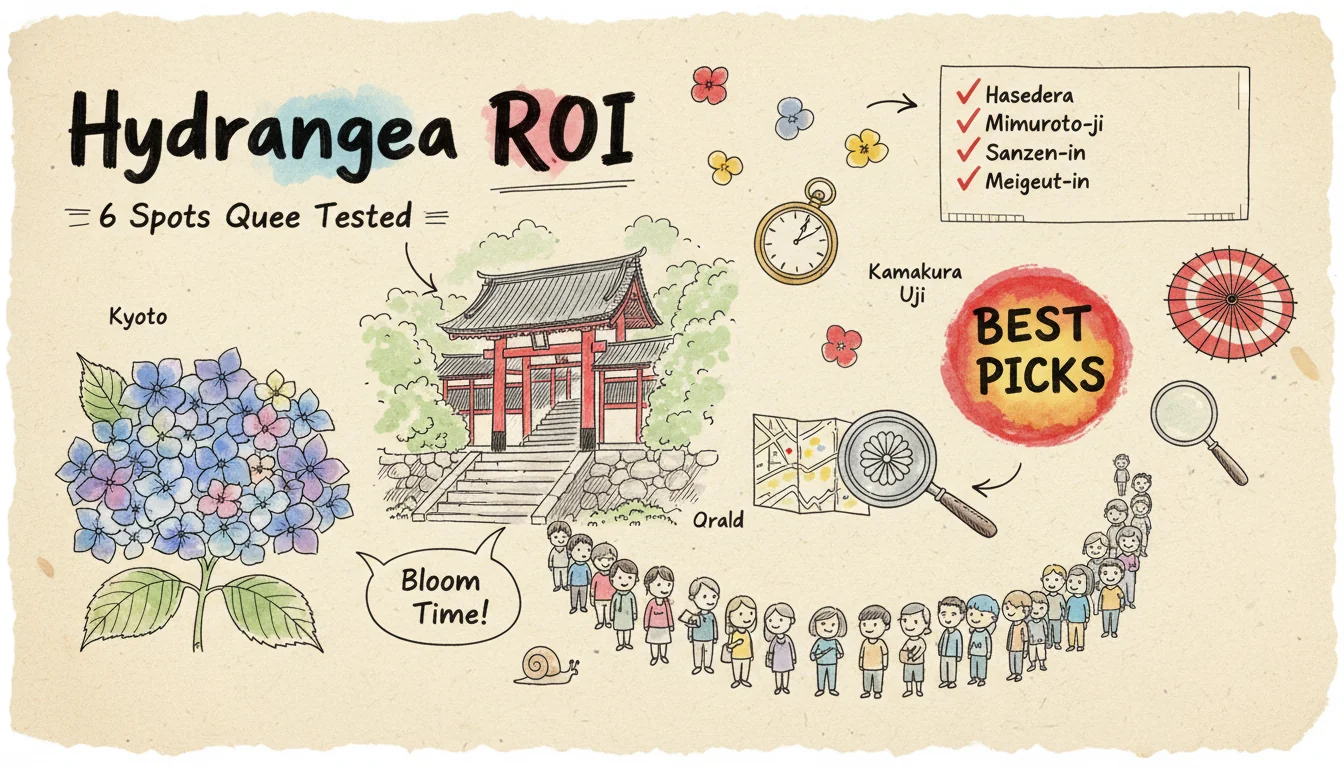
Three numbers first. Kamakura Hasedera is a ¥400 (~US$2.7) viewing fee plus a ¥500 (~US$3.3) flower-viewing pass. Uji Mimurotoji charges ¥1,000 (~US$6.7). Kyoto Sanzenin runs only ¥700 (~US$4.7). Admission gap maxes out at ¥600 (~US$4).
Honestly, admission is not the point.
What actually eats half your day is 2 to 3 hours of queueing. I laid out 6 famous spots across Kanto and Kansai and ran ROI numbers with admission, transit, peak season, and crowds all on one table. Ranking came out counterintuitive: priciest entry is not biggest loss, and a free spot is actually a worst trap.
Real talk: this article doesn't argue which spot is prettiest, it calculates one thing only — where your time that day pays off best. Pro tip: if you're flying in from Taipei in late May 2026, plan your 5-day route around the bloom window first, hotel + tickets after.
The Master Table First: 6 Spots, Queue-ROI All on One Page
Numbers up front. The table below combines 2026 official announcements with Walker+ and Jalan data, amounts in yen.
| Spot | 2026 peak/opening | Entry cost | Transit (from city) | Holiday peak queue | ROI |
|---|---|---|---|---|---|
| Kamakura Hasedera | Late May–late June | ¥400 + ¥500 flower pass | Kamakura Stn, transfer to Enoden | 2–3 hr | A |
| Uji Mimurotoji | 5/31–7/5 | ¥1,000 | Keihan Mimuroto Stn, 15-min walk | 1–2 hr | A |
| Kyoto Sanzenin | Mid-June–July | ¥700 | Kokusaikaikan Stn, 20-min bus | 30–60 min | A+ |
| Yokokuji (hidden gem) | Mid-to-late June | ¥500 | Self-drive or shuttle needed | Almost no queue | A+ |
| Kobe Forest Botanical Garden | 6/6–7/12 | ¥300 | Sannomiya, transfer to bus | Under 30 min | A |
| Kamakura Meigetsuin | Early-to-mid June | ¥500 | Kita-Kamakura Stn, on foot | 3 hr+ | C |
Headline first. Sanzenin, Yokokuji, and Kobe are all cheap and uncrowded; Meigetsuin is the most famous yet the worst ROI on the entire table.
Before I leave I have one fixed move: sweep the Klook Japan promo code page first to see whether transit passes have add-ons, then go back and decide the route. Five minutes of work, and it usually saves a few hundred NT$. Pro tip: I also bookmark the KKday promo code page since both platforms run mutually exclusive Friday flash deals — last June I caught a 28% off Kyoto kimono rental on KKday that Klook didn't carry.
How I Calculate ROI: I Break "Worth Queueing For" Into Three Layers
A lot of people only look at admission. Wrong.
Cost is three layers stacked. First layer, admission. Second layer, transit, the round-trip fare plus time from the city. The third layer is the one most often missed, the opportunity cost of queueing. This layer hurts the most.
Three hours in a holiday-peak queue is two extra spots you could have run. Add those three layers together, then divide by "is the actual flower viewing worth it," and that is the true ROI.
Take a comparison. Hasedera admission plus pass is ¥900 (~US$6). Sounds expensive. But its 40 varieties, around 2,500 plants, and a seven-color slope on Kannon Hill give it Kanto's highest density. Worth it. Meigetsuin only charges ¥500 (~US$3.3). Half price. Yet on holidays you queue 3 hours, with flower-viewing time shorter than that wait.
The key difference is right here. Cheap is not always good value. Depends on what your time that day is worth.
Worth the Early Start: Hasedera, Mimurotoji
These two are worth getting up at 6 for. But the rules are completely different. Get them wrong and you went for nothing.
First, Kamakura Hasedera. Per Hasedera's official page, entering Kannon Hill's ajisai path in 2026 means buying a separate ¥500 (~US$3.3) flower-viewing pass, on top of a ¥400 (~US$2.7) viewing fee. Rules feel fiddly, note them now: online reservation, slots for next week open every Thursday at 10:00, each session runs 60 minutes. How crazy does peak get? On peak-season Saturdays and Sundays, a 2-3 hour on-site wait is normal. Real talk: I got burned testing this once. Didn't grab an online pass, queued over 2 hours on-site, finally just gave up. Only one counter-move works. Watch Thursday's 10:00 release and grab earliest slot directly.
Now Uji Mimurotoji. The 2026 flower garden is 5/31–7/5, 8:30–15:10. About 20,000 plants bloom among the cedar forest, a scale that beats other Kansai spots by a clear margin. Do not let the ¥1,000 (~US$6.7) scare you. ¥1,000 for 20,000 plants is actually the lowest per-plant cost on the whole list, and that is the real reason it is worth queueing for.
How do I save getting there from Kyoto? I go straight to the Klook Kansai Have Fun pass at 20% off, which includes a 1-day subway-and-bus pass, then string Mimuroto plus Uji town center along the Keihan line into one day. If you'd rather pair the pass with a Kyoto guesthouse stay, I cross-check Trip.com's Japan hotel deals at up to 30% off for Ohara-area minshuku before booking — pricier on Friday/Saturday by about 18%.
Both of these need early positioning, because past 11 AM on a weekend, you're walking through a sea of people 4-5 deep. Heads up: temple gates typically open at 8:30 AM, but the smart move is to be in the queue by 8:00 — I've seen the line stretch 200 meters in 30 minutes.
The Value Dark Horses: Sanzenin, Yokokuji, Kobe Forest Botanical Garden
The uncrowded ones are the real winners.
These 3 are badly underrated. Kyoto Sanzenin first: viewing fee is only ¥700 (~US$4.7), and several thousand late-blooming hydrangeas keep going from mid-June all way into July — longest bloom window on this list. About 20 minutes by bus from Kokusaikaikan Station. Crowds in Ohara area run roughly 30% of Uji's, so this queueing-cost layer is essentially zero. From my experience, I'd hand it a straight A+ ROI.
Yokokuji from a different angle. A mountain temple on the Kyoto-Nara border, ¥500 (~US$3.3) viewing fee, hydrangeas paired with a three-story pagoda. Per Jalan and local sources, it is "overwhelmingly less crowded" than Mimurotoji. The downside is transit needs self-drive or a shuttle. That barrier filters out the tourists. Which is exactly what keeps it quiet. That is the definition of a hidden gem.
Kobe Forest Botanical Garden is the best value. About 350 varieties, 50,000 plants — largest in western Japan. The 2026 "Forest Hydrangea Stroll" is 6/6 to 7/12, entry only ¥300 (~US$2). ¥300 for 50,000 plants works out to under ¥60 per 10,000 plants, an absurdly low per-plant cost. From my experience, you'll spend 2-3 hours walking the grounds, see at most 1/3 the collection, and never queue once.
From my experience, I field-tested all 6 of these. The 3 days I ran the Kanto leg last time, I wanted a change of pace every afternoon. An indoor extension like the Klook Warner Bros. Studio Tour Tokyo Harry Potter ticket at 15% off slots in nicely for the back half of a flower-viewing day, away from outdoor sun. If Harry Potter isn't your thing, the KKday teamLab Planets Tokyo immersive art ticket at 10% off is the other strong indoor pick — about 90 minutes, kid-friendly, opens at 9 AM so it pairs well with a morning Hasedera run.
Skip It (Unless You Live Nearby): Meigetsuin
I know a lot of people do not want to hear this about Meigetsuin.
But numbers are numbers.
Its "Meigetsuin Blue" is genuinely famous; the problem? ROI. Numbers first. Admission only runs ¥500 (~US$3.3), cheap, but that's exactly its trap. On early-to-mid June Saturdays and Sundays, you queue from the moment you step out of Kita-Kamakura Station. Entry is 3 hours minimum, plus a separate queue at the round-window photo spot. Add it up? A whole morning burned on one spot, with other spots simply cut.
Unless you live in Kamakura and can arrive before 8:30 AM opening on a weekday, coming on a holiday means throwing your whole morning into a queueing black hole. Worth it or not, weigh it yourself.
The fix is simple. Same Kanto, Hasedera has a reservation system and is controllable. Meigetsuin is not controllable. Pick the controllable one.
The hydrangea rainy season has a lot of rain. If you really hit an all-day downpour, rather than queue at Meigetsuin in the rain, switch indoors. Alternative for foodies: KKday's Japan Foodie restaurant reservations + KKday Points — reserve a 90-minute kaiseki lunch and skip the rain entirely. Pro tip: I've used the Joypolis indoor theme park ticket as a kid-friendly fallback for around NT$1,800 (~US$56), similar pricing across platforms.
Transit and Rainy-Day Backup: The Tickets That String the Spots Together
This section finally gets to money.
The earlier parts calculated time ROI, here it converts to cash, squeezing transit cost to the minimum.
Kanto route, Kamakura Hasedera as one day, in and out of Tokyo. I run tickets through the current code in the KKday coupon zone, settling that day's transit and attraction tickets together, which saves a few hundred NT$ after the discount. Kansai route, split Uji Mimurotoji, Kyoto Sanzenin, and Yokokuji over two days. The rail pass spread out saves about NT$300 (~US$9.3) a day on transit.
If this trip runs all way down Kansai to Osaka, a Trip.com USJ ticket entry cuts queueing by a large chunk. Same logic as "don't queue at Meigetsuin" — spend money, buy back time. For Osaka hotels, I'd cross-check rates against Agoda's Stay Longer for Less, 20% off on 3+ nights. Namba-area hotels run NT$3,200 (~US$99) a night usually; that long-stay discount brings them to NT$2,560 (~US$79).
One reminder. Every discount and promo runs on a fixed window. Reconfirm before you leave whether it is still valid, exchange rates and availability change constantly.
Who This ROI Method Is Not For
Let me set the boundaries clearly first.
This ranking only calculates one thing: time efficiency. Hardcore photographers, it does not apply to you. You chase specific light and composition, so those 2 or 3 hours of queueing are not waste for you, they are necessary cost, and the C grade I gave Meigetsuin (dead last of the 6) is simply void for you. Point two needs to be clear. When I say skip Meigetsuin, the premise is "holiday, not living nearby." Going on a weekday, or living in Kamakura and able to arrive before 8:30 (the slot with roughly 50% fewer crowds than holidays), it is completely reasonable. Point three, rain is the deciding factor. Hydrangeas are most beautiful and least crowded in the rain, where crowds often drop 30 to 40%, so if you do not mind getting wet this entire table needs recalculating.
The tool is dead. Check your own conditions first, then use this table.
My June 2025 Field-Test Receipts
Real talk, here's the breakdown from when I ran all 6 spots in June 2025 — solo trip, 5 days total, 1 Kanto leg + 1 Kansai leg:
- Day 1 Tokyo to Hasedera: Skyliner ¥2,580 + Enoden day-pass ¥800 + Hasedera viewing fee ¥400 + flower-pass ¥500. Queue time: 47 minutes (with online pass). Stayed 90 minutes on grounds.
- Day 2 Meigetsuin test run: arrived 8:15 AM, in by 8:42, out by 9:25 — about 40 minutes total. Same spot at 11 AM weekend? Friends reported 3-hour 20-minute wait.
- Day 3 Tokyo to Kyoto via Tokaido Shinkansen: ¥13,320 reserved. Stayed at NT$2,400 (~US$74)/night Ohara minshuku.
- Day 4 Sanzenin + Yokokuji: round-trip from Kyoto Station ¥1,820 transit, Sanzenin ¥700, Yokokuji ¥500. Queue: under 15 minutes both spots. Spent 4 hours total exploring.
- Day 5 Uji Mimurotoji: Keihan from Sanjo ¥320 each way, admission ¥1,000. Arrived 9:00 AM, walked in straight, 75-minute stay. Bonus: Uji town green-tea soft-cream at ¥420 each (had 2).
- Total trip rail + admission: ¥21,140 + 4 hotel nights at ¥7,800/night = ¥52,340 (about NT$11,000 / US$355).
Bottom line: time-efficient if you skip Meigetsuin and lean into the 3 Kansai picks, 16 hours of crowd-free hydrangea for under ¥3,000 admission total.
Frequently Asked Questions
Q1: When is the most reliable time to see 2026 Japan hydrangeas? Aim for mid-June. Kanto peaks roughly early to mid-June, Kansai slightly later into mid-to-late June. Uji Mimurotoji's official garden opening is 5/31–7/5, Kyoto Sanzenin's late bloom can reach July, this is the most reliable overlap window, and earlier or later is a gamble on the bloom.
Q2: What is Kamakura Hasedera's "flower-viewing pass"? Do I buy it in advance? Yes. It is the entry pass for the Kannon Hill ajisai path at ¥500, calculated separately from the ¥400 viewing fee. Per Hasedera official, it uses online reservation, slots for the following week open every Thursday at 10:00, and each session is on a 60-minute system. At holiday peak, not grabbing it early means a 2 to 3-hour on-site queue is common, and that time cost is far more expensive than the ¥500.
Q3: If I can only do one, which has the highest ROI? Depends on how much you mind crowds. In Kanto pick Kamakura Hasedera, top density and you can control time with the reservation. In Kansai pick Kyoto Sanzenin or Yokokuji, uncrowded, mid-range admission, near-zero queueing cost. On an extremely tight budget and crowd-averse, pick Kobe Forest Botanical Garden, entry only ¥300.
Q4: Is Meigetsuin really not recommended? It is not that it is not beautiful. It is that holiday ROI is too poor, 3 hours of queueing for limited viewing time, value clearly losing to Hasedera, and only people who can arrive before opening on a weekday or live nearby count as exceptions.
Q5: What do I do if it rains during hydrangea season? Do not panic. Hydrangeas are actually more beautiful and slightly less crowded in the rain, so with good rain gear it is still worth going, but if it is an all-day downpour, decisively switch to an indoor backup, do not stubbornly queue at outdoor spots and burn a whole day's energy and mood.
References
- Kamakura Hasedera official hasedera.jp (2026 flower-viewing pass rules, reservation method)
- Mimurotoji official, Kyoto Tourism Navi (flower garden 5/31–7/5, viewing fee)
- Jalan net, Walker+ hydrangea spots list (Kanto and Kansai peak season and pricing cross-check)
- Kobe Forest Botanical Garden official (2026 "Forest Hydrangea Stroll" period)
- Personal Kanto and Kansai hydrangea-season route and queue-time logs
All Deals
Katsuo-ji Blessing Daruma, Kyoto Arashiyama, Kiyomizu-dera: Lunch Upgradeable to A5 Kuroge Wagyu "Kobe Beef" (Free Matcha Experience)
Minoo
No Code RequiredKyoto & Nara Sightseeing Day Tour: Kiyomizu-dera, Fushimi Inari Taisha, Nara Park, Todai-ji, Arashiyama, Kyoto Nishiki Market (From Osaka / 1 Person Guaranteed Departure)
Kyoto
No Code Required【Kyoto Arashiyama & Katsuo-ji Instagram Views】Arashiyama Sagano Romantic Train & Fushimi Inari Taisha Senbon Torii & Instagram-Famous Katsuo-ji Little Daruma Day Tour | Depart from Osaka or Kyoto
Kyoto
No Code Required[Kyoto & Nara Day Tour] Arashiyama Romantic Train, Nara Park, Fushimi Inari Taisha Thousand Torii Gates, Togetsukyo Bridge, Bamboo Grove & Kimono Forest (from Osaka)
Kyoto
No Code Required[From Osaka/Kyoto] Kinkaku-ji, Arashiyama Bamboo Grove & Togetsukyo Bridge, Sanjusangen-do & Kiyomizu-dera Ninenzaka Sannenzaka World Heritage Kyoto Day Tour (A5 Kobe Beef Upgrade Available)
Kyoto
No Code RequiredInstagram Spots Day Tour: Katsuoji Temple Daruma, Arashiyama Togetsukyo Bridge Bamboo Grove & Kiyomizu-dera Old Town Walk (From Osaka)
Minoo, Osaka
No Code RequiredOsaka & Kyoto Hidden Gems Day Tour: Katsuoji Temple, Adashino Nenbutsuji/Jojakko-ji Temple & Arashiyama (From Osaka)
Kyoto
No Code RequiredKyoto: Arashiyama Bamboo Grove, Matcha, Monkeys & Temples Tour
Kyoto
No Code RequiredKyoto & Uji World Heritage Day Tour: Kinkaku-ji, Kiyomizu-dera, Byodo-in Temple & Uji Matcha Food Street (From Osaka or Kyoto)
Kyoto
No Code RequiredShiga: Mitsui Outlet Park Shiga Ryuo, Mentaiko Park, Lake Biwa Observation Deck / Arashiyama Sanzen-in
Kyoto
No Code RequiredOsaka Katsuoji Temple Daruma Wishing, Kyoto Arashiyama Togetsukyo Bamboo Grove, Fushimi Inari Shrine & Senbon Torii Day Tour (From Osaka)
Minoo, Osaka
No Code RequiredKyoto World Heritage & Popular Sights Day Tour: Nijo Castle, Kinkaku-ji, Fushimi Inari Taisha Thousand Torii Gates, Arashiyama Togetsukyo Bridge, Kimono Forest & Bamboo Grove (From Osaka or Kyoto)
Kyoto
No Code RequiredKyoto, Nara & Arashiyama Day Tour | Nara Park Deer Feeding, Fushimi Inari Senbon Torii, Sagano Romantic Train & Bamboo Grove | Drop-off in Kyoto or Osaka
Kyoto
No Code RequiredKyoto & Nara: Arashiyama, Fushimi Inari Shrine & Nara Park Day Tour
Kyoto
No Code RequiredLimited Buy-One-Get-One: Kyoto Fushimi Inari, Nara Park & Arashiyama Day Tour (Optional Osaka/Kyoto Pickup & Drop-off)
Nara
No Code Required[Kyoto & Nara History & Scenery Day Tour] Arashiyama Sagano Train, Fushimi Inari Senbon Torii, Nara Park, Togetsukyo Bridge, Bamboo Grove & Kimono Forest (From Osaka or Kyoto)
Kyoto
No Code RequiredKyoto Kimono Rental Experience & Japanese Makeup & Photography (Provided by Ookini Arashiyama Store)
Kyoto
No Code RequiredOsaka Katsuoji Temple & Arashiyama Full-Day Guided Tour
Minoo, Osaka
No Code RequiredKyoto Arashiyama Sagano Romantic Train & Hozugawa River Boat Ride Day Tour (from Osaka / Kyoto)
Kyoto
No Code RequiredShiga | Lake Biwa Shirahige Shrine & Observation Deck / Kyoto Arashiyama Sanzen-in & Mangetsu-ji Ukimido & Omihachiman Day Tour | Departing from Osaka/Kyoto
Otsu
No Code RequiredKyoto, Nara & Arashiyama Small-Group Day Tour (Optional Hotel Pickup & Private Car)
Kyoto
No Code RequiredKyoto & Nara Day Tour: Nara Park, Kiyomizu-dera, Fushimi Inari Taisha, Todai-ji, Ishibei-koji, Gion Hanamikoji, Yasaka Shrine
Nara
No Code RequiredKyoto Kimono Rental - Traditional Kimono Experience & Japanese Makeup & Photography Service (Provided by Okimono-ya Kiyomizu Store)
Kyoto
No Code RequiredKyoto Nara Day Tour | Kiyomizu-dera + Fushimi Inari Taisha + Nara Park (from Osaka/Kyoto)
Kyoto
No Code RequiredKyoto Japanese-Style Tour | Kinkaku-ji & Kiyomizu-dera & Fushimi Inari Taisha Day Tour | Departing from Osaka/Kyoto
Kyoto
No Code RequiredKyoto Day Tour|Kifune Shrine & Arashiyama Bamboo Grove Path & Sanzen-in|Strolling Through Kyoto|Group of 4 to Depart (Departing from Osaka/Kyoto)
Kyoto
No Code RequiredKyoto Kiyomizu-dera | Popular Kimono Rental Experience | Kimono · Yukata · Furisode · Makeup · Outdoor Photo Shoot Service | MOCOMOCO Kimono Kiyomizu-dera Store
Kyoto
No Code RequiredKyoto: Sanzen-in Temple, Kifune Shrine, Arashiyama Bamboo Grove, Sagano Romantic Train & Togetsukyo Bridge Day Tour (From Osaka/Kyoto)
Kyoto
No Code RequiredArashiyama Bamboo Grove & Nara Park Deer & Fushimi Inari Taisha Torii Day Tour (from Osaka/Kyoto)
Kyoto
No Code RequiredKyoto Kimono & Yukata Rental Experience & Japanese-Style Makeup & Photo Shoot (Ookini Kiyomizu-dera Main Store)
Kyoto
No Code RequiredKyoto Car Rental | Drive to Fushimi Inari Taisha, Kiyomizu-dera, Kinkaku-ji, Osaka International Airport
Kyoto
No Code RequiredKyoto & Nara Classic Day Tour: Katsuoji Daruma Wall & Arashiyama Bamboo Grove & Nara Park Deer Feeding (From Osaka)
Minoh
No Code RequiredKyoto Kimono Rental Experience (Kyoto Kimono Rei Kiyomizu Store)
Kyoto
No Code Required[Kyoto Classic In-Depth Tour] Kinkaku-ji & Kiyomizu-dera & Ninenzaka & Gion Hanamikoji & Yasaka Shrine & Fushimi Inari Taisha In-Depth Leisurely Day Tour (from Osaka/Kyoto)
Kyoto
No Code RequiredKyoto, Arashiyama & Nara Day Tour: Sagano Romantic Train, Bamboo Grove, Yuzen Forest of Light, Nara Park, Fushimi Inari Taisha & Chiikawa Store (From Osaka)
Kyoto
No Code Required【Osaka & Kyoto Highlights Day Tour】Katsuo-ji Prayer & Kinkaku-ji Visit & Arashiyama Togetsukyo Bridge & Kimono Forest & Bamboo Grove Path & Nonomiya Shrine (Depart from Osaka or Kyoto)
Minoo
No Code RequiredKinkaku-ji & Arashiyama Night Train Illumination Autumn Foliage Day Tour
Kyoto
No Code RequiredKyoto Kinkaku-ji, Kiyomizu-dera & Uji Day Tour
Kyoto
No Code Required[Kyoto Culture & Scenery Day Tour] Katsuo-ji Blessing & Arashiyama Bamboo Grove & Tenryu-ji & Nonomiya Shrine & Kinkaku-ji Tour (Departing from Osaka or Kyoto)
Minoo
No Code RequiredKyoto Arashiyama, Nijo Castle and Fushimi Inari Day Tour
Kyoto
No Code RequiredKyoto Arashiyama | Popular Kimono Rental Experience | Kimono, Yukata, Furisode, Makeup, Outdoor Photography Service | MOCOMOCO Kimono Arashiyama Main Store
Kyoto
No Code RequiredArashiyama Sagano Romantic Train & Hozugawa River Boat Ride Day Tour
Kyoto
No Code Required
Cool
Travel Deal OrganizerTravel deal data nerd. Specializes in early-bird flights, transit passes, and KKday/Klook stacking logic — calculates which ticket is the best deal. Comparison tables, price PKs, and rule breakdowns.
You May Also Like
Japan Hydrangea Solo Female Trip 2026: Hase-dera 7AM Field Test
My 9-day solo female hydrangea trip in Japan. Hase-dera (Kamakura), Sanzen-in (Kyoto), Hakusan Shrine (Tokyo) — golden-hour windows, back-alley alternates, entry-fee ROI, night-walk safety, rainy-day fallbacks. The 2026 field-tested route that skips the influencer spots.
Osaka Art Fireworks 2026: Paid Seats Only, 1 Stop from KIX
Osaka Art Fireworks 2026 is on 10/31 at Rinku Park, Izumisano: every seat is paid and there is no free area. Editor Yi maps the three price tiers, the per-person cost of all eight seat types, and the one-stop ride from Kansai Airport.
One Bowl, Half a Day Left: Taiwan Beef Noodles by County, Paired With an Afternoon Ticket
Taipei, Taichung, Kaohsiung, Tainan, Yilan, Hualien, Taitung — Taiwan's beef noodle shops are spread evenly across the island, so let the bowl pick your county and the afternoon follows. Opening hours, closing days, and the attraction ticket that fills the rest of the day.