Japan Hydrangea Solo Female Trip 2026: Hase-dera 7AM Field Test
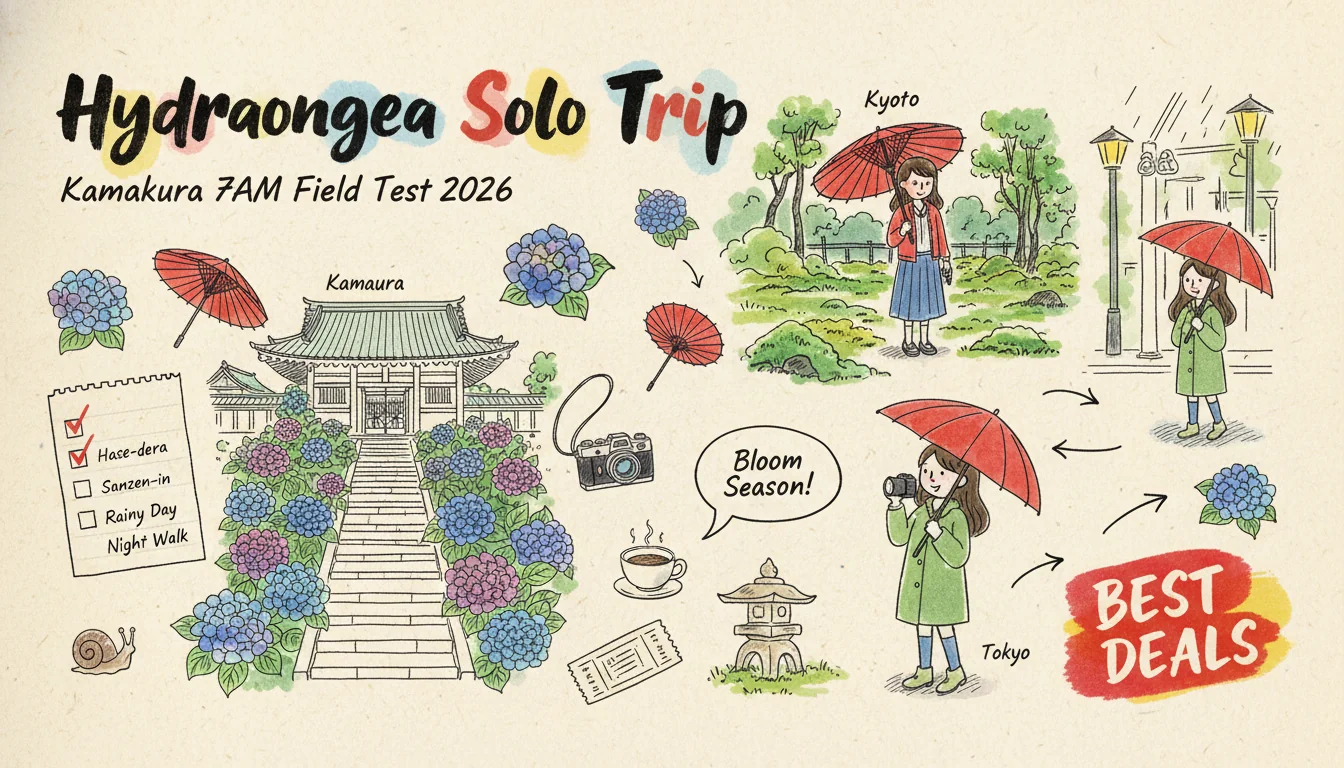
"Ohitorisama? Someone's already in line at 6:50." The 7-Eleven clerk in front of Kamakura Station glanced at the Hase-dera map I was holding. She slid a paper sleeve onto my coffee cup. "About an 8-minute walk from here. Take it slow." She didn't look up. The change pushed back across the counter.
That coffee cost NT$48 (~US$1.5). I followed Yuigahama-dōri toward the temple. Sea breeze still mixed with the leftover damp of night. The sky hadn't fully opened yet.
This was day three of my 9-day, 8-night solo female trip. I had already cleared Kamakura Hase-dera, Kyoto Ohara Sanzen-in, and Tokyo Hakusan Shrine.
I followed the alley.
One sentence kept looping in my head.
The route bloggers describe and the route I actually walked are very different things.
This post records on-site time windows, queue conditions, back-alley alternates, night-walk safety, and rainy-day fallbacks. If you're like me — flying solo in June for hydrangeas, worried about walking into peak-season chaos — this is for you. To see every Japan hydrangea-season ticket discount currently live, check the 1stCoupon Klook deals page first to compare prices. Then come back for the route.
The real situation for solo female hydrangea travel: read this table first
Conclusion up front. This table is my "is it worth the queue" rating, built only after I walked it. I shot at least 5 photos at every spot, stayed 60+ minutes, and had at least one real conversation with a clerk, miko, or auntie on the street.
| Location | Entry fee | Best window | Queue (peak weekend) | Solo awkwardness | Photo ROI |
|---|---|---|---|---|---|
| Kamakura Hase-dera | JPY 400 + Ajisai Path JPY 500 | Line up 30 min before 8:00 open | Peak midday: 1-3 hr for numbered ticket | Low (lots of solo visitors) | Mid (crowded but flower density is high) |
| Kyoto Sanzen-in | JPY 700 (+JPY 500 during festival) | Right at 9:00 open | Weekdays almost no queue | Low (garden-style, open sightlines) | High (rare star hydrangea here) |
| Tokyo Hakusan Shrine | Free | Weekday 7:00 / festival closing day 16:30 | Festival weekends 30-60 min | Mid (small grounds, easy to be noticed) | Mid-high (Fujizuka mound rarely opens) |
| Kamakura Myohonji (alt) | Free | All day | None | Very low (almost empty) | Mid (small volume but quiet) |
| Kamakura Jomyoji (alt) | JPY 100 | 9:00-15:00 | None | Low | Mid (garden-style) |
| Kyoto Jakkoin (alt) | JPY 600 | 9:00-12:00 | None | Very low | Mid (small volume but right atmosphere) |
My takeaway after reading my own table: "the must-shoot list bloggers push" and "what's actually worth queuing for as a solo female" are two completely different standards. Hase-dera does have dense flowers. But after 11:00 the crowd squeezes you so tight you can't even stop. Myohonji, Jomyoji, and Jakkoin are the three I added to my back-alley alternate list. They have less than half the flower volume. But the photos turn out exactly right.
If you're new to Japan rail, KKday Japan rail 5% off covers the gaps. The smaller segments Klook misses (Enoden one-day pass, Tokyu Toyoko Line) usually sell as single tickets on KKday.
Kamakura Hase-dera: is 7AM actually crowded? (My 2026 field test)
Headline answer first.
7AM is not crowded. The 8AM open is the cutoff line.
That day was a Tuesday. Not a weekend. I arrived at the gate at 6:50 — 12 people in front of me. Eight Japanese photo crews, two Japanese solo female travelers, one couple, and one Taiwanese (I guessed from the accent).
8:00 sharp. The gate opened.
The 12 of us filed in. I kept pace. From the entrance to the Ajisai Path numbered-ticket counter took just 4 minutes. My slip said 8:15-8:30 entry.
Straight in.
But.
By 8:30, when I walked from the Ajisai Path back to the Kannon-do observation deck, the line outside the gate had already stretched to the corner of Yuigahama-dōri — about 200 meters. A miko came over collecting paper cups. She told me: "Today's morning numbered tickets ran out at 8:20. Anyone in line now is on the afternoon batch." Per the Hase-dera official notice, the Ajisai Path costs JPY 500 separately. On peak-season weekends, numbered tickets often run out before 10AM.
My Hase-dera solo female time table
- 6:30 leave Kamakura Station — the Enoden hasn't started yet (first train 6:51), so walking is faster. About 12 minutes from the station to Hase-dera
- 6:45-7:00 line up at the gate — on weekdays this stretch is mostly photographers, very quiet. I finished my breakfast bread here
- 8:00-8:30 enter the Ajisai Path — the full path takes about 25 minutes including photo stops
- 8:30-9:30 Great Buddha + surroundings — after 8:30 the crowd explodes, but the main Hase-dera buildings are still shootable
- 9:45 leave — after 9:45 the station and the alleys are jammed with people. Even cafés have a wait
Golden-hour rule of thumb: on a clear day, golden hour runs 6:30-7:30 — light slants in and the hydrangeas hit peak color saturation. On a rainy day, the hour before sunset wins, when wet reflections deepen the purple.
My day, 8:10 — sudden rain. The Japanese photographers all opened umbrellas and kept shooting. I, the umbrella-less solo, was the most pathetic person in the group.
So the first piece of advice I'd give a solo female: in June, for hydrangea, the umbrella matters more than the camera.
By the way. If you want to extend the Kamakura day to Enoshima in one go, Klook JR Pass Tokyo Wide covers the Kamakura route. The JR Yokosuka Line goes from Tokyo Station direct in 56 minutes. JPY 15,000 over 3 days works out to about NT$1,050 (~US$32) per day. I used this pass — Tokyo, Shinjuku, Kamakura, Nikko, Izu, all on one ticket. Saved me the cost of buying 4 separate segments.
Kyoto Sanzen-in: garden-style hydrangea, the best spot for a solo female photo
Sanzen-in is in Ohara. From central Kyoto it's a 65-minute ride on bus 17. This is the longest leg of the trip. It's also my top recommendation.
The reason is simple. A garden-style hydrangea grove gives you open sightlines. Standing alone in the Ajisai-en, no one walks behind you. No one squeezes into your frame. I arrived 9:30 on a Wednesday. The whole garden, including me, had 12 people in it.
Sanzen-in golden-window table
- 8:30 leave Kyoto Station — Kyoto City Bus 17 (JPY 230 one-way, ICOCA accepted), 70 minutes to Ohara bus stop
- 9:00 Sanzen-in opens — Official hours March-October are 9:00-17:00
- 9:30-11:00 Ajisai-en + main garden — peak-season admission JPY 700 + JPY 500 festival surcharge (JPY 1,200 total)
- 11:30 move to Jakkoin — 25-minute walk, the biggest back-alley win of this trip. More on it below
Per the Ohara Tourism Preservation Society, the 2025 Sanzen-in Ajisai Festival ran June 7 to July 6. 2026 falls in the same week.
Sanzen-in's rarest flower is the Hoshi-ajisai (seven-tier flower). It blooms mid-June and lasts to month-end. The center of each leaf forms a small star-shaped flower. Most special. Bloggers rarely write about it.
Solo female transport from central Kyoto to Ohara — field test
I researched this leg the longest. There's no subway from central Kyoto to Ohara. Bus is the only option. To reach Sanzen-in, my recommendation is to buy a Klook Keihan one/two-day pass, ride to Demachiyanagi, then transfer to Kyoto Bus 17. Even simpler: tap a Kansai ICOCA card — Kyoto Bus 17 accepts it the whole way. I went directly from Kyoto Station, 70 minutes with a seat, much more comfortable than I expected.
If you want to book a kaiseki spot or a popular ramen joint in Kyoto, KKday Japan Foodie Pass lets you reserve online. As a solo female you can also walk in. Zero language hassle.
Tokyo Hakusan Shrine: festival is busy, but the Fujizuka mound only opens this one week
Hakusan Shrine is by Hakusan Station in Bunkyo, Tokyo. What I'm really writing about here is the "Bunkyo Ajisai Matsuri" festival — not the everyday Hakusan Shrine.
Why this festival earns a slot on a solo female itinerary
On a normal day Hakusan Shrine is unremarkable — a small shrine in a residential block. But every year during the second week of June, for the Bunkyo Ajisai Matsuri, 3,000 hydrangea plants dye the whole grounds blue-purple. The Fujizuka miniature mound inside the shrine only opens to the public for these 9 days. No photos allowed on the Fujizuka — I confirmed this with the on-duty miko. So you can barely find pictures of it online.
Per the Bunkyo Tourism Association, the 2025 dates were June 7-15. By convention 2026 falls in the same week. Free entry.
Hakusan Shrine solo female time-window read
- Weekday 7:00 — grounds open, hydrangeas shootable, but the Fujizuka isn't open yet
- Weekday 10:00-15:00 — moderate tourist traffic, food stalls open, the atmosphere lively
- Weekend 10:00-16:00 — the entire Hakusan-shita shopping street is packed. The line forms right at exit A3 of Toei Mita Line Hakusan Station
- Festival closing day after 16:30 — this is when I went. Stalls start packing up, but the Fujizuka is still climbable, and the slanted afternoon light makes hydrangea photos look their best
Solo awkwardness rating. The Hakusan Shrine grounds are tiny. A full loop takes 15 minutes. When you stop alone to take a photo, the person behind you can see your phone screen.
That day I asked another Japanese woman — also there alone — to take a photo for me. She took 8 shots, gestured for me to change pose, then handed back the phone with one she'd picked: "This one's for Instagram."
The caffeine that day didn't give me half the courage those 3 minutes did.
If you're heading directly from the airport to Bunkyo for the festival closing day, Klook Limousine Bus has an "Ikebukuro/Tokyo Station" line that drops you near the area. No dragging luggage through a Shinjuku transfer.
Skipping the must-shoot blogger list: 3 back-alley alternate routes
This section is the most important part of this post. You've already read 30 Kamakura hydrangea articles, and you've noticed everyone writes the same four spots: Meigetsu-in, Hase-dera, Gokuraku-ji, Goryo Shrine. The problem is — those 4 spots are jammed solid every weekend in mid-June. You burn 3 hours queuing for a 5-minute shot.
Three spots. I walked all of them myself. Stayed 30+ minutes at each.
Route 1: Kamakura Myohonji (free / zero queue / quiet like crossing into a sealed barrier)
A 12-minute walk from Kamakura Station east exit, into Omachi shopping street and then a left. In front of Myohonji's Soshido Hall is a hydrangea grove. The volume is small but the variety is full — gaku-ajisai, yama-ajisai, even the rare tama-ajisai.
That Tuesday, 11:00 in the morning. Including me, 4 people in the temple. Nothing on the grounds. No clerk, no guide, no numbered tickets. You just walk in, sit down, look at the flowers, listen to cicadas.
Search "Kamakura hidden hydrangea spots" and Myohonji barely makes the top 3.
But this was the spot I was most reluctant to leave on the entire trip.
Route 2: Kamakura Jomyoji (JPY 100 / zero queue / garden-style, no crowd)
From Kamakura Station take the Keikyu bus to "Jomyoji" stop, 7 minutes JPY 200. Jomyoji is farther from the station, and the tourist count is less than 1/20th of Hase-dera. Entry is just JPY 100 — the cheapest entry I paid all trip. Garden-style hydrangeas pair with the 13th-century tea house Kisen-an, where you can buy a matcha + wagashi set for JPY 1,300 and sit by the window alone to finish it.
When I finished the matcha, an obāsan with an umbrella at the next table suddenly turned and asked: "Taiwanese?" I said yes. She told me her son had worked in Taipei for 5 years. She'd come specifically to see the hydrangeas today, and would call him that evening: "She'll show me the photos."
That cup of matcha cost NT$280 (~US$8.7).
Pricey but worth it.
To book a similar tea-room seat, KKday Japan Foodie Pass covers some of the older Kamakura spots. Way less stress than gesturing through a language barrier.
Route 3: Kyoto Jakkoin (JPY 600 / zero queue / quietest hydrangea spot in all of Kyoto)
A 25-minute walk from Sanzen-in. Another thousand-year temple in Ohara. Per Kyoto travel info, the Jakkoin main hall was burned down by arson in 2000 and rebuilt — so the building looks new. The garden hydrangeas sit right at the entrance, and the full loop only takes 20 minutes.
That Wednesday, 14:30. Inside the temple, just me as a tourist, plus a sweeping nun. She watched me writing in my notebook and asked if I was a blogger. I nodded. She said: "Don't write about June too much. If you write, everyone comes."
I laughed.
I still wrote this post. But I tucked it into the back-alley alternate list — I hope you, reader, walking into this paragraph, will also treasure the quiet.
Rainy-day fallback: hydrangeas are best in the rain, but rain is also the dilemma
Japan's tsuyu (rainy season) typically begins around June 8. If you book 5 days in this window, your rain probability is over 65%. I had 4 rainy days out of 9. But the rain is when hydrangeas look their best.
Adjustments I make on rainy days
| Original plan | Rainy-day swap |
|---|---|
| Hase-dera at 7AM | Switch to 16:00 (softer light, fewer people, more vivid hydrangeas) |
| Sanzen-in all day | Compress to 9:00-11:00 (Ohara mountain stone steps get slick after rain) |
| Hakusan Shrine festival | Move indoors: Edo-Tokyo Museum or Bunkyo Civic Center observation deck |
| Outdoor café walk | Indoor cafés: Kamakura Komachi-dōri "John Kanaya" or Kyoto Pontocho "FRANÇOIS" |
If the rain is too heavy to leave at all. Klook Mt. Fuji classic day tour from Tokyo is the "rainy-day plan B" I prepped for this trip. The coach has air conditioning the whole way, lunch is included, no rain-soaked transfers. Downside: you don't see the summit. But you can shoot hydrangeas around the 5th station.
Rainy-day hydrangea photo tips
- Water drops are the most important element: on clear days hydrangea color looks washed out, rain reflections boost the blue-purple about 30%
- Light read: rainy-day golden hour is the 60 minutes before sunset. The hydrangeas literally glow then
- Phone protection: I use a sealed plastic bag and cut a lens hole into it — saves NT$50 (~US$1.5) over a real waterproof case
- White balance tweak: dial color temperature to about 5,500K and the purple cleans up
Entry fee vs photo ROI: where to queue, where to skip
This table took me a full week to put together. The "worth queuing for" standard isn't how pretty the flowers are. It's whether you'll feel that 1 hour was well spent when you walk out.
| Location | Entry fee | Expected queue | Photo ROI score | My solo verdict |
|---|---|---|---|---|
| Kamakura Meigetsu-in | JPY 500 | Peak day 1-2 hr | 6/10 | Not for solo: crowd kills the atmosphere |
| Kamakura Hase-dera | JPY 900 (incl. Ajisai Path) | Peak day 1-3 hr | 7/10 | Recommend, but only at 7AM |
| Kamakura Myohonji | 0 | 0 | 8/10 | Strong recommend |
| Kamakura Jomyoji | JPY 100 | 0 | 8/10 | Strong recommend (with tea room) |
| Kyoto Sanzen-in | JPY 1,200 (festival) | Almost none on weekdays | 9/10 | Strong recommend |
| Kyoto Jakkoin | JPY 600 | 0 | 8/10 | Strong recommend |
| Tokyo Hakusan Shrine | 0 | Festival weekend 30-60 min | 7/10 | Recommend on festival closing afternoon |
After running it all, my takeaway is: a solo female has limited time in hydrangea season, and 6 spots over 9 days is plenty. If I were doing it again, I'd cut Kamakura Meigetsu-in, add Kamakura Myohonji, and promote Kyoto Jakkoin from "if I have time" to "main recommend."
If you need to compare Keihan vs Kintetsu vs JR price combinations further. Head to the 1stCoupon Klook page and see them all in one place.
Night-walk safety: how to get from station to hotel after 9PM
This is the most important section of this post, and the one bloggers rarely cover. The walk from a sunset photo spot back to your hotel — alone, in a foreign city — is when your judgment is tested most.
Kamakura night walk (Kamakura Station → Yuigahama hotel area)
- After 9:00: Enoden runs about every 12-15 minutes. Station staff on the platform. Safe.
- After 9:30: the 7-Eleven at Kamakura Station east exit is open 24/7. I always go in first to buy water and confirm the map.
- Route read: Yuigahama-dōri has streetlights but few pedestrians. Walking along the rail-side is safer than cutting through alleys.
- My small trick: keep Google Maps open while walking. You'll look like a local who knows the way, not a "lost tourist."
Kyoto night walk (Gion → Kawaramachi hotel area)
- After 10:00: the lights on Hanami-koji in Gion go out. Detour via Shijo-dōri.
- Taxi cost: Kyoto taxi base fare JPY 500. Gion to Kyoto Station JPY 1,500-2,000.
- Solo female rule: about 90% of Kyoto taxi drivers are male, but the cars have surveillance cameras and visible driver ID. Safer than I expected. I rode 3 times this trip with zero issues.
Tokyo night walk (Hakusan Station → Ikebukuro / Ueno hotel area)
- Hakusan Station last train 0:30 — this is the line inside the Yamanote loop I worry about least
- Transfer call: Hakusan → Mita Line → Otemachi → Yamanote. If you stay in Ikebukuro, switch to a taxi (JPY 2,500), 20 minutes
- Solo reminder: avoid transferring at Sugamo or Kita-senju after 9PM. Both stations get sparse at night.
My overall advice: don't force yourself through a dark alley to save train fare. I paid JPY 2,000 from Gion back to Kyoto Station once this trip. Felt expensive in the moment. Looking back, NT$420 (~US$13) for 25 minutes of safety was the smartest spend of the trip.
For redeye arrivals — airlines love to slot female tickets into the small hours. Klook Limousine Bus is what I buy every time. Direct from Narita or Haneda to the hotel. No transfers. Worth it for a solo female. The 2% off only saves NT$28 (~US$0.9). But the time and mental energy are real.
Solo-entry, solo-photo awkwardness: my 9-day log
This section is for the "thinking about flying solo to Japan for the first time" version of you. I logged every "ohitorisama?" reaction I got over 9 days.
- Hase-dera gate miko: handed the ticket, didn't ask, didn't look
- Myohonji monk: didn't notice me at all (the grounds were so quiet, he probably thought I was a neighbor)
- Sanzen-in ticket auntie: asked "ohitorisama?" then handed me an English guide map
- Jakkoin nun: chatted 5 minutes, asked where I was from and where I was heading next
- Hakusan Shrine miko: locals are completely used to "solo women at festivals." Didn't even glance
- Kamakura Komachi-dōri café: "ohitorisama" — the staff brightened the lamp over the middle of the bar. The warmest moment of the trip
- Kyoto Gion kaiseki restaurant: turned me away, reason "no solo diners." The only refusal of the trip
- Tokyo Yanaka Ginza soba shop: seats packed but the staff added a small stool so I could put my bag down
My takeaway: Japan's tolerance for solo female dining and photo-taking is extremely high. 9 reactions, 1 rejection. You really don't need to skip anything because you're "afraid of being seen alone." A lot of staff actively help — they brighten lamps, add chairs, recommend menu items. Walk this alley, and you'll find Japan is genuinely gentle to solo female travelers.
To pre-book hard-to-reserve spots. KKday Japan Foodie Pass puts 90% of the popular shops online. What solo female travelers fear most is rejection. Booking ahead solves 80% of the awkwardness.
FAQ
Q1: Which week is best for hydrangea season in Japan in June?
A: Week 2 to week 3 of June (June 8-22) is peak bloom. Kamakura Hase-dera and the Tokyo Hakusan Shrine festival both fall in this stretch. Kyoto Sanzen-in is about 1 week later (mid-to-late June). If you can only pick one week, my pick is June 14-21 — 8 days, peak bloom, festival overlap. Rain probability about 60%, but not 100%. For official bloom data check the JR East 2026 Kanto hydrangea page.
Q2: Can I solo-travel Japan with weak English?
A: Absolutely yes. All major Japanese tourist sites have English / Chinese signage. Convenience-store staff use Google Translate. Taxis have GPS.
In 9 days I used fewer than 20 Japanese phrases. Rest was English plus gestures.
Screenshot your hotel address before you go. Drivers read screenshots 10x faster than they parse spoken addresses.
Q3: What do I wear for hydrangea season?
A: June Japan runs 22-28°C, dropping to 18°C after rain. My pack: a thin long-sleeve, one waterproof jacket, one light-color dress (for the hydrangea backdrop), waterproof sneakers.
Don't wear sandals. Stone steps get slick after rain.
Light-color clothes look best in front of hydrangeas. White, beige, light pink, light blue all work. Dark colors get swallowed by the flowers.
Q4: How do I take photos of myself when I'm alone?
A: Three methods. 1) Selfie stick — easiest but the vibe is off. 2) Phone timer + tripod — gets you "doesn't look like a selfie" shots. A tripod for NT$300 (~US$9.3) is enough. 3) Ask a Japanese auntie. Japanese aunties are usually very willing. Their composition is unexpectedly good. Over 9 days I got 8 shots from Japanese aunties. Every one beat my own selfies.
Q5: What's the rough budget for hydrangea season?
A: 9 days 8 nights including flights, lodging, transport, food, entry fees — my total was NT$48,500 (~US$1,500).
- Flight NT$11,000 (~US$340) (China Airlines direct round-trip Tokyo)
- Lodging NT$22,000 (~US$681) (1 night Kamakura boutique NT$5,500, 4 nights Kyoto business hotel NT$8,000, 3 nights Tokyo capsule NT$3,500, 1 night airport hotel NT$5,000)
- Transport NT$6,500 (~US$201) (JR Pass + Keihan one-day pass + ICOCA reload + Limousine Bus + taxi)
- Food NT$5,500 (~US$170) (NT$610/day average)
- Entry fees + miscellaneous NT$3,500 (~US$108)
References
- Kamakura Hase-dera official June Ajisai Path notice
- Bunkyo Tourism Association: Bunkyo Ajisai Matsuri
- Ohara Tourism Preservation Society: Sanzen-in Ajisai Festival
- Tendai Sect Kyoto Ohara Sanzen-in official site
- Miura Hanto: 2025 Kamakura hydrangea hidden spots top 15
- Kyoto Travels: Jakkoin access info
- JR East: 2026 Kanto hydrangea bloom forecast
All Deals
From Tokyo: Tokyo / Yokohama / Kamakura Private Charter Day Tour (with Driver)
Tokyo
No Code Required[Kamakura & Yokohama | Free Train Experience] Enoshima & Kamakura Kokomae & Tsurugaoka Hachimangu & Yokohama Night View Day Tour (from Tokyo)
Kamakura
No Code Required【Kamakura|Train Experience】Great Buddha of Kamakura & Kamakura Train Experience & Kamakura High School & Enoshima & Tsurugaoka Hachimangu & Komachi Street Tokyo Kamakura Day Tour (Departing from Tokyo
Kamakura
No Code RequiredKamakura & Enoshima Day Tour from Tokyo: Tsurugaoka Hachimangu, Hasedera, Great Buddha of Kamakura & Mount Fuji Views
Kamakura
No Code RequiredKamakura | Great Buddha of Kamakura & Tsurugaoka Hachimangu & Enoshima Benzaiten Nakamise Street & Kamakura High School Day Tour | Departing from Tokyo
Kamakura
No Code RequiredFireworks Limited | Atami Kamakura / Atami Hakone Fireworks Festival Day Tour | from Tokyo
Atami
No Code RequiredMt. Fuji, Hakone & Kamakura Day Tour | Hakone Pirate Ship, Ropeway, Lake Ashi, Owakudani & Kamakura Enoshima Day Tour | From Tokyo
Hakone
No Code Required[Mt. Fuji, Hakone, Kamakura & Enoshima Day Tour] Pirate Ship on Lake Ashi, Ropeway Views of Mt. Fuji & Owakudani, Enoshima Scenery & Food (From Tokyo/Shinjuku)
Hakone
No Code RequiredAtami Fireworks Day Tour: Optional Hakone, Mt. Omuro & Kamakura Route (Optional Hotel Pickup)
Kamakura
No Code RequiredOptional Fireworks Cruise: Tokyo Atami Sea Fireworks Festival Day Tour - Kamakura/Enoshima or Hakone Lake Ashi Route Available (From Tokyo, Chinese/English Service)
Hakone
No Code RequiredYokohama Minato Mirai Osanbashi Pier, Cosmo Clock 21 Ferris Wheel & Cable Car, Enoshima, Kamakura High School & Tsurugaoka Hachimangu Shrine Day Tour (From Tokyo)
Yokohama
No Code RequiredAtami Fireworks Festival Day Tour: Hakone Boat Cruise / Mt. Omuro Ropeway / Kamakura Enoden (Multiple Routes, From Tokyo)
Atami
No Code RequiredKamakura Day Tour | Great Buddha of Kamakura, Enoden (Train Ticket Included), Kamakura Kokomae Shonan Sea View, Enoshima Walk, Tsurugaoka Hachimangu (from Tokyo)
Kamakura
No Code Required[Atami Fireworks Limited] Shizuoka Izu Atami Fireworks Festival & Izu Omuroyama with Cable Car & Kamakura Kokomae Day Tour | from Tokyo
Atami
No Code RequiredFrom Tokyo: Enoden Ride Through Kamakura, Enoshima & Yokohama Day Tour
Kamakura
No Code Required
Nana
Solo Female Travel EditorSolo travel + women's-route editor. Has flown alone to 12 cities — writes 'safe routes', 'photo vibes', and 'one cup of coffee price points' into every guide. Loves alley cafes, design hotels, golden-hour street corners, and women-friendly spots.
You May Also Like
Moraine Lake Has No Car Access: 2026 Banff Shuttle Timings
Moraine Lake Road is closed to private cars all year. Shuttle seats drop in two waves, entry is free only through Sept 7, and I ran the ticket maths for going solo.
BIGBANG Seoul 2026: A Solo Female Fan's Goyang Trip Guide
BIGBANG's 20th anniversary tour opens in August at Goyang, outside Seoul. Not a ticket-buying post: how I flew in alone as a woman and made three days work, from flight timing and a safe place to sleep to eSIM picks and getting out when 40,000 people hail at once.
Sagrada Familia Topped Out After 144 Years: Your 2026 Guide Rewrite
The Sagrada Familia's central tower topped out in 2026 at 172.5m, the world's tallest church, with the Pope marking Gaudi's centenary inside. Nana breaks down the new €33.80 ticket prices, Nativity vs Passion tower picks, stained-glass light hours, and how to book solo around the pilgrim crowds.