Japan Summer Festivals Solo: Yukata, Yatai & Bon Odori Guide 2026
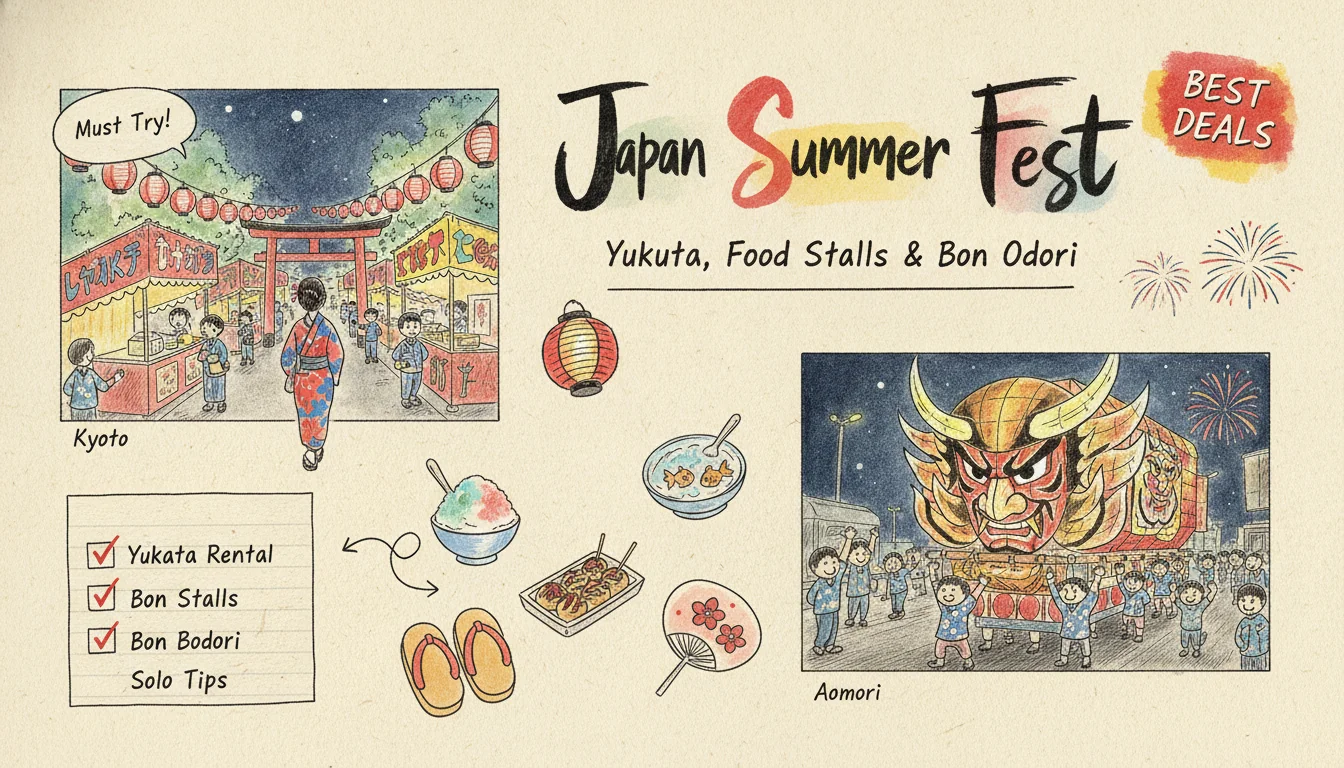
It was past 7pm, and I was standing alone at the mouth of a narrow lane on Kyoto's Shijo Street. High schoolers in yukata drifted toward Yasaka Shrine in little clusters, and the clack of their wooden geta on the stone path drowned out my own footsteps. That night I didn't buy a paid fireworks seat. I just let the crowd carry me along, slowly.
In Japan, fireworks are only one square of the summer.
Most guides turn the summer festival into a "fireworks schedule." Fireworks are gorgeous, sure. But fighting for a paid seat, camping out for 3 hours, getting packed in so tight you can't move? Going alone, that kind of scene honestly wears you out. What actually pulls me back every single summer is everything around the fireworks: the yukata, the Bon Odori, a whole street of food stalls. That's what this is about.
A Yukata Isn't a Photo Prop: What a Rental Really Costs and How to Pick One
Money first. This is the piece everyone wants to know and almost nobody writes down clearly.
The price range is wide. Based on the 2026 public rates from several kimono shops in Kyoto and Asakusa: a set in central Kyoto with dressing service (someone helps you put it on) runs about ¥5,500. Asakusa is a notch cheaper, around ¥4,000, with the absolute lowest hovering near ¥2,980. The gap comes down to location, how new the styles are, and whether hair styling is included. The time I went, I added an updo for ¥1,100 in Kyoto, which pushed the whole thing close to ¥6,600.
Worth it? Depends on how many photos you take.
There are 3 things about picking a shop that I only understood after getting it wrong. First, choose a plan with "same-day return up to evening." Summer festivals only come alive after dark, so returning the outfit by 5pm means you basically wore it for nothing. Second, test-walk the geta. Stone paths plus brand-new wooden sandals shred your feet, and that one time I had to stick 3 bandages on my heels just to make it through the night. Third, prioritize shops with free luggage storage so you're not dragging a suitcase around a festival. Don't skimp on any of these 3.
I'll be honest, the yukata has downsides too. Wrapped in a full set in summer, you're hot and you walk half a step slower, so anyone with a sensitive stomach or a train to catch that day really shouldn't wear it from morning to night. The rental cost has a catch as well: prices jump in peak season, and if you book only a week before a holiday weekend, you're usually left with the pricier styles. But if you avoid high noon, set your return time for early evening, and reserve a week ahead, you can dodge all of it. One more thing to watch: kimono shops are most crowded around midday, so if you want a clean background for photos, take the early slot.
To lock in the price, you can start with Klook's Kyoto kimono and yukata rental at 16% off, which bundles dressing service plus accessories into one price so nothing gets tacked on item by item at the counter. If you're heading to Okinawa in summer, there's also Klook's Okinawa yukata and kimono rental from 7% off, where the tropical floral patterns are a whole category of their own.
A yukata isn't a prop, it's a ticket.
The moment you put it on, you go from tourist to part of the festival. Even the way the staff look at you changes.
Beyond Fireworks: Bon Odori, Nebuta, Awa Odori, and Which One Suits a Solo Trip
Japan's three great festivals usually mean Kyoto's Gion Matsuri, Osaka's Tenjin Matsuri, plus Tokyo's Kanda Matsuri. But for someone traveling solo, "big" doesn't equal "right." The bigger the scene, the harder it is to fold yourself into it alone.
Let me lay a few of the main ones side by side:
| Festival | Location | Rough timing | What it feels like solo |
|---|---|---|---|
| Gion Matsuri | Kyoto | All of July | Massive crowds for the float parade; the yoiyama nights are best for strolling the stalls |
| Tenjin Matsuri | Osaka | Around July 25 | Fire-and-water festival, boat procession plus fireworks, the biggest sense of spectacle |
| Aomori Nebuta | Aomori | Aug 2 to 7 | Giant lantern parade; you can sign up to jump into the dancing line |
| Tokushima Awa Odori | Tokushima | Obon, August | The whole city dances, the wildest energy and the strongest feeling of taking part |
| Akita Kanto | Akita | Early August | Jaw-dropping pole-balancing skill; this Tohoku event is relatively easy to find a spot at |
Kyoto's Gion Matsuri has over 1,100 years of history and the biggest name. But July is also when it's most packed. The one I love most is actually a Tohoku event. The way those giant Nebuta lanterns at Aomori roll toward you in the dark, with the drums hitting you square in the chest, and the obasan next to me just grabbing me to shout "Rassera!" together.
That moment of being treated as one of them is something a fireworks show can't give you.
August is Obon season, and shrines and shopping streets big and small across Japan hold Bon Odori. These small gatherings are my favorite fit for solo travel. No ticket, no jockeying for position. You just join a circle and go around, and nobody cares if you mess up a step. Tohoku is awkward to reach by transit, so if you want to keep it simple you can use KKday's Akita local activities at 25% off (EXP25) to bundle transport and experience into one booking.
One reminder: the dates in the table above are the customary windows, and they shift slightly each year. Always double-check the official site before you go. Don't just copy them.
A Yatai Food Map: Stall-by-Stall Prices
The soul of a summer festival is the yatai. That little food street under the lanterns is the real heart of the whole thing.
Get a baseline first, so the atmosphere doesn't sweep you away. Here's what I jotted down for the common ones: a box of takoyaki runs about ¥600, yakisoba ¥500, a grilled chicken skewer from ¥150, shaved ice ¥400, a candy apple ¥500, and ramune soda ¥300. On a solo lap, just over ¥2,000 gets you all the way from savory to sweet.
My order is always the same: salty before sweet, hot before cold. The minute I arrive I grab yakisoba or takoyaki to line my stomach and eat on the move. Mid-lap I'll have a grilled chicken skewer with a ramune. I save a shaved ice for last, eating it while I people-watch. I buy a candy apple every time, and it's less about taste and more that holding that little red orb in your hand photographs just right.
If the stalls aren't enough and you want to slot in a proper local food experience, flip through KKday's Japan products at 6% off every Thursday (JPDAY) to stitch a meal plan onto the same day as the festival.
There was a guy grilling corn who watched me shoot photos alone for a while, then slipped me an extra cob and said, "Even on your own, you should eat well."
Don't fill up at the first stall.
Walk the whole street, then circle back for the one you wanted most. That's the lesson it took me three food-stall streets to learn.
Doing a Summer Festival Solo: Routes, Night Roads, and Crowds
The two most real concerns when you're alone: how not to get separated, and how to get back to the hotel safely.
Crowds peak in that 1 hour right before and after fireworks go off. I avoid that window. I arrive 1 hour early, or I slip out about 10 minutes before a finale. Your walk back to the hotel is the make-or-break part. When a big festival ends, a station floods with tens of thousands of people in an instant, and there's no way you're squeezing onto a last train. Real talk, when Tenjin Matsuri ended and I insisted on taking the train, that platform line stretched past where I could see its end. So I just walked. 25 minutes to my inn, which turned out faster than waiting.
For the night roads, I walk the "venue to hotel" route once during daytime first, noting which alleys are lit and which are too dark. I keep my phone at 30% battery. When the geta become unwalkable, I buy a pair of flip-flops at a convenience store and switch. Wearing a yukata already slows you down, so give yourself a little extra time.
Solo travel isn't about staying tense, it's about being able to wander slowly with peace of mind.
Plan your way out, and the rest of the time is yours just to soak in the atmosphere.
How to Slot a Summer Festival Into Your Itinerary: Transport and Tickets
Summer festivals mostly run from early evening into the late night. The daytime is actually empty, and a lot of people don't take advantage of that.
My approach is to hit the outskirts by day and head into town toward evening. For Kyoto, I'll push out to Amanohashidate or the Ine boat houses in daylight. Then I come back to change into a yukata and stroll the yoiyama. If you're moving between cities, Trip.com's Japan travel with JR PASS from 50% off lets you lock in long-haul tickets first, since buying on the spot is often pricier and comes with a line. Want to see every Japan ticket at once? You can also scan KKday's full Japan ticket deals page.
Book your stay early.
On festival day, hotels around the venue double in price and are nearly impossible to get. I book a slightly outer area that still has a direct train, where the price gap often runs over 30%, and I always compare options near the outer stations on Agoda Japan hotels before I commit.
Book a night earlier, pay 10% less.
Frequently Asked Questions
Q1: I don't speak Japanese. Can I do a summer festival alone? Yes. At the stalls you can point and hold up fingers for the quantity, and the festival grounds have route signs everywhere. My Japanese is terrible, and with 3 phrases plus a translation app I got through several festivals just fine. Bon Odori, where you just follow the circle, has zero language barrier at all.
Q2: Do I have to rent a yukata in Kyoto? No. Asakusa starts at ¥4,000, cheaper than Kyoto and with plenty of styles too. Rent near wherever you're spending the day at the festival. The key is choosing a plan that allows evening return, or you'll have to take it off by afternoon.
Q3: Is it awkward to walk the food stalls alone? Not at all. Japan's solo-dining culture is well established, and eating standing at a stall or while walking is completely normal. I go alone every time and have never once felt out of place. If anything, I can eat at my own pace more easily.
Q4: Are a fireworks show and a summer festival the same thing? Not exactly. A fireworks show is the "set off fireworks" event, while a summer festival is the broader traditional celebration, which can include parades, Bon Odori, and food stalls, with some adding fireworks on top. This piece is about that whole big chunk beyond the fireworks. If you specifically want fireworks seating, there's a separate article.
Q5: Can I actually join the Bon Odori dancing? Yes, and you're welcome to. Bon Odori was made for everyone to take part, so just copy the moves of the person in front of you. Nobody laughs if you get it wrong, and it's the moment with the strongest sense of belonging, the least like being a tourist.
Further Reading
- Narita Airport to Tokyo Transit Guide: Skyliner vs Airport Transfer (sort out the trip into the city before the festival)
- Are City Passes Worth It? Break-Even Math for Seoul, Busan, and Klook Pass (how to use a pass to save on daytime outskirts sights)
- 5 High-Value Chartered Day Tours for Summer: Okinawa, Hokkaido, to Europe (outskirts options if you'd rather not pack onto a train)
Sources
- Klook's Japan Festivals 2026 Summer Festival Guide (Gion Matsuri, Tenjin Matsuri and other dates)
- KKday's Japan Summer Festival Guide (nationwide summer festival dates and yatai food)
- JNTO Japan's Summer Festivals (official cultural and historical background)
- MATCHA Kyoto Kimono and Yukata Rental Comparison (2026 rental prices and plans)
- Personal notes on actual costs and routes across several solo summer-festival trips in Japan
All Deals
Tokyo Kimono, Furisode, and Yukata Rental Experience | Exquisite Hairstyling & Japanese Makeup &...
Cultural experiences • Tokyo
No Code RequiredNagoya VASARA Kimono & Yukata Rental
Nagoya
No Code RequiredKyoto Fushimi Inari|Popular Kimono Rental Experience|Kimono, Yukata, Furisode, Makeup, Outdoor Photography Service|MOCOMOCO Kimono Fushimi Inari Store
Kyoto
No Code RequiredAsakusa Kimono & Yukata Rental (Asakusa Kimono Miyabi)
Tokyo
No Code RequiredTokyo Kimono, Furisode & Yukata Rental Experience | Elegant Hairstyling & Japanese Makeup & Photography (Ookini Asakusa Kaminarimon Store)
Tokyo
No Code RequiredKimono & Yukata Rental & Photo Experience (Osaka Kimono Rei Shinsaibashi Store)
Osaka
No Code RequiredKyoto Kiyomizu-dera | Popular Kimono Rental Experience | Kimono · Yukata · Furisode · Makeup · Outdoor Photo Shoot Service | MOCOMOCO Kimono Kiyomizu-dera Store
Kyoto
No Code RequiredKyoto Kimono & Yukata Rental Experience & Japanese-Style Makeup & Photo Shoot (Ookini Kiyomizu-dera Main Store)
Kyoto
No Code RequiredTokyo Asakusa Kimono & Yukata Experience Asakusa Station Store (by Wasou Koubou Miyabi)
Tokyo
No Code RequiredFukuoka VASARA Kimono and Yukata Rental
Fukuoka
No Code RequiredKyoto Kimono & Yukata Experience (Kyoto Kimono Miyabi)
Kyoto
No Code RequiredTokyo Asakusa Kimono/Yukata Rental & Souvenir Photo
Tokyo
No Code RequiredMatsue Castle Trip with Kimono, Hakama, and Yukata Rentals in Horikawa Komachi (Complete with Hai...
Matsue Castle · 5.0 (8) · US$ · 26.45
No Code RequiredKyoto Arashiyama | Popular Kimono Rental Experience | Kimono, Yukata, Furisode, Makeup, Outdoor Photography Service | MOCOMOCO Kimono Arashiyama Main Store
Kyoto
No Code RequiredNEW OPEN Kyoto Yasaka Shrine & Gion | Popular Kimono Rental Experience | Kimono, Yukata, Furisode, Makeup & Photoshoot Service | MOCOMOCO Kimono Yasaka Shrine & Gion Store
Kyoto
No Code Required[Kyoto & Nara Day Tour] Arashiyama Romantic Train, Nara Park, Fushimi Inari Taisha Thousand Torii Gates, Togetsukyo Bridge, Bamboo Grove & Kimono Forest (from Osaka)
Kyoto
No Code RequiredKyoto World Heritage & Popular Sights Day Tour: Nijo Castle, Kinkaku-ji, Fushimi Inari Taisha Thousand Torii Gates, Arashiyama Togetsukyo Bridge, Kimono Forest & Bamboo Grove (From Osaka or Kyoto)
Kyoto
No Code RequiredKyoto Kimono Photoshoot Experience
Kyoto
No Code RequiredTokyo Asakusa Kimono & Furisode Rental Experience
Tokyo
No Code Required[Kyoto & Nara History & Scenery Day Tour] Arashiyama Sagano Train, Fushimi Inari Senbon Torii, Nara Park, Togetsukyo Bridge, Bamboo Grove & Kimono Forest (From Osaka or Kyoto)
Kyoto
No Code RequiredAuthentic Japanese Tea Ceremony & Kimono Experience in Asakusa
Tokyo
No Code RequiredNagasaki Dejima admission ticket + kimono rental plan available (Nagasaki Prefecture, Nagasaki City)
Nagasaki Shinchi Chinatown · 4.9 (10) · 75+ booked · US$
No Code RequiredKyoto Kimono Rental Experience & Japanese Makeup & Photography (Provided by Ookini Arashiyama Store)
Kyoto
No Code RequiredKyoto Kimono Rental Experience & Japanese Makeup & Photo Shoot (Ookini Fushimi Inari Store)
Kyoto
No Code RequiredAsakusa Kimono & Furisode Rental Experience (Tokyo / by Wasou Komachi Kanon)
Tokyo
No Code RequiredKyoto Kimono Rental - Traditional Kimono Experience & Japanese Makeup & Photography Service (Provided by Okimono-ya Kiyomizu Store)
Kyoto
No Code RequiredKimono Rental Experience (Kyoto / Kyoto Kimono Rei Gion Store)
Kyoto
No Code RequiredKyoto Kimono Rental Experience (Optional Deluxe Hairstyle / Japanese Makeup / Photography) (Ookini Kimono Rental Yasaka Shrine Gion Store)
Kyoto
No Code RequiredKyushu Summer Exclusive: Kanmon Strait Fireworks Festival Day Tour (Optional Japanese Yukata Experience)
Shimonoseki
No Code RequiredKimono Rental (Kyoto / Provided by Kimono Rental Kanwa Yasaka Shrine Store)
Kyoto
No Code RequiredTokyo Asakusa Kimono Memorial Photo Shoot (by HANAYAKA)
Tokyo
No Code RequiredTokyo Asakusa Kimono & Tea Ceremony Experience
Tokyo
No Code RequiredSensoji Temple Kimono Rental & Photography Experience (Tokyo Wakomori Kaminarimon Store)
Tokyo
No Code RequiredAsakusa Kimono Rental Experience (Tokyo / by Rental Kimono First)
Tokyo
No Code RequiredKyoto Kimono Rental Experience (Kyoto Kimono Rei Kiyomizu Store)
Kyoto
No Code RequiredKyoto Higashiyama Gion Kimono & Photo Shoot (by Okimono)
Kyoto
No Code Required【Osaka & Kyoto Highlights Day Tour】Katsuo-ji Prayer & Kinkaku-ji Visit & Arashiyama Togetsukyo Bridge & Kimono Forest & Bamboo Grove Path & Nonomiya Shrine (Depart from Osaka or Kyoto)
Minoo
No Code RequiredKimono Rental at okeiko Japan Miyajima | Hiroshima
Miyajima · 5.0 (4) · 25+ booked · US$
No Code Required
Nana
Solo Female Travel EditorSolo travel + women's-route editor. Has flown alone to 12 cities — writes 'safe routes', 'photo vibes', and 'one cup of coffee price points' into every guide. Loves alley cafes, design hotels, golden-hour street corners, and women-friendly spots.
You May Also Like
Moraine Lake Has No Car Access: 2026 Banff Shuttle Timings
Moraine Lake Road is closed to private cars all year. Shuttle seats drop in two waves, entry is free only through Sept 7, and I ran the ticket maths for going solo.
Sagrada Familia Topped Out After 144 Years: Your 2026 Guide Rewrite
The Sagrada Familia's central tower topped out in 2026 at 172.5m, the world's tallest church, with the Pope marking Gaudi's centenary inside. Nana breaks down the new €33.80 ticket prices, Nativity vs Passion tower picks, stained-glass light hours, and how to book solo around the pilgrim crowds.
Tokyo DisneySea 25th 2026: Solo Night Shows + Cheapest Tickets
My solo guide to Tokyo DisneySea's 25th 'Sparkling Jubilee': four Jubilee Blue night show times, how to grab a harbor spot alone, and where tickets cost least.