How Cool Is Hokkaido in Summer? My Solo 5-Day Lavender Escape (2026)
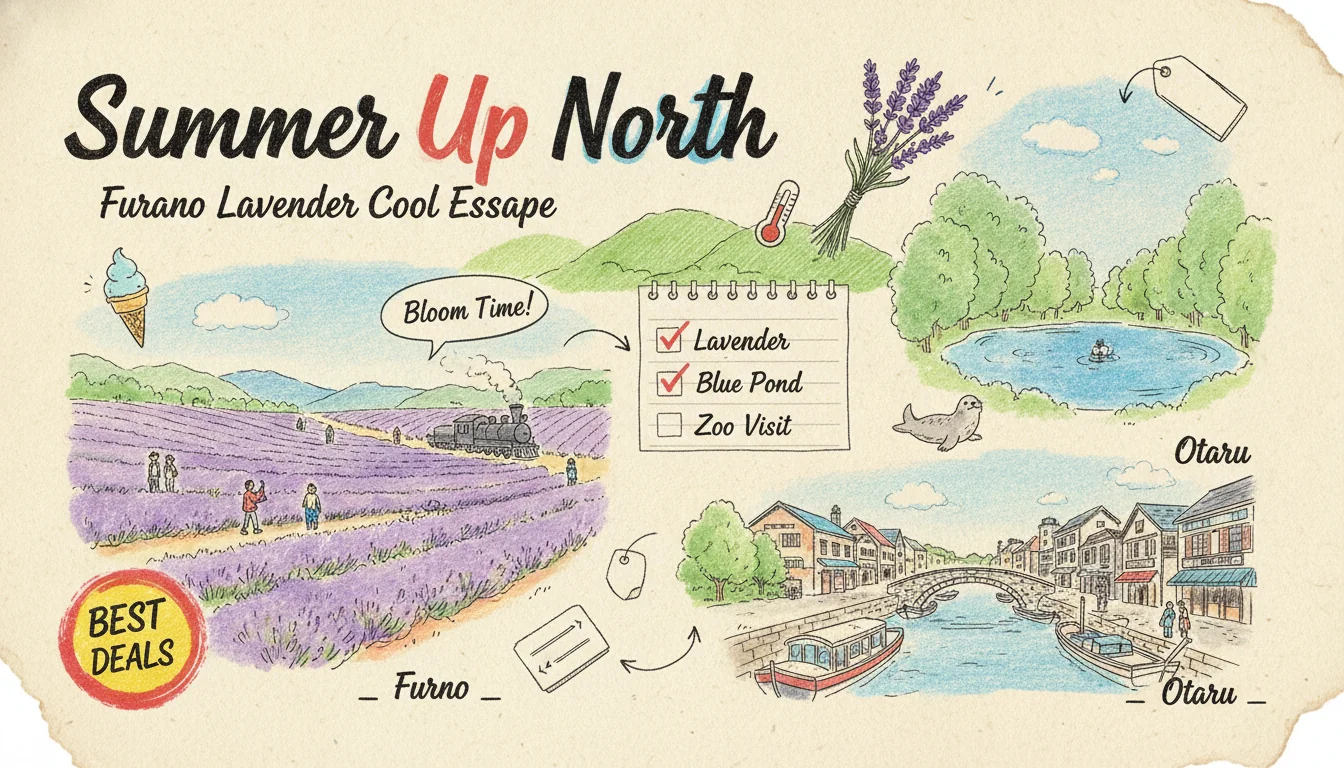
At 6:30 in the morning in Nakafurano, the air was 16C. I zipped my thin jacket all the way up to my chin, and the hot latte I grabbed from a convenience store was still steaming in my hand. It was July. Yet twelve days earlier I was standing on a Taipei asphalt road at 36C, waiting for a slow traffic light with my whole back soaked through.
I flew that trip alone, five days and four nights, no group, no boyfriend to take my photos. I just wanted to go somewhere that wouldn't steam a person alive in summer. Hokkaido turned out to be exactly that answer: Furano lavender, the Biei blue pond, Asahiyama Zoo, plus one day in Otaru. What follows is not a pretty-picture guide. It is the field notebook where I logged everything: felt temperature, crowd windows, and how a woman traveling solo can move with the least effort.
First, the "felt-temperature math": why July Hokkaido was worth the flight for me
Let me start with the most practical part. From Taipei it is a direct flight of about 4 hours to New Chitose Airport, and you feel it the moment you land. Inland Hokkaido, meaning Sapporo, Asahikawa, and Furano, averages around 22 to 23C in July, with daytime highs of 23 to 25C, dropping to 15 to 17C at dawn and at night. According to Japanese weather data, that is 5 to 9C lower than Tokyo over the same period. Taipei humidity in July routinely tops 75%, while inland Hokkaido often sits around 60%, and honestly that is the part that matters.
My own felt temperature was even cooler than the numbers. Those 33C in Taipei stuck to my skin, and two steps had me sweating. Furano's 24C was bone dry. Standing in the middle of a flower field there was a breeze, and the sun reached me without leaving me breathless. The owner of my local guesthouse told me they often run the heater on July nights. I did not believe him at first, but by the second night I obediently dug my thin down jacket out of my luggage.
I put the comparison table below together myself, lining up the numbers I looked up before leaving with what I actually felt on the ground, so you can gauge how thick to pack:
| Comparison | July Taipei | July inland Hokkaido |
|---|---|---|
| Daytime high | about 34 to 36C | about 23 to 25C |
| Dawn / night | about 28 to 29C | about 15 to 17C |
| Humidity feel | muggy and sticky | dry with a breeze |
| Daily range | about 6 to 8C | about 8 to 10C |
| Sun protection | heatstroke risk | strong UV but not hot |
My one-line takeaway: Hokkaido in July is the kind of escape where the sun reaches you but the heat never makes you surrender. That is exactly why I was willing to spend roughly NT$15,000 (about US$465) on a round-trip ticket and fly 4 hours for it.
Lavender 2026, which month is most reliable? Bloom timing and "the two quietest hours"
A lot of people get stuck on "which month do I actually go." Let me line up the official information with what I saw on the ground.
The 2026 Furano lavender season overall runs from late June into early August. The early-blooming varieties start showing color at the end of June, and the late-blooming ones hold on into early August. If you want that "purple all the way to the horizon" scene, schedule your trip for July 10 to 25 for the best odds. Those 15 days are the most saturated window of the whole year. Farm Tomita's official notice says its flagship "Lavender East" field is open from June 20 to July 20 in 2026, while the areas outside that field stay open year round. I would suggest checking Farm Tomita's official "bloom report" page again the week before you go to confirm the live status, because temperature and rainfall shift the bloom timing by several days every year, and that is not something you can gamble on.
As for crowds, I learned a lesson that trip: the lavender field peaks from 10am to 3pm. The parking lot held more than 20 tour buses, and even pressing the shutter meant queuing. The two genuinely comfortable windows are before 7am and after 5pm. On my first day I reached the field at 6:30, and the whole expanse held only me and three older gentlemen with cameras. The air was 17C, dew still clinging to the flower spikes. That was my quietest 2 hours of the entire trip. The mood was just right, and the photos came out best.
How to reach and move around Furano: the Lavender Express plus the Norokko's final year
I researched the transport for a long time, because as a solo traveler who does not drive, how I move directly decides whether the itinerary flows.
The easiest way into Furano from Sapporo is the direct "Furano Lavender Express," about a 2-hour ride, running only in peak season, sparing you any transfers. If you want something more scenic, the "Furano-Biei Norokko," a slow sightseeing train, runs from June 6 to September 23, holding its speed at around 30km/h as it ambles along. It stops at the temporary "Lavender Field Station," and a 7-minute walk from there gets you to Farm Tomita. One heads-up: according to JR Hokkaido's notice from late March 2026, this Norokko, which has run for 28 years, makes its final run in 2026 and retires next year, so anyone who wants to ride it needs to seize the chance this year.
In peak season the Norokko runs about 6 services a day, meaning 3 round trips. The cars are retro-styled with window-facing seats, and one direction takes about 50 minutes. Once you arrive in Furano, do not panic about not having a car. Furano Station has a sightseeing loop bus linking the main flower-field spots, and for more flexibility you can share a chartered car. I compared most of my transport tickets for this trip first at the Klook Hokkaido JR and bus pass entry, and found the combo passes usually came in noticeably cheaper than buying singles. Loading the e-tickets before I left and just scanning a QR on site to board saved a lot of hassle for someone hauling luggage alone like me.
How to wander Farm Tomita solo: free entry, a cool route, and that lavender soft serve
Farm Tomita (ファーム富田) is free to enter, which a lot of people do not know, and I only confirmed it on site. It charges no admission and keeps the lights on through souvenirs, melon, and coffee, so you can drift in and stay a whole morning. I spent about two and a half hours there that day. The melon, soft serve, and farm-experience tickets around Furano can actually be price-checked ahead too. I like to browse the KKday Hokkaido food and experience deals once before leaving so I have a price floor in mind before deciding what to buy on the spot.
Farm Tomita has 7 themed flower fields, and my cool-weather route went like this: head straight for the "Colorful Flower Field" at the very back first, since the crowds arrive there latest. Then loop the "Forest of Fragrant Colors," a stretch with tree shade so even the strong midday sun does not scorch you. Entering before 9 and looping once in about 90 minutes is the most comfortable. When my feet got tired I sat at the farm cafe and ordered the signature lavender soft serve, ¥400 (about US$2.50) a cone, lightly floral and not too sweet. Half a freshly cut melon beside it ran ¥800 (about US$5), eaten ice cold, and that was my happiest 10 minutes of the day.
Wandering here solo is not awkward at all, because eight in ten people on site are photographers and independent visitors, and nobody gives you a second look. The cafe staffer there noticed me photographing flowers alone for a long while and quietly gestured for me to stand on the empty patch to the left, saying that angle "comes out just right." Later that really was my favorite photo of the whole trip.
The Biei patchwork road: blue pond, Seven Stars tree, and a no-car bus solution
Biei is just one stop from Furano, yet the scenery is completely different. Furano is flower fields; Biei is rolling hills, with farm plots of different colors laid out like a "patchwork road," dotted with named trees one by one.
Let me list the must-sees for you. Shirogane's "Blue Pond" is about a 20-minute drive from Biei Station, and because the water holds minerals like aluminum, sunlight turns it a dreamy cobalt blue. The "Seven Stars Tree" is a single cypress that became famous after appearing on the Seven Stars cigarette packaging in 1976. The "Parent and Child Tree" is three cypresses standing side by side, a symbol of a happy family. This patchwork road stretches about 20km, with spots scattered across the hills, 3 to 8km apart, which is not close, and that is the most headache-inducing part for a solo traveler.
My solution was the sightseeing bus. Biei has its own "Biyu Bus," running daily in summer from April to October, with a day pass at ¥1,500 (about US$10, roughly NT$420), stringing together the headline spots like the Blue Pond and Shikisai-no-oka. If the bus schedule feels too rigid, you can also take the KKday Biei private-car mini tour, which runs with just 2 people, no strangers in the group, and a dedicated car, which suited me perfectly since I wanted to sleep in without driving. The official bus tour route has actually accounted for photo lighting and can sweep the representative spots in 5 hours, far more efficient than me wandering on my own.
Half a day cooling off at Asahiyama Zoo: no penguin walk in summer, but a cooler draw
Let me be honest first about something a lot of people get wrong: the Asahiyama Zoo "penguin walk" only happens in winter, roughly the December to March snow season. Go in July and you will not see penguins parading, and I nearly got burned on this before my trip.
But summer has its own way to play. According to KKday's Asahiyama Zoo overview and official information, summer opening hours run roughly 9:30 to 17:15, with last entry at 16:00. Admission is ¥1,000 (about US$6.50) for adults, free for junior high students and younger, and given the richness of the 100-plus animal species in the park, I found it great value for money. It is about a 40-minute route bus from Asahikawa Station. Summer's signature is "Mogu Mogu Time" (もぐもぐタイム, feeding time), split into 5 or 6 slots a day, where keepers feed the animals while explaining how the penguins and seals eat, far more engaging than watching them sit idle. On top of that is Asahiyama's most famous "behavior exhibit," where a seal whooshes past your eyes through a cylindrical water tube, and the polar bear's dive is worth queuing for.
I scheduled this as a half day, getting in right at the 9:30 opening to dodge midday. I would suggest checking the day's feeding schedule beforehand and planning your route around it. I bought my ticket straight from the Klook Hokkaido theme park and zoo tickets as an e-ticket, skipping the ticket-window queue and scanning in, with no fumbling for change even traveling alone.
Otaru day trip: 35 minutes from Sapporo, the canal, Sakaimachi Street, and Sankaku Market
If you want one "no early alarm, slow stroll" rest day in your Hokkaido plan, I strongly recommend Otaru.
From Sapporo, the JR Rapid Airport gets you there direct in about 33 to 35 minutes, ¥800 (about US$5) one way, with frequent departures. That trip I picked up a local's move: enter at "Minami-Otaru Station" and exit at "Otaru Station" for the least effort, because the Sakaimachi shopping street is closer to Minami-Otaru, and once you finish browsing you walk straight toward the canal and loop right back to Otaru Station.
The Otaru canal runs 1,140 meters, lined with 63 gas lamps that look their best when they light up each evening after sunset. The Sakaimachi shopping street runs about 900 meters, with LeTAO's flagship cheesecake, Kitakaro, Rokkatei, and Kitaichi Glass lined up four in a row, so you sample your way along on foot without taking any transport. At the end I detoured to "Sankaku Market," a 3-minute walk from JR Otaru Station, and ordered a seafood rice bowl for dinner. The one with king crab legs ran about NT$700 (about US$22), the freshly cut crab sweet, a meal satisfying even for one. The whole stretch on foot is about 3 to 5 hours, not counting transport. A half-day works perfectly, leaving you half a day of energy to head back to Sapporo for the evening. If you want to sort the tickets out at the same time, KKday Hokkaido day trips and tickets often has ready-made Otaru itineraries to pick from.
Solo cool-weather outfits and night-road safety: how to survive a 15C daily swing
This is the part I feel most needs saying yet other guides write the least about. The biggest trap for a woman on a solo Hokkaido summer trip is not crime, it is the "temperature swing" and the "night roads."
First, outfits. A daytime 24C against a dawn 16C is nearly a 10C gap in a day, and inland it stretches to 15C. My formula is "short sleeves plus a packable thin jacket plus 1 scarf." The scarf blocks sun by day and keeps you warm at night. UV in Furano and Biei is very strong, with the index often spiking above 8, so wear at least SPF50 and reapply every 2 to 3 hours. But because it is not hot you forget to apply it, which is the lesson behind my sunburned neck and back that trip. Bring a good pair of walking shoes too, since both the flower fields and the hills are gravel-dirt paths.
Now safety. I found Hokkaido's public safety very reassuring, but rural station areas are nearly empty and unlit after 8pm. Summer sunsets are late, dark only around 7pm, which actually makes it easy to overdo it. My rule is to get back to the lodging area before dark, and on that night-road stretch I never skimp on the NT$30 (~US$0.9) or NT$60 (~US$1.9) taxi fare. For booking, I prioritize hotels within a 5-minute walk of the station with a 24-hour staffed lobby. When I checked into a small Furano guesthouse, the owner handed me my key plus a hand-drawn map, circling "which roads have streetlights at night." That feeling of being looked after is the detail most worth it in solo travel. Before heading back to the hotel I make a habit of buying the next morning's breakfast at a convenience store, so I am not fumbling around in the dark at dawn unable to find food.
Full 5-day, 4-night cool route summary plus how to buy tickets cheapest
Tying it all together, this is the route I actually walked and recommend most to first-timers. Plan it like this:
| Day | Main itinerary | Felt-temp focus |
|---|---|---|
| Day 1 | Arrive Sapporo, shop, adjust to the cool | 20C in the evening, grab a thin jacket first |
| Day 2 | Furano Farm Tomita (dawn slot) | 16 to 18C in the morning, best for photos |
| Day 3 | Biei patchwork road plus Blue Pond (bus) | 24C by day, strong UV |
| Day 4 | Asahikawa Asahiyama Zoo half day | Enter at 9:30 opening, dodge midday |
| Day 5 | Otaru day trip, back to Sapporo | JR 35 minutes, a slow breather |
My money-saving takeaway on tickets is simple: compare Hokkaido's transport passes, attraction tickets, and day trips across 2 or 3 platforms before deciding. Combo passes often come in 10 to 20% cheaper than buying singles on site, and e-tickets that skip the queue are the friendliest for a solo traveler. Before leaving I check the Klook bank card daily 25% off entry to see whether any of it matches my own credit card perks, since stacked it can save another 5 to 10%. One reminder: the promo periods and discounts change daily, so before you check out, read the validity dates and terms carefully and do not get burned by an expired code.
FAQ
Q1: For 2026 Furano lavender, which month is safest? The overall flower season runs late June to early August, with the most saturated full bloom landing July 10 to 25. The week before you go, check Farm Tomita's official "bloom report" again to confirm the live status, since temperature and rainfall shift the timing back and forth each year.
Q2: Can I do Furano and Biei without driving, traveling solo? Yes. Furano has a sightseeing loop bus, and Biei has the "Biyu Bus" day pass at ¥1,500. Pair those with the Furano Lavender Express and the Norokko and it all links up. For more flexibility, pick a 2-person private-car mini tour and skip sharing with strangers.
Q3: Can I see the penguin walk at Asahiyama Zoo in summer? No. The penguin walk is limited to the winter snow season, roughly December to March. The summer draws are "feeding time" (もぐもぐタイム) and the behavior exhibits of the seals and polar bears. Admission is ¥1,000 for adults, free for junior high students and younger.
Q4: Do I really need a jacket in Hokkaido in July? Yes. Inland daytime is about 24C, dropping to 15 to 17C at dawn and at night, nearly a 10C daily swing, so bring one packable thin jacket plus a scarf. Some guesthouses even run the heater at night.
Q5: How many days should I give Otaru? Half a day to a full day is enough. It is about 35 minutes by JR from Sapporo, ¥800 one way, and walking the canal plus Sakaimachi Street plus Sankaku Market takes about 3 to 5 hours, which makes it a perfect rest day in the middle of a trip.
Further reading
After coming home from this escape, I wrote up a few of the routes I walked in the same series as standalone guides, so if you want to keep planning, read them together:
- To shoot Furano right, in Hokkaido Furano lavender photo route and golden hours I marked out every camera position and its light timing.
- Also traveling solo, Okinawa summer solo female cool route is my island-version record of summer escape and solo safety details.
- Want to tack another Japan leg onto your summer, Japan summer fireworks festival booking guide covers how to grab paid viewing seats next.
Sources
- Furano Tourism Association official site "Lavender Bloom Report"
- ファーム富田 (Farm Tomita) official site
- JR Hokkaido "Furano-Biei Norokko" train overview
- Asahikawa City Asahiyama Zoo official opening period and admission
- Japan Meteorological Agency past weather data search (Hokkaido July temperatures)
- KKday Blog and travel media such as Letsgojp on Biei and Otaru day trips
All Deals
Summer Free Shikisai-no-Oka Ticket + Flower Field Tractor Ride: Hokkaido Biei Furano Flower Fields or Winter Fun Asahiyama Zoo Day Tour | Two Routes Available & Chinese & English Service | Departing f
Hokkaido
No Code RequiredHokkaido Popular Photo-Spot Day Tour: Asahiyama Zoo, Biei Shirogane Blue Pond, Instagram-Famous Tree, Shirahige Falls, Forest Fairy Terrace (Departs Sapporo, Multiple Languages Optional)
Asahikawa
No Code RequiredAsahiyama Zoo & Biei Blue Pond & Shirahige Waterfall or Farm Tomita Day Tour (from Sapporo, Hokkaido, Original Souvenir Included)
Asahikawa
No Code RequiredFurano & Biei Blue Pond & Shikisai-no-Oka Day Tour | From Sapporo
Hokkaido
No Code Required[Late Departure] Biei Furano Relaxing Day Tour Highlights
Hokkaido
No Code RequiredHokkaido Biei Furano Panoramic Day Tour | Farm Tomita & Biei Blue Pond & Shirahige Waterfall & Viral Tree & Shikisai-no-oka (from Sapporo, Multi-language Options) [Free Flower Viewing Ticket + Flower
Furano
No Code RequiredFarm Tomita, Shikisai-no-Oka, Blue Pond: Furano & Biei Day Tour from Sapporo (All-You-Can-Eat Melon Option)
Hokkaido
No Code RequiredHokkaido Summer Day Tour: Patchwork Road & Farm Tomita & Shikisai-no-oka & Blue Pond & Shirahige Waterfall (from Sapporo)
Furano
No Code Required(Summer Furano Exclusive) Ningle Terrace & Shikisai-no-Oka & Farm Tomita & Blue Pond & Waterfall Day Tour
Hokkaido
No Code RequiredIllumination Tour: Furano Fairy Terrace & Biei Blue Pond & Shirahige Waterfall Day Tour
Furano
No Code RequiredJapan Hokkaido Sapporo Cape Kamui + Otaru + Shiroi Koibito Park Day Tour
Shakotan
No Code Required【Hokkaido Summer Exclusive】Furano Farm Tomita & Shikisai-no-Oka & Blue Pond & Waterfall & Patchwork Road Day Tour|Departing from Sapporo
Hokkaido
No Code RequiredHokkaido | Shakotan Sea Urchin, Yoichi Whisky Distillery Fruit Picking | Cape Kamui, Otaru Mount Tengu Scenic Day Tour
Shakotan
No Code RequiredHokkaido Furano Melon Day Tour: Blue Pond & Shikisai-no-Oka & Farm Tomita & Ningle Terrace (Chinese, English & Cantonese Guide)
Hokkaido
No Code RequiredHokkaido Otaru Cape Kamui Day Tour | Cape Kamui, Otaru Canal, Blue Cave Boat Ride, Shiroi Koibito Park | Depart from Sapporo
Otaru
No Code RequiredHokkaido Otaru Cape Kamui Summer Views: Cape Kamui + Blue Cave Seagull Feeding + Otaru Canal + Shiroi Koibito Park (Chinese/English Guide)
Shakotan
No Code Required[Hokkaido | Noboribetsu, Lake Toya & Niseko Day Tour] Little Fuji Mount Yotei & Takahashi Farm & Lake Toya & Noboribetsu Jigokudani & Bear Farm & Kyogoku Spring Water Park & Winter Lake Shikotsu Ice F
Abuta
No Code RequiredHokkaido Lake Toya Fireworks Festival, Lake Shikotsu & Bear Park & Observatory Day Tour (Boat Cruise Optional)
Usu District
No Code RequiredSapporo Car Rental | Drive to the Beer Museum, Asahiyama Zoo, Odori Park, Jozankei Onsen, and Sapporo Clock Tower
Chitose
No Code RequiredDeparts Sapporo | International Ski Resort All-Inclusive Day Tour | Hokkaido Tourism Organization (HTO) Official Member Certified
Sapporo
No Code RequiredHokkaido Lake Toya Observatory & Noboribetsu Jigokudani & Showa Shinzan Bear Park & Mount Usu & Lake Hill Farm Day Tour (Depart from Sapporo)
Usu District
No Code RequiredJapan Hokkaido Noboribetsu Jigokudani + Showa Shinzan + Lake Toya Day Tour (Depart from Sapporo, Lake Toya)
Noboribetsu
No Code Required[11:00 Departure] Blue Pond Illumination & Fairy Terrace & Christmas Tree & Shirahige Waterfall & Shikisai-no-oka Day Tour | from Sapporo
Furano
No Code RequiredHokkaido Shikisai-no-Oka & Farm Tomita Small-Group Day Tour Adventure
Hokkaido
No Code RequiredHokkaido|Lake Toya Fireworks Festival & Showa Shinzan & Lake Hill Farm Day Tour|Departing from Sapporo
Ishikari City
No Code RequiredCape Kamui & Shiroi Koibito Park & Otaru & Shakotan Day Tour
Otaru
No Code RequiredSummer First Love Waves: Shakotan, Yoichi & Otaru Day Tour | Incl. Seafood or Sea Urchin Rice Bowl, All-You-Can-Eat Fruit, Mount Tengu Cable Car
Shakotan
No Code RequiredSapporo Giant Buddha Hill, Shrine & Otaru Day Tour
Sapporo
No Code Required[Summer 11am Departure] Shikisai-no-Oka & Tomita Farm & Blue Pond & Waterfall & Fairy Terrace Illumination Day Tour
Hokkaido
No Code RequiredFrom Sapporo | Teine Ski Resort All-Inclusive Day Tour | Hokkaido Tourism Organization (HTO) Official Member Certified
Sapporo
No Code RequiredSapporo Cape Kamui, Otaru & Yoichi Distillery Day Tour
Otaru
No Code RequiredHokkaido Day Tour: Hoheikyo & Jozankei & Lake Toya & Showa Shinzan & Mount Yotei Spring Water Park (From Sapporo)
Sapporo
No Code Required[Hokkaido Summer Flower Viewing] Shikisai-no-oka & Farm Tomita & Blue Pond & Waterfall & Patchwork Road Day Tour | from Sapporo
Hokkaido
No Code RequiredHokkaido Enjoy Pass (1 Week Free Pass)
Asahikawa
No Code Required
Nana
Solo Female Travel EditorSolo travel + women's-route editor. Has flown alone to 12 cities — writes 'safe routes', 'photo vibes', and 'one cup of coffee price points' into every guide. Loves alley cafes, design hotels, golden-hour street corners, and women-friendly spots.
You May Also Like
BIGBANG Seoul 2026: A Solo Female Fan's Goyang Trip Guide
BIGBANG's 20th anniversary tour opens in August at Goyang, outside Seoul. Not a ticket-buying post: how I flew in alone as a woman and made three days work, from flight timing and a safe place to sleep to eSIM picks and getting out when 40,000 people hail at once.
Sagrada Familia Topped Out After 144 Years: Your 2026 Guide Rewrite
The Sagrada Familia's central tower topped out in 2026 at 172.5m, the world's tallest church, with the Pope marking Gaudi's centenary inside. Nana breaks down the new €33.80 ticket prices, Nativity vs Passion tower picks, stained-glass light hours, and how to book solo around the pilgrim crowds.
Tokyo DisneySea 25th 2026: Solo Night Shows + Cheapest Tickets
My solo guide to Tokyo DisneySea's 25th 'Sparkling Jubilee': four Jubilee Blue night show times, how to grab a harbor spot alone, and where tickets cost least.