Europe Attraction Tickets: Klook vs KKday vs Trip.com (2026)
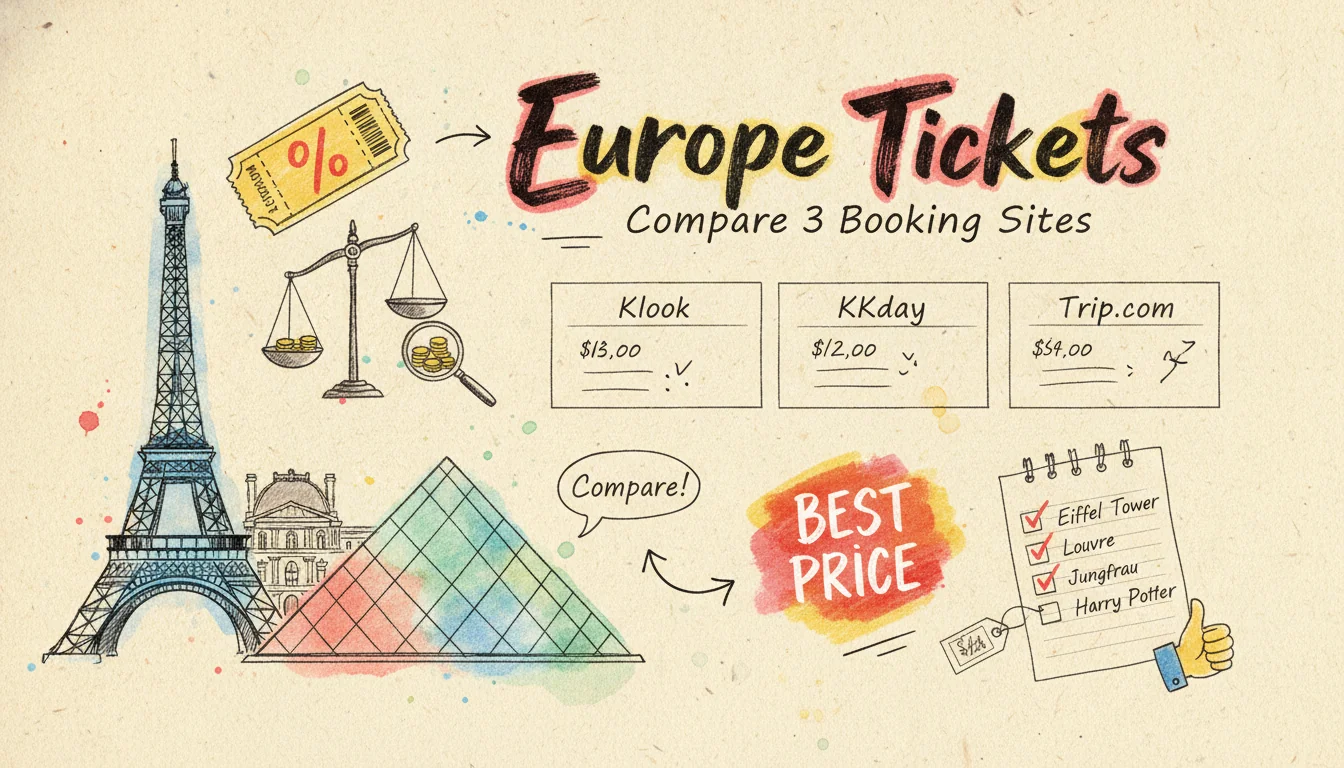
The same second-floor elevator ticket at the Eiffel Tower costs €23.5 on an official site, but €52 on KKday once you add a Chinese-language guide. That is a €28.5 gap, which works out to roughly US$31. For a family of four it becomes US$124, about one decent dinner in Paris. So when it comes to "where do I buy Europe attraction tickets," I actually ran the numbers, and my answer is not "always pick the cheapest one."
Last year I planned a 14-day France-Switzerland-Italy trip for my family, and just for tickets I built a whole spreadsheet. I filled in prices, language support, and refund terms for big spots like Eiffel Tower, Louvre, and Jungfrau, comparing official sites against three big booking platforms. After all that comparing, one thing became clear: Europe tickets are a deep rabbit hole. "The official site is cheapest" is true, but "the official site is the best value" often is not, especially once you factor in queue time, language cost, and refund risk.
This post is that spreadsheet, laid open for you. I will use Klook, KKday, and Trip.com, the three platforms travelers reach for most, and go line by line through four popular European attractions, marking which platform is cheapest right now for each one. Here is the takeaway up front: no single platform wins everything, and matching the right spot to the right platform is the real key to saving money.
First, understand this: Europe ticket pricing comes in three layers
A lot of people assume booking platforms just take the official ticket, slap a markup on it, and sell it to you. That is only half right. The pricing structure for European attraction tickets actually splits into three layers, and once you get this, you understand why the price gap on the same spot can be so big.
Layer one is the bare official ticket, meaning entry only, no extra service. This is the cheapest. On Eiffel Tower's official site, a second-floor elevator adult ticket is €23.5, summit is €36.7, and stairs-only is €14.8 (source: official Eiffel Tower site, toureiffel.paris). Louvre's online adult ticket is €22, but the museum already announced it rises to €32 from January 14, 2026. Heads up: an official price can shift on its own, and that number is your baseline for every comparison below.
Layer two is the value-added platform ticket. A platform stacks services on top of the bare ticket — Chinese-language interface, fast-track entry, audio guide, Chinese customer support — so the price naturally climbs. KKday's second-floor Eiffel ticket runs €52 with an English-speaking guide, or €49 without one (source: callingtaiwan's Eiffel ticket roundup). Yes, that is noticeably more than official. But what you are really buying is this: no reading a French official site, no figuring out how to pick a time slot, and someone on site to walk you past the line.
Layer three is the package tour ticket, which bundles entry, transport, and a guide into one product — think London Harry Potter Studio combo with a city shuttle bus. This one is the priciest. But for someone with no car, a language barrier, or a packed itinerary, it can actually save the most time. All three layers show up across platforms. Something like Trip.com Europe attraction tickets covers both layer two and layer three. Pro tip: compare the layers separately, or a "total price" will mislead you.
Here's the thing: if you are happy to use an official site, comfortable in English, and flexible on timing, layer one always wins on value. For the other ninety percent of travelers, honestly pricing out layer two is the realistic move. That is also why, below, I never just look at whichever column shows the smallest number.
Eiffel Tower: the official site is cheapest, but the platform sells you "time-slot insurance"
The Eiffel Tower was the spot I went back and forth on the most. Let me put the numbers out first.
| Ticket type / channel | 2nd floor (adult) | Summit (adult) | Chinese / guide | Refundable |
|---|---|---|---|---|
| Official site (bare ticket) | €23.5 | €36.7 | No, entry only | Mostly non-refundable |
| KKday Europe ticket pass | €49 (no guide) / €52 (English guide) | About €99 (with audio) | Chinese interface | Depends on product, mostly refundable |
| Klook Europe tours | Depends on product | Depends on product | Chinese interface | Depends on product |
Do the math: official second floor at €23.5 is a full half cheaper than KKday's €49. If your English can handle a French booking flow, and you are willing to lock in early (elevator tickets open up to 60 days ahead on the official site, stairs tickets 14 days), then by all means go official.
Fair warning, here is a trap I got burned by: popular official time slots sell out fast. In peak season, evening tickets and the light-show photo slots often vanish soon after they go on sale. Carol's travel blog flagged the same thing when I read it: once official is sold out, try your luck on Klook or GetYourGuide, since platforms sometimes still have tickets — a bit pricier, but with fast-track entry and an English opening guide (source: carolblog's Eiffel guide).
So my advice is blunt: rush official for the slot you want, and only switch to a platform if you miss out. That extra €25 or so on a platform is basically insurance that "you get up there that day." You already spent on a flight and a Paris hotel — risking not getting up the tower just to save a dinner's worth of cash? Not worth it. When you switch, KKday's Europe ticket pass has Eiffel products with a Chinese guide, and the interface beats a French official site by a mile. I score this column for the official site, but a platform is the necessary Plan B.
Louvre: after the official price hike, the gap is shrinking
The situation at the Louvre changed in 2026, so it is worth its own section.
Louvre's official online ticket used to be €22, while platform tickets typically sold around €30 — a gap of roughly €8. Back then I would recommend official without a second thought. But the museum announced its bare ticket rises to €32 from January 14, 2026 (source: lillian.tw's Louvre guide). After that hike, the gap got squeezed down to almost nothing. Now whether you want to wrestle a French booking system for that tiny gap becomes a personal call.
My reasoning goes like this. The Louvre forces an online time-slot reservation, so buying on site is not just pricier — you might not get in at all. That makes "buy online" mandatory, and the only question left is which interface you buy through. Official is €32 but entirely in French (though you can rent a Chinese audio guide). A platform costs a few euros more, but hands you a Chinese interface, Chinese support, and someone to help if a reservation fails. Trust me, for a first-timer who does not want to study reservation steps, those few euros are worth it.
If you really want to save, the key is not the ticket itself but the museum pass. Hitting several Paris spots in a row? A Paris Museum Pass bundles Louvre, Versailles, and more together, spreading out your per-spot cost. You can find this kind of cross-attraction pass on both KKday's Europe France-Switzerland-Italy pass and Klook, and it works out cheaper than buying each one separately. I give the Louvre column a slight edge to platforms — not because they are cheaper, but because the gap is now small enough that "Chinese convenience" finally pays off.
Jungfrau: the train ticket is the real boss, and here the platform genuinely helps
If the platforms were only about convenience at the first two spots, at Jungfrau the platform genuinely saves you real money, because its "ticket" is actually a very expensive train ticket.
A standard round-trip train ticket from Interlaken Ost to the top of Jungfrau costs CHF 223.8 (Swiss francs, roughly US$280). And it does not stop there: in the June-to-August peak season each ticket adds CHF 20, plus a round-trip seat reservation fee of another CHF 10 (source: vocus's Jungfrau transport roundup). For a family of four, just getting up the mountain runs over US$1,100, and that is the real vampire of a Europe trip.
There are two ways to save. First is the Swiss Half Fare Card: with it, the ride up from Grindelwald drops from CHF 190 to CHF 95, almost half off. But the card itself costs money, so work out how many train rides you need to break even. Second is to just buy a platform day-trip or package product, which ties together transport, the seat reservation, and sometimes even lunch.
My call that time was this: if the trip runs longer than 4 days and you will take many Swiss train rides, buy the Half Fare Card and ride on your own to save the most. If you are only at Jungfrau for a day or two and do not want to study Switzerland's complicated ticketing system, just book a platform day trip, which is the least stressful and often cheaper too. That is because the platform's group fare is sometimes lower than buying each ticket yourself. For Swiss tickets tied to Jungfrau, both KKday's Europe France-Switzerland-Italy pass and Klook have plenty of ready-made options.
One more heads-up: if you plan to ride trains across multiple countries between cities (the Paris to Zurich to Milan kind), On a big pass like a Eurail or Swiss Travel Pass, even a few percent is a few hundred dollars, so sweep Klook's Europe rail tickets the week you actually book. Europe codes rotate every quarter and are never the same batch twice. Real talk, I score this spot a clear win for the platform.
London Harry Potter Studio: the one spot where the package is always the better deal
The Warner Bros. Studio Tour London is a special case, the one example in my entire spreadsheet where the package beats the bare ticket.
The reason is geography. The studio sits in Leavesden on the outskirts of London. To get there on your own, you first take about a 20-minute train from the city to Watford Junction, then switch to about a 15-minute shuttle bus, so you are looking at about an hour all in. The route is not intuitive for foreign visitors, and it is easy to misjudge the timing and miss your reserved slot (slots usually run in 30-minute waves, and showing up late voids your ticket). Both Klook and KKday offer a "ticket plus round-trip city shuttle bus" package (source: KKday and Klook studio product pages). The total is higher than a bare ticket, but what you save is the entire cost of "figuring out three legs of transport yourself, leaving early, and gambling you will not get lost."
In my experience, for a spot like this that "is not in the city, has complicated transport, and absolutely needs you on time," that extra US$15 to US$25 shuttle fee on a package is almost always worth it. My iron rule when planning this kind of itinerary: whenever transport is harder to deal with than a ticket, buy the package. Harry Potter Studio fits perfectly. London studio's ticket-plus-shuttle package is on both Trip.com tickets and experiences and Klook, so just pick a version that includes a shuttle.
By the way, Tokyo also has a Warner Bros. Harry Potter studio (on the old Toshimaen site), and the ticket on Klook is 15% off, saving about US$9 each. If you are a Muggle flying to Japan first, that is another story. For London, I score the package (platform) the winner, no contest.
The personality of each platform: match the person before the spot
Now that I have compared item by item, let me sum up each platform's "personality" too, because choosing a platform is not only about one spot, it is also about your habits for the whole trip.
| Platform | Europe coverage | Strength | Who it suits |
|---|---|---|---|
| Klook | Most Europe and US spots of the three | Wide tour and ticket selection, often exclusive promo codes | People hitting many spots who love comparing |
| KKday | Fewer Europe items but hand-picked | Familiar to Asian travelers, Chinese support, detailed product info | First-time independent travelers worried about getting confused |
| Trip.com | Medium count of Europe tickets | Fast refunds, quick customer support | People whose plans shift, who value refundability |
Here is the basis for this table: Klook started in Hong Kong and has the widest global spread of attractions, clearly more Europe and US coverage than KKday (source: hello-alpine and lifegoods platform comparisons). KKday started in Taiwan and focuses on Japan, Korea, Thailand, and markets familiar to Asian travelers, so Europe is hand-picked rather than stocked in volume. Trip.com (the international version of Ctrip) gets singled out for its refund speed and support responsiveness in comparison articles (source: andyventure's four-platform review). If refundability matters to you, check the refund terms listed on each product page at Trip.com Europe attraction tickets before you book.
In my experience, people worried about last-minute itinerary changes should check Trip.com's refund terms first, people chasing offbeat spots or wanting to compare more should lean on Klook, and people going abroad for the first time with everything still uncertain will panic least with KKday. On my 4-spot trip, I ended up using Klook for 2, KKday for 1, and the official site for 1, rather than putting all my eggs in one basket. There is no best platform, only the one that best fits your travel rhythm.
Three-platform live promo code roundup
Here is where I would look on each platform, gathered in one place. Offers change all the time, and every code has an expiry, so always confirm once more on the platform before you go.
- Trip.com Europe attraction tickets and experiences: no code I can hand you here. Check the current price on the product page before you book.
- Klook Europe rail tickets: no fixed code this season. The Europe promo hub carries whatever is live the week you book.
- KKday Europe products: no code I can hand you here either. Compare the current price on the product page before you pay.
For a fuller, live-updated list, check the Klook Europe deals hub, and scan it once more right before you leave to be safe.
My final allocation: which spot pairs with which platform to save most
Here is the whole spreadsheet boiled down to a one-line version you can copy.
| Spot | Cheapest channel | Why |
|---|---|---|
| Eiffel Tower | Official site (if the slot sells out, platform) | Bare ticket is half the price, but the platform is time-slot insurance |
| Louvre | Platform (the gap has shrunk) | After the official hike, Chinese convenience finally pays off |
| Jungfrau | Half Fare Card for many days, platform day trip for few | The train ticket is the boss, so let the trip length decide |
| London Harry Potter Studio | Platform package (with shuttle) | Transport is harder than the ticket, so the package saves time and money |
See the pattern? If a spot is easy to reach and your language skills have room to spare, go official. If transport is complicated, language is a barrier, and slots are tight, go platform. Honestly, that beats "always pick the cheapest," because the real cost of travel was never just a ticket price — it is your time and your risk of getting it wrong. By the time I had crunched all this, I saved about US$190 on that trip, just enough for a pricey but very worth-it Swiss fondue at the top of Jungfrau. To see all current Europe codes across three platforms in one place, bookmark this Trip.com deals overview as a final check before you travel.
Frequently asked questions (FAQ)
Q1: Do I have to buy Europe attraction tickets online in advance? Can't I just buy on site?
I strongly recommend buying ahead. The Louvre already forces an online time-slot reservation, so buying on site is not only pricier but might not get you in that day, and the Eiffel Tower's popular slots often sell out too. The only cost of buying ahead is locking in your plans first, but in return you get on-time entry and usually a lower price.
Q2: If the official ticket is so much cheaper than the platform, why do people still use platforms?
Because you are not just buying a ticket. Platform tickets usually include a Chinese interface, Chinese support, and an audio guide, and some add fast-track entry and refund terms. For people not comfortable in English or French, or whose plans might change, the value of those services often exceeds the few extra euros. People who can handle the official site themselves will of course go official.
Q3: If the price after a promo code is still higher than the official site, is the code even worth it?
It is, but it depends on what you are comparing it to. A promo code is meant to lower a "platform price," not to beat a bare official ticket. For example, a €52 platform ticket is a little cheaper after a code, but it was always more expensive than that official site's €23.5 bare ticket, so those two prices are not on the same battlefield. If you already decided to use a platform (for Chinese support or refundability), a code is a real saving. If you can use an official site, you were never on the code's battlefield in the first place.
Q4: Which of Klook, KKday, and Trip.com is the easiest for refunds?
Going by comparison articles and general user experience, Trip.com's refund speed and support responsiveness get singled out as faster, which suits people whose plans change often. But whether you can actually refund, and how much, depends on the refund terms of the specific product you bought, not on the platform as a blanket rule. Always read the refundable terms on that product page before you order.
Q5: For Jungfrau, should I buy the Half Fare Card or just a day trip?
It depends on the number of days. If your trip runs longer than 4 days and you will take many Swiss train rides, the Half Fare Card and riding on your own saves the most. If you are only at Jungfrau for a day or two and do not want to study the Swiss ticketing system, a platform day trip is usually less stressful, and the group fare is sometimes lower than buying it yourself. Work out how many train rides you expect inside Switzerland first, then decide.
Sources
- Official Eiffel Tower site|ticket prices and opening hours
- Carol's travel blog|Eiffel Tower 2026 tickets and buying guide
- Lillian|2026 Louvre ticket reservations and price hike info
- vocus|Jungfrau transport routes and ticket roundup
- callingtaiwan|Eiffel Tower tickets and platform price roundup
- Andy Venture|GetYourGuide, Klook, KKday, Trip.com four-platform review
- Lifegoods|Klook vs KKday, which is better (2026)
All Deals
Travel Deals up to 30% OFF
Click to view full deal details and terms
Tokyo Departure: Car Rental with Driver to Mt. Fuji/Hakone/Nikko - Chinese-speaking Driver
Car charters • Tokyo
Taipei Metro (MRT) Unlimited Travel Pass
Train tickets • Taipei (From Taipei)
Shanghai Disneyland Ticket
6% OFF · Get Your Exclusive Discount Code:SHDRSEA94
SHDRSEA94Macau Parisian Eiffel Tower Tickets
Macau

Cee
Credit Card VeteranCredit card veteran. Lives on a NT$30K monthly salary but saves NT$20K a year through cashback — treats every purchase as an optimization problem. Studies cash back rates, points, FX multipliers, and multi-card stacking to figure out which card pays back the most.
You May Also Like
Reykjavik in 3 Days: 2026 Guide to Blue Lagoon, Golden Circle and What to Book Ahead
A 3-day Reykjavik plan built around what actually sells out: Blue Lagoon timed entry, Silfra sizing limits, Golden Circle costs, and the tour-vs-rental-car math at 1, 2 and 4 travellers.
48 Hours in Saigon 2026: What to Book Before You Land
A weekend in Ho Chi Minh City is a scheduling problem, not a sightseeing one. Editor Yi works through entry permission, the arrival hour at Tan Son Nhat, connectivity, cash versus card, and the two bookings that must exist before wheels-down.
Osaka Art Fireworks 2026: Paid Seats Only, 1 Stop from KIX
Osaka Art Fireworks 2026 is on 10/31 at Rinku Park, Izumisano: every seat is paid and there is no free area. Editor Yi maps the three price tiers, the per-person cost of all eight seat types, and the one-stop ride from Kansai Airport.