Okinawa Summer 2026 Ticket Costs: JUNGLIA + Aquarium + Transit, 3 Platforms
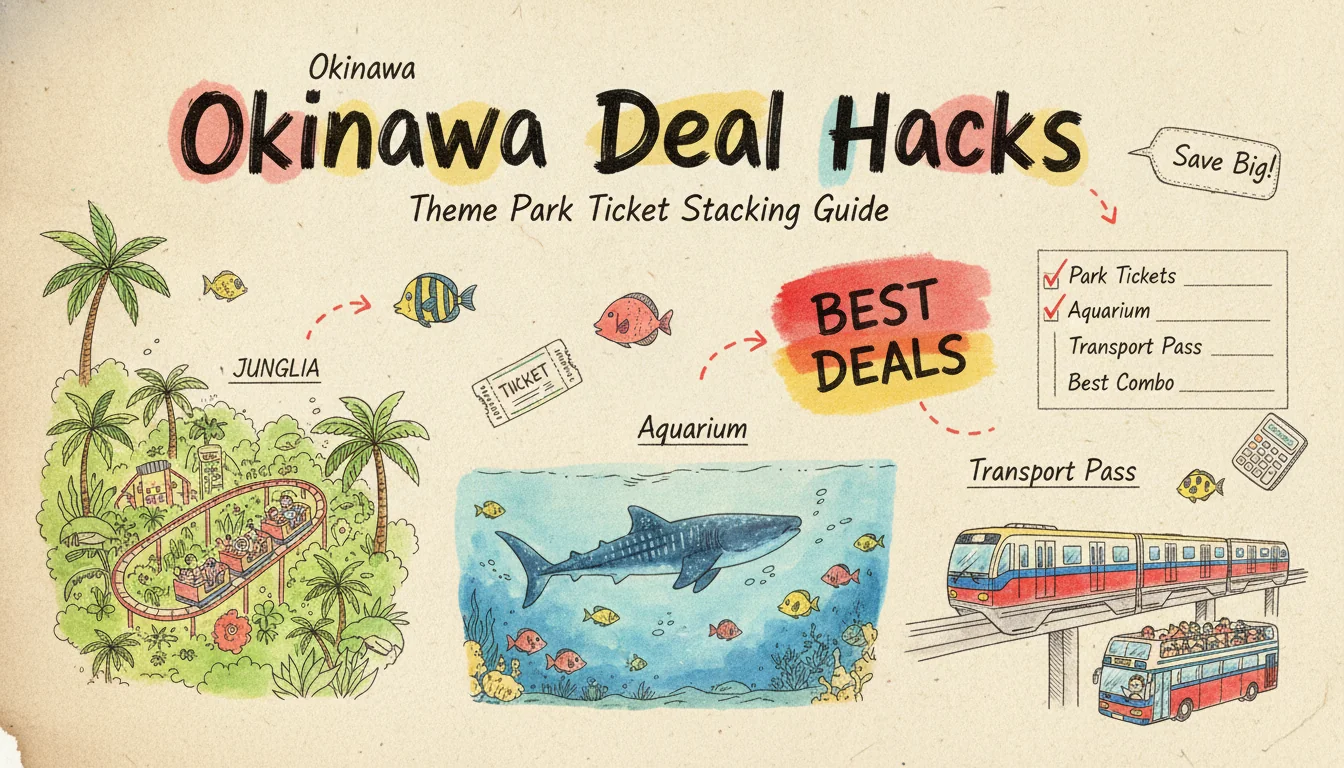
On the same JUNGLIA ¥8,800 ticket, swiping the wrong card versus the right one at checkout costs you more than a few dozen yen: the gap is an entire Churaumi Aquarium ¥2,180 ticket. Over one Okinawa summer trip, just the three big buckets (theme park, aquarium, and getting around without driving) can stack a family of four up to around ¥40,000 in tickets alone, which works out to nearly NT$8,600 (about US$265). Whether I spend that money on Klook, KKday or Trip.com, which ticket I buy first, and which code I punch in last can swing the final total by a double-digit percentage.
I am not writing the "which JUNGLIA rides suit which age" breakdown here (that is a separate post). This time I do exactly one thing: I lay out the full ticket map that all three platforms sell for Okinawa, the official list prices, the stacking order, and the break-even point for each ticket ("how many attractions do you need to hit before it pays off"), then I crunch it all into one decision table. By the end you will know which route fits your trip, which ticket to buy online, and which one is actually cheaper bought on the spot.
Exchange-rate note: ticket prices here follow the official yen figures, with NT$ estimated at ¥1 ≈ NT$0.215 (~US$6.7). The real charge depends on your platform's exchange rate at checkout. All promo codes and promo windows can change at any time, so confirm the platform page before you order.
Laying out all three platforms' Okinawa ticket maps first
Once I sort them out, what Klook, KKday and Trip.com sell in Okinawa overlaps far less than you would think. Reading the fine print across all three, you see a clean split: who leads with single-attraction tickets, who leads with transit-inclusive day tours, and who leads with flight-plus-hotel bundles. That split directly decides where you should book.
Klook's strength in Okinawa is "single-attraction tickets plus flash sales." JUNGLIA tickets, Nago Natural Botanical Garden, Okinawa World and similar single-venue tickets all have their own pages, and the Monday 11am Fun Pass buy-one-get-one is its signature play. KKday's depth is in "northern day tours with a guide and tickets included." Churaumi Aquarium is almost always sold inside a "departs Naha, with transfers, ticket included" package, which suits people who do not want to drive at all. Trip.com runs "spend-and-save plus car-rental and transfer discount" windows that bundle flights, hotels and tickets, ideal for people booking their flight and hotel together who want to shave the ticket cost along the way.
| Platform | Okinawa focus | Best for | Signature mechanic |
|---|---|---|---|
| Klook | Single tickets, park tickets, passes | Self-drivers, single-venue buyers | Monday Fun Pass buy-1-get-1, Okinawa Fun Pass |
| KKday | Transit-and-ticket northern day tours | No driving, want a guide | Northern day tour with Churaumi ticket |
| Trip.com | Flight+hotel+ticket bundles, rental/transfer discount | Booking flight and hotel together | Spend 5,000 save 400, rental 8% / transfer 20% |
Getting this map straight matters, because the same attraction can sit under completely different product structures across the three. Comparing Klook's "single-ticket price" against KKday's "day tour with transfers" price is comparing apples to oranges. If you want to see every current Okinawa ticket on Klook, scan a multi-attraction combo like the Klook Okinawa Fun Pass from 39% off first, then decide whether to split it into single buys. I keep the full list on our Klook deals page.
JUNGLIA jungle park: that ¥8,800 ticket, where do the platforms differ?
I copied the JUNGLIA official ticket page column by column this time. The one-day Park-only ticket is ¥8,800 for adults and ¥5,940 for children aged 4 to 11, all tax included. The "Park + Spa" set that adds the hot-spring zone runs ¥11,550 for adults and ¥7,480 for children. There are also two easily missed options: the fast-track Premium Pass starts at ¥1,870 per item, and a July-only "Furatto Ticket" with just one experience included costs ¥3,190. Just figuring out which ticket you actually want saves you half the comparison work.
| JUNGLIA ticket type | Adult (tax incl.) | Child 4-11 (tax incl.) | Key point |
|---|---|---|---|
| One-day Park-only | ¥8,800 | ¥5,940 | Standard ticket for most visitors |
| One-day Park + Spa | ¥11,550 | ¥7,480 | Worth it only if you want the spa |
| Premium Pass (fast-track) | from ¥1,870 | from ¥1,870 | Only needed at summer peak |
| July-only Furatto Ticket | ¥3,190 | — | One experience only, not the whole park |
The real difference is in "platform promo windows," not the list price itself. All three sell officially licensed JUNGLIA tickets at the same base price, so the gap is whatever discount you can stack. The most direct play on Klook is the JUNGLIA ticket page, which right now throws in a 15%-off Okinawa car-rental voucher when you book, so for self-drivers that is extra car savings on top of the ticket. If a Monday fits your itinerary, the Monday 11am Fun Pass buy-one-get-one (code JUNG0119) is the deepest cut in this whole post. Two people enter for the price of one ticket, so ¥8,800 gets halved, but stock is limited and you have to grab it on time. Miss it and you go quietly back to single buys plus a bank code.
The trap I fell into: I assumed the platform promo code and the credit-card code could stack together. In reality the two are mostly mutually exclusive, and the checkout field only takes one code. So what you compare is whether a product-level promo like "Fun Pass buy-one-get-one" or "a bank code discount at checkout" saves you more, not both added together. I break this logic down further in the next section.
Churaumi Aquarium: the ¥2,180 official price is not the lowest, and most people get this wrong
The Churaumi Aquarium adult ticket is officially ¥2,180, with high schoolers at ¥1,440, elementary and middle schoolers at ¥710, and under-6s free. That is the on-site box-office rate. Most people see that number and buy online at list price, which is actually the wrong math. Per travel-blogger field tests and official notices, the "Michi-no-Eki Kyoda" roadside station along the way has long offered discount tickets at roughly ¥2,000 for adults, meaning the on-site price beats the official site by about 8%. If you are self-driving and pass Kyoda, buying the ticket there on the way is cheaper than booking online.
So where is the point of buying online? In "saving once by bundling it with transport." KKday folds Churaumi into a northern day tour, and the northern day tour departing Naha with the Churaumi ticket included prices the drive, guide and ticket as one. For people who do not drive at all, what you save is the two or three hours of "looking up bus schedules, transferring and waiting," not the 8% on the ticket. The decision is clear: self-drive past Kyoda and buy on the spot, do not drive and buy the transit-inclusive day tour, and the one thing you should never do is buy a single full-price ticket online and then ride the bus yourself separately.
Summer adds one timing detail: Churaumi usually runs to 18:30 (last entry 17:30), but in peak season it often extends to 20:00. If you only arrive at three or four in the afternoon and worry about not getting your fill, confirm that day's extended hours first, then decide whether to slot in the Kuroshio Sea feeding show. That is far more useful than saving a few dozen yen on the ticket.
DMM Kariyushi Aquarium: summer hits the peak surcharge, ¥2,800 becomes ¥3,200
This section is the one to underline hardest in this summer edition. DMM Kariyushi Aquarium pricing splits by off-peak and peak. Off-peak (October to June) is ¥2,800 for adults, ¥2,200 for youth aged 13 to 17, and ¥1,700 for children aged 4 to 12. But peak season (July to September plus Japanese holidays) raises everything: adults to ¥3,200, youth to ¥2,600, children to ¥2,100, with under-3s free. In other words, going in summer means every adult ticket costs ¥400 more than off-peak, and a family of four (two adults, two kids) spends about ¥1,000 extra on that peak surcharge alone.
| DMM ticket type | Off-peak Oct-Jun | Peak Jul-Sep | Summer difference |
|---|---|---|---|
| Adult | ¥2,800 | ¥3,200 | +¥400 |
| Youth 13-17 | ¥2,200 | ¥2,600 | +¥400 |
| Child 4-12 | ¥1,700 | ¥2,100 | +¥400 |
DMM's biggest advantage is location: it sits inside the iias Okinawa Toyosaki shopping mall, only about 20 minutes by car from Naha Airport. Laid out plainly, it works best as a "arrival-afternoon" or "before the flight home" filler, pairing neatly with eating and shopping at iias so the route wastes nothing. The value of buying online is skipping the on-site ticket-machine line (that queue gets very long in peak summer), but the discount room is limited. What you can save comes mainly from platform windows and bank codes, not from any buy-one-get-one on the ticket itself. If your Okinawa itinerary is already packed up north with JUNGLIA and Churaumi, you can keep DMM as a flexible "rainy-day backup" rather than forcing it in.
The no-driving transport bill: monorail day pass vs bus pass vs transfers
For people who do not drive, transport tickets are the second-biggest expense after the parks, and the easiest to buy wrong. Lining up the three main tickets: the Okinawa Monorail (Yui-Rail) one-day pass is ¥1,000 for adults and ¥500 for children, the two-day is ¥1,800 / ¥900, but it only runs central Naha (the airport-to-Shuri stretch) and cannot leave the city. To reach Churaumi up north or American Village in the center, you need the "Okinawa Route Bus Pass," with a one-day at ¥2,500 for adults and ¥1,250 for children, and a three-day at ¥5,000 and ¥2,500, giving unlimited rides on many main-island route buses.
| Transit ticket | Adult | Child | Coverage | Best for |
|---|---|---|---|---|
| Yui-Rail monorail 1-day | ¥1,000 | ¥500 | Central Naha | City only, strolling Kokusai-dori |
| Yui-Rail monorail 2-day | ¥1,800 | ¥900 | Central Naha | Two-day city itinerary |
| Bus pass 1-day | ¥2,500 | ¥1,250 | Main-island route buses | One-day push up north |
| Bus pass 3-day | ¥5,000 | ¥2,500 | Main-island route buses | Touring the island without driving |
Reading the terms, there are two traps to note. First, the bus pass excludes routes 111 and 117, the Yanbaru Express, airport buses and sightseeing buses, so check that the route you take to Churaumi is actually covered. Second, the monorail one-day pass is "24 hours from activation" rather than "valid until midnight that day," so it is actually more flexible. For airport-to-city transfers, if you cannot be bothered to look up the bus, Trip.com's Okinawa flight-hotel-ticket window also lets you grab a separate rental 8% / airport transfer 20% discount, so people booking flight and hotel together can shave the transfer along the way. The call is simple: city only buys the monorail, going north without driving buys the three-day bus pass, and if you drive, a rental plus the codes above is usually the most flexible.
The math of stacking order: bank code times platform promo times pass, how much does sequence matter?
This is the most valuable section in the post. Split the discounts into three layers: layer one is the "platform window price / pass price" (the product itself is already discounted), layer two is "punch in a bank credit-card code at checkout," and layer three is "swipe the right card for points cashback on top." Layers one and two are mostly mutually exclusive, while layer three can usually stack separately. Get the order wrong and you give away a discount you could have kept.
First, the depth ranking within the bank-code layer. On the same ticket, the discount varies wildly by card: one card's 25%-off overseas experience deal is the strongest but is limited to that specific card; a 15%-off card capped at NT$400 (~US$12) is next and almost anyone can apply for it; and the site-wide few-percent-off codes on Klook are the most universal but cut the least. On the same ¥8,800 (about NT$1,892) JUNGLIA ticket, 4% off saves only around NT$76 (~US$2.4), while 15% off can save close to the NT$284 (~US$8.8) cap. That gap is nearly the price of one monorail day pass.
| Discount layer | Example | Saved on a ¥8,800 ticket | Exclusivity |
|---|---|---|---|
| Platform promo (Fun Pass buy-1-get-1) | JUNG0119 | One ticket for two people (about NT$1,892 / 2 people) | Exclusive with bank code |
| Bank code 4% off | Site-wide code type | About NT$76 (~US$2.4) | Exclusive with platform promo |
| Bank code 15% off, cap 400 | Spend-threshold, capped code type | About NT$284 (~US$8.8) | Exclusive with platform promo |
| Points cashback | Cashback card 2-3.3% | About NT$38-62 (~US$1.2-1.9) | Can stack separately |
KKday has its own bank-code system too, and which products each code maps to varies (some are day-tour only). Check what qualifies this window on the KKday card-offer section. The correct order is this: first check whether the ticket has a product-level deep discount like "buy-one-get-one / pass," and if it does, take that path and drop the bank code; if it does not, compare which card in your wallet cuts deepest and lay points cashback underneath. Learn this order and what you save on one Okinawa trip is a solid NT$2,000 to 3,000 (about US$62 to 93).
The break-even point for each ticket: how many attractions before you stop overpaying
The most common myth with passes and day tours is "it looks like a deep discount so it must be worth it." Actually, to work out the break-even point, you have to genuinely hit a certain number of attractions before the average per-item price beats buying singles. Let me break down the break-even logic for each ticket.
JUNGLIA's one-day Park-only ticket at ¥8,800 has a break-even of "you can fill most of a day in the park," because it is all-you-can-ride in nature, so the more you do the better the value, and anyone who cannot stay four hours is actually losing on an hourly basis. The Okinawa Fun Pass from 39% off, pick 2 to 5, has a break-even of "picking at least your third item," since at only two items you are usually better off buying two single tickets and stacking a bank code on each. The three-day bus pass at ¥5,000 has a break-even of "your one-way bus fares over three days adding up past ¥5,000," and with Naha to Churaumi at roughly ¥2,000 one way, a single round trip up north already burns ¥4,000, so the second central-area leg breaks even the moment you board.
| Ticket | Price | Break-even point | What to buy if you fall short |
|---|---|---|---|
| JUNGLIA one-day | ¥8,800 | Stay 4+ hours, hit 6+ attractions | Only 1-2 items, switch to Premium singles |
| Okinawa Fun Pass | from 39% off | Pick a full 3 items | Only 2 items, single buys + bank code |
| Bus 3-day pass | ¥5,000 | North round trip + one central leg | City only, buy the monorail day pass |
| Churaumi ticket | ¥2,180 | Self-drive past Kyoda for the ¥2,000 on-site ticket | No driving, buy the transit-inclusive day tour |
Conclusion up front: JUNGLIA visitors are safest going "ticket + the 15%-off card," and the Nago Natural Botanical Garden at 16% off makes a good add-on in the same direction as Churaumi to round out the day. City-only travelers should not touch the bus pass, since the monorail day pass is enough. For people going north without driving, the three-day bus pass always breaks even, so buy it with your eyes closed.
Total Okinawa ticket cost for a family of four over five days: three routes, actually calculated
Put all the numbers above together and run three typical routes for "two adults, two kids (children counted as 4 to 11)," and it lands much harder. Below I count only tickets and transport, no flights or hotels, in yen, with NT$ estimates in parentheses.
| Route | Ticket mix | Ticket subtotal | Transit subtotal | Total (NT$ estimate) |
|---|---|---|---|---|
| A Park fanatic (self-drive) | JUNGLIA x4 + Churaumi x4 | ¥35,260 | Rental on your own | About NT$7,581 (~US$235) |
| B Family balance (bus) | Churaumi x4 + DMM peak x4 | ¥16,380 | Bus 3-day pass x4 ¥15,000 | About NT$6,747 (~US$209) |
| C City easy mode (monorail) | DMM peak x4 | ¥10,600 | Monorail 2-day pass x4 ¥5,400 | About NT$3,440 (~US$106) |
Laid out plainly, the gap is not where you think (which attraction costs more), but in "the self-drive versus no-drive transport structure." Route A has the priciest tickets because JUNGLIA alone is ¥29,480 for a family of four, but it saves on bus passes. Route B has two adults and two kids on a three-day bus pass eating ¥15,000, so the total actually lands close to A. Route C never leaves the city, so tickets and transport are both cheapest but you do the least. What can save you once more on each of these three routes is using the bank code right: Route A's JUNGLIA on the 15%-off card cuts the ticket alone to near the cap, which is like saving one monorail two-day pass. I sort out which card codes are usable right now in the next section.
Three-platform promo codes and limited-time deals (summer 2026)
This is the one section in the whole post that focuses purely on promos, listing the current Okinawa-related, actually-usable discount codes in one table so you can cross-check before ordering. Codes change with the promo window, so go by what the platform page shows.
| Platform | Discount | Code / mechanic | Key limit |
|---|---|---|---|
| Klook | JUNGLIA Fun Pass buy-1-get-1 | JUNG0119 (Monday 11:00 drop) | Limited stock, grab on time |
| KKday | 6% off Japan products every Thursday | JPDAY | Capped at NT$150 (~US$4.6) |
| Trip.com | Okinawa flight-hotel-ticket, spend 5,000 save 400 | Discount on the page | Plus rental 8% / transfer 20% |
The operating advice is one line: first decide which route you are taking and which ticket you are buying, then come back to this table and pick the code that is "compatible with that ticket and cuts deepest," instead of saving every code you see. If you want the full current list, the KKday Okinawa-related deals and Klook's pages both refresh with the promo window, so a quick re-check before ordering is the safest move.
Frequently asked questions
Q1: Do I have to buy JUNGLIA online first? Can I buy on the spot? In peak summer I strongly recommend buying online first. One, the on-site count can hit crowd limits or sell out; two, only online lets you stack the platform promo and the bank code. The base price is the same across all three, and the only difference is the discount you can reach. To check current ticket status directly, see the Klook JUNGLIA ticket page.
Q2: Is Churaumi Aquarium cheaper online or on the spot? It depends on whether you drive. If you self-drive and your route passes the Michi-no-Eki Kyoda station, the on-site ticket at about ¥2,000 beats the official ¥2,180 by roughly 8%. For people who do not drive at all, buying KKday's transit-inclusive northern day tour saves you the drive time, which is more useful than that 8% on the ticket.
Q3: Why is DMM Kariyushi more expensive in summer? DMM pricing splits by off-peak and peak, with July to September and Japanese holidays counting as peak. Adults rise from off-peak ¥2,800 to ¥3,200, ¥400 more per ticket. A family of two adults and two kids spends about ¥1,000 extra on the peak surcharge alone, so factor that in when planning.
Q4: With no driving, should I buy the monorail day pass or the bus pass? For central Naha only, the monorail one-day pass (¥1,000 adult) is enough. To reach Churaumi up north or American Village in the center, the monorail cannot leave the city, so you need the bus pass, and the three-day at ¥5,000 breaks even on one round trip up north plus one central leg.
Q5: Can I use a platform promo code and a credit-card discount code together? In most cases they are mutually exclusive, and the checkout field only takes one code. The right approach is to compare whether a "product-level deep discount like buy-one-get-one / a pass" or a "bank code discount" saves more, and pick one. The credit card's "points cashback" can usually stack on top separately.
Sources
- JUNGLIA official ticket guide (ticket types and tax-inclusive pricing)
- Okinawa Churaumi Aquarium tickets and opening hours roundup
- DMM Kariyushi Aquarium off-peak and peak prices
- Okinawa Route Bus Pass official price page
- Okinawa Monorail Yui-Rail one-day pass guide
- More on our site: JUNGLIA Okinawa jungle park age-4 vs age-7 field test (the by-age ride list, a complement to this cost-angle post)
All Deals
Tokyo Departure: Car Rental with Driver to Mt. Fuji/Hakone/Nikko - Chinese-speaking Driver
Car charters • Tokyo
No Code RequiredTaipei Metro (MRT) Unlimited Travel Pass
Train tickets • Taipei (From Taipei)
No Code RequiredXiang Xiang - Xinyi Store - MRT Taipei City Hall Station
Food & dining • Taipei
No Code RequiredGrand Skylight International Hotel Shenzhen Guanlan Special Offer
1. Deluxe twin room with bathtub for 1 room 2 nights or 2 rooms 1 night enjoys a buy 1 get 1 offer, from HK$802; enter the promo code to enjoy from HK$722. 2. Sports car theme room package enjoys HK$950 per night; enter the promo code to enjoy HK$870 per night. 3. Deluxe family suite package enjoys HK$1,168 per night; enter the promo code to enjoy HK$1,088 per night. 4. Superior room with bathtub plus breakfast and dinner for two enjoys HK$802 per night; enter the promo code to enjoy from HK$722.
26DBS80Travel Deals up to 30% OFF
Click to view full deal details and terms
No Code RequiredA Joy : Taipei 101 Sky Buffet
Food & dining • Taipei
No Code RequiredTaiwan High Speed Rail Ticket for non-Taiwanese
Rail passes • Taipei
No Code RequiredTokyo Yakatabune Cruise: Sukiyaki Cuisine, Show Performance, and Tokyo Tower Sightseeing Plan
Cruises • Tokyo
No Code RequiredShanghai Disneyland Ticket
6% OFF · Get Your Exclusive Discount Code:SHDRSEA94
SHDRSEA94Okinawa Car Rental | Rent a Car to Gyokusendo Cave, Churaumi Aquarium, Okinawa World, International Street, Shuri Castle
Naha
No Code RequiredOkinawa Churaumi Aquarium Tickets
Kunigami
No Code RequiredOkinawa North Day Tour | Manzamo, Kouri Island & Churaumi Aquarium Day Tour | from Naha & Chatan
Kunigami
No Code RequiredOkinawa Private Charter with Driver - Customized Okinawa Churaumi Aquarium / Shurijo Castle Itinerary - Chinese/English/Japanese Driver
Kunigami
No Code RequiredOkinawa FunPASS (Churaumi Aquarium Series)
Kunigami
No Code RequiredOkinawa Sightseeing Bus North & South Route Day Tour: Gyokusendo Cave, DMM Kariyushi Aquarium, Senagajima & Manzamo, Churaumi Aquarium, American Village
Naha
No Code RequiredSouthern Okinawa Day Tour: Chinen Cape & Okinawa World Gyokusendo Cave/Kingdom Village & Itoman Seafood Market & Senagajima & Outlet [Chinese/Japanese Guide & Free Ticket]
Nanjo
No Code RequiredCentral Okinawa Day Tour: Hoshino Banta Cafe & Cape Zanpa & Southeast Botanical Gardens & Rycom (Chinese-Speaking Guide)
Nakagami District
No Code RequiredOkinawa Onna Village Blue Cave Snorkeling & Scuba Diving Experience
Kunigami District
No Code Required[Korean Support] Okinawa Blue Cave Boat Diving & Snorkeling All-Inclusive Tour (Free Photos/Videos/Fish Feeding Experience)
Kunigami District
No Code RequiredMiyakojima Sea Turtle Snorkeling Half-Day Experience (Okinawa)
Miyako District
No Code RequiredOkinawa Go-Kart Experience (by Gorilla Kart Okinawa)
Naha
No Code RequiredOkinawa FunPASS (Value Series)
Itoman
No Code RequiredOkinawa Enjoy Pass 1 Week Free Pass
Okinawa City
No Code Required
Cool
Travel Deal OrganizerTravel deal data nerd. Specializes in early-bird flights, transit passes, and KKday/Klook stacking logic — calculates which ticket is the best deal. Comparison tables, price PKs, and rule breakdowns.
You May Also Like
JUNGLIA Okinawa 2026: Fast Pass Break-Even and Klook's VIP Lounge
JUNGLIA Okinawa turns one in 2026. The Premium Pass break-even worked out, the Klook-exclusive VIP lounge priced against the standard ticket, the ¥2,970 Furatto half-price ticket, and one- and two-day plans with Churaumi.
JUNGLIA Okinawa Age-by-Age Field Test 2026: 4 vs 7, Which 22 Rides Work
I took my 4-year-old and 7-year-old through all 22 JUNGLIA Okinawa attractions, with a 2026 summer height-and-age chart, stroller routing, diaper-station map, feeding-time pacing, and a 4-person ROI table vs Churaumi (¥2,180) and DMM (¥2,800), plus the Klook Fun Pass buy-1-get-1 and airport transfer notes.
Okinawa Solo Female Travel 2026: 5-Day US$829 Field Report
Okinawa 5-day solo female trip, ~US$829 full breakdown. I walked Naha Kokusai-dori vs Urasoe Maeda nights, tested the real minimum-headcount bar for solo snorkel day tours, mapped 4 golden-hour cafes in Sakaemachi Market, and stacked hotel + credit-card + Klook discounts to save ~US$108.