Tateyama Kurobe Closes Nov 30: 2026 Autumn Foliage by Altitude
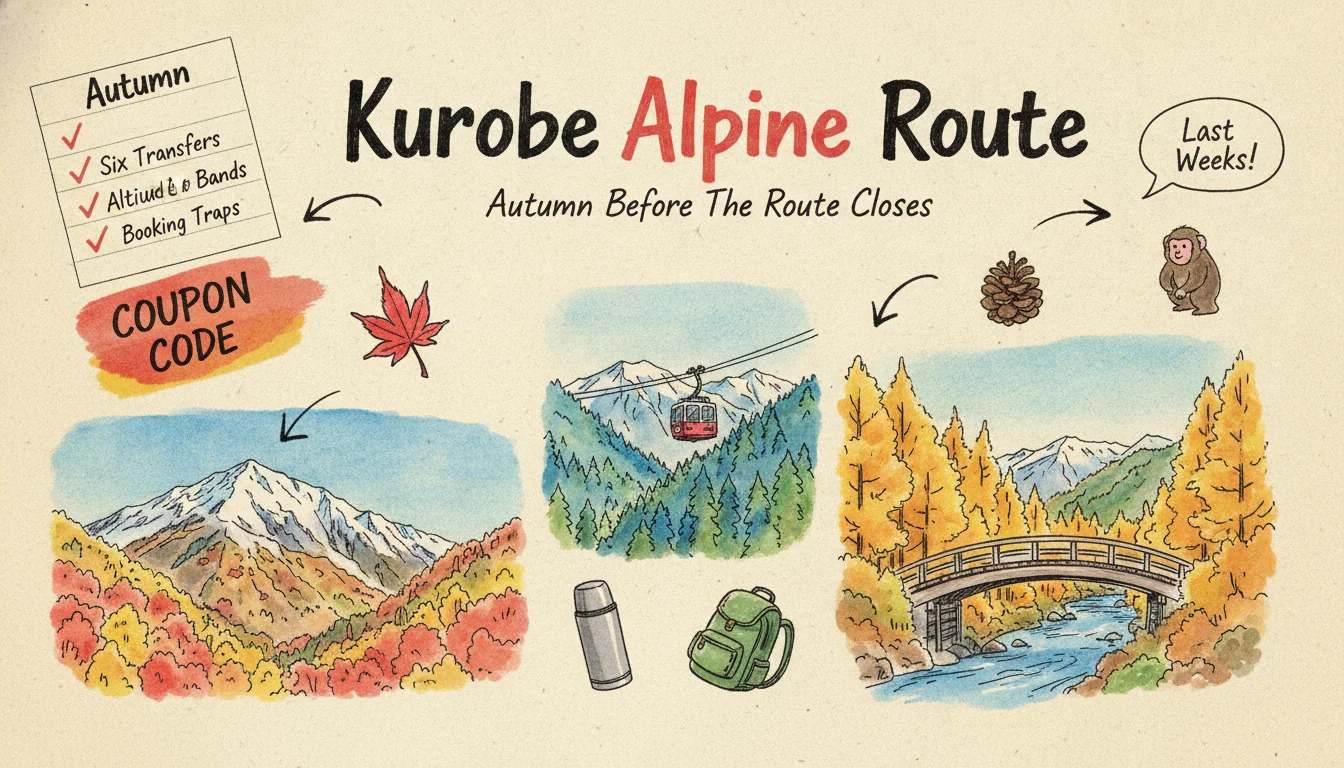
Half past six in the morning at Tateyama Station, and the queue had already curled out past the eaves of the waiting room. The man in front of me was rubbing his hands together while he hauled a down jacket out of his pack. Down at the base it was in the low teens Celsius, and the sun coming off the car park asphalt was almost harsh. Where he was going, at that same moment, it was in single digits. On that trip I rode the Highland Bus up from Bijodaira, and over fifty minutes the trees outside the window went from green to yellow to bare branches. No junction, no transfer, not one administrative boundary crossed. The only thing that changed was altitude.
It took me until I got home to properly understand that. Tateyama Kurobe is not a "foliage spot". It is a route that lays an entire autumn out vertically in front of you. The day you go up does not decide whether the leaves have turned. It decides which band of that vertical spectrum you get to stand in.
And this year there is only one stretch of it left to walk. The Tateyama Kurobe Alpine Route operates from 15 April to 30 November 2026; the day after that the whole line closes and nothing reopens until spring 2027. Kamikochi, at the other end of most itineraries, shuts even earlier — 15 November. Counting from today, 4 September, that leaves 87 days and roughly 12 weekends for Tateyama Kurobe, and 72 days for Kamikochi. The same four questions come back again and again from people planning this right now: how to connect onward from Komatsu Airport, which ticket to buy, how to reserve the Matsumoto–Kamikochi bus, and how to string Kanazawa and Toyama together. Everybody is trying to squeeze through the same window.
One table: the date you pick decides the colour you stop at
Start by laying the altitudes and this year's peak-colour forecast side by side. This is the part of the article I actually want you to keep. Everything after it is detail.
| Place | Altitude | 2026 peak forecast | What you get |
|---|---|---|---|
| Murodo | 2,450m | 21 Sep – 2 Oct | Japan's earliest turn: alpine grassland in red, mirrored in the ponds |
| Midagahara | 1,930m | 30 Sep – 9 Oct | Wetland plateau, a whole sweep of yellowing marsh grass and boardwalk |
| Ropeway span (Daikanbo ↔ Kurobedaira) | 2,316m→1,828m | 7–16 Oct | 1.7 km of tower-free cable, an entire cliff face turned red |
| Kurobe Dam | 1,470m | 17–30 Oct | Reservoir water framed by both slopes; the tourist water discharge is over by then |
| Kamikochi (around Kappa Bridge) | approx. 1,500m | 19–30 Oct | Golden larch against the Azusa River, Hotaka Range behind it |
| Bijodaira | 977m | 24 Oct – 3 Nov | Deep green Tateyama cedar primeval forest against beech gold |
(Peak-colour dates compiled from travel outlet tabibei's 2026 forecast and the latest official foliage report on alpen-route.com; the Kamikochi row also draws on the Hotel Gosenjaku 2026 foliage page. A forecast is a forecast — a hot summer or the first cold front will shift it. Check the official foliage page again in the week before you go.)
Read that table and something counterintuitive falls out: "Tateyama Kurobe autumn foliage" is not a date at all. It is a sliding window forty days wide. Go up in late September and Murodo is blazing while Bijodaira is still entirely green. Go up in late October and Bijodaira and Kamikochi are perfect, while Murodo has already had snow and its grassland has gone brown. If you want the most colour in a single day, aim for the middle value — early to mid-October. That is when every segment of the route sits at a different stage at the same time.
If you would rather skip the transfer arithmetic altogether, Klook has one itinerary built almost exactly around this window: Tateyama Kurobe Alpine Route & Kamikochi Autumn Foliage 2-Day Tour — guaranteed transport ticket and mountain entry, from Nagoya. It ties the two genuinely annoying parts of this route — the transport ticket and the entry slot — into a single booking.
Three-tier foliage is not an adjective, it is what a 1,473-metre drop does
When Japanese guides talk about sandan koyo, three-tier foliage, they mean three layers in one frame: snow white on the summits, red forest across the mid-slopes, green still holding at the foot. At most foliage destinations that phrase is a lottery ticket. At Tateyama Kurobe it is closer to something you can calculate.
From Tateyama Station (475m) to Murodo (2,450m) the vertical gain is 1,975 metres. The Highland Bus leg alone, Bijodaira (977m) up to Murodo, climbs 1,473 metres. Apply the standard atmospheric lapse rate — roughly 0.6°C cooler per 100 metres — and that bus ride drops the temperature around you by nearly 9°C in fifty minutes, or close to 12°C measured from Tateyama Station. So the man putting a down jacket on in the car park was not overdressing. He had been before.
Seeing all three layers at once has one more precondition that gets glossed over: the weather. My early-October run had Murodo buried in cloud all morning, visibility maybe thirty metres, not a hint of the snow line on the Tateyama peaks. I saw exactly one tier. A Japanese hiker on the same bus told me the days that deliver the full three are not many in a year, and most of them fall on the high-pressure clear mornings of early October. I got unlucky. Not a wasted day, though: dropping to Kurobedaira that afternoon the cloud tore open, and the whole cliff outside the ropeway window was red.
If all you want is to guarantee the highest tier, something like the Tateyama Kurobe Alpine Route Day Tour from Nagano — in from the Ogizawa side to Murodo and back out the same way — actually has a better chance of catching a gap in the cloud than a full traverse, simply because you spend longer up top.
Six modes of transport, really seven legs: the official fare split leg by leg
Every tour title says "includes the six-vehicle Tateyama Kurobe transport ticket". That is true, but it does not tell you what the six are, what each is worth, or that there is a leg wedged in the middle that costs nothing and offers no alternative.
I pulled the station-to-station fares off the official Kurobe Dam site and subtracted my way down the line. Here is what falls out:
| # | Section | Vehicle | Time | One-way fare (adult) | Approx. NT$ (US$) |
|---|---|---|---|---|---|
| 1 | Tateyama → Bijodaira | Tateyama Cable Car | 7 min | ¥1,090 | NT$219 (US$7) |
| 2 | Bijodaira → Murodo | Tateyama Highland Bus | 50 min | ¥3,000 | NT$603 (US$19) |
| 3 | Murodo → Daikanbo | Tateyama Tunnel Electric Bus | 10 min | ¥2,200 | NT$442 (US$14) |
| 4 | Daikanbo → Kurobedaira | Tateyama Ropeway | 7 min | ¥1,700 | NT$342 (US$11) |
| 5 | Kurobedaira → Kurobeko | Kurobe Cable Car (underground) | 5 min | ¥1,150 | NT$231 (US$7) |
| — | Kurobeko → Kurobe Dam | on foot | 15 min | ¥0 | NT$0 (US$0) |
| 6 | Kurobe Dam → Ogizawa | Kanden Tunnel Electric Bus | 16 min | ¥1,800 | NT$362 (US$11) |
| Full line: Tateyama → Ogizawa | approx. 3.5 hr | ¥10,940 | NT$2,199 (US$70) |
Add the six fares and you get ¥10,940 — identical, to the yen, to the published Tateyama ↔ Ogizawa one-way through fare. Which means this line has no "through-ticket discount" whatsoever. The so-called combination ticket is six tickets stapled together. You pay for each leg you ride, not a yen more and not a yen less.
The seventh leg, the one that gets left out, is that fifteen-minute walk. Between Kurobeko station and Kurobe Dam station there is 0.8 km of dam crest you cross on your own feet; the official figure is 15 minutes, and anyone carrying luggage will feel every one of them. Put plainly: it does not take your money, it takes your time and your legs, and every itinerary written for this route pretends it is not there.
One more detail worth knowing, because it will change how you read older information online. The Murodo–Daikanbo leg (#3 in the table) used to be a trolleybus — the last trolleybus line in Japan. It ran its final service on 30 November 2024 and was retired, replaced from 15 April 2025 by an electric bus with no overhead wire. So if you were planning this trip partly to ride Japan's last trolleybus, that reason no longer exists. The vehicle is still there; the species changed.
If you want to solve accommodation in the same sitting, Trip.com's Japan travel sale, hotels up to 40% off covers Toyama, Nagano and Matsumoto, the staging towns you will almost certainly need. Rooms in those small cities get tighter in autumn than people expect.
¥10,940 one-way or ¥19,680 return? Costing out the three routings
Once the leg-by-leg fares are clear, you can finally work out which ticket is yours. There are really only three ways to do this route, and the gap between them is wider than most people assume.
Routing A: the traverse (in at Tateyama, out at Ogizawa). One-way ¥10,940 (about NT$2,199 / US$70). You ride all six vehicles and never retrace a step. The cost is that your luggage has to be forwarded or left in a locker, and your hotels have to sit one on the Toyama side and one on the Nagano side.
Routing B: the traverse both ways. Return ticket ¥19,680 (about NT$3,956 / US$126). There is a piece of arithmetic here that is easy to miss: two one-way tickets come to ¥21,880, while the return is ¥19,680, so the return ticket saves you ¥2,200 — exactly the price of one extra ride on the Murodo–Daikanbo electric bus. That is about 10% off.
Routing C: up to Murodo and back, no crossing. The Tateyama ↔ Murodo return is ¥7,380 (about NT$1,483 / US$47), against ¥8,180 for two one-way tickets, so you save ¥800. For a first visit with only one day, this is the one I recommend. All you give up is the ropeway and Kurobe Dam, and what you get back is three extra hours of slack on the mountain. The fare is 37.5% of the full-line return.
The conversion basis: Bank of Taiwan published rate for 3 September 2026, ¥1 ≈ NT$0.201, which is where the NT$ figures come from. USD figures are rounded at roughly NT$31.5 to US$1 and are indicative only — your card will settle at its own rate.
The payback logic is simple enough. If the point of the trip is seeing colour, Routing C wins on value. If the point is riding all six vehicles, it is A or B — and B costs ¥8,740 more than A, in exchange for one return crossing. My second time up I chose C and spent the three hours I saved walking the Murododaira loop trail. I saw more in those three hours than I did on the entire first traverse.
Kamikochi has its own closing day: 15 November, fifteen days ahead of Tateyama Kurobe
Plenty of people put these two places in one trip without noticing that their closing dates are 15 days apart. Kamikochi's 2026 season runs from 17 April to 15 November. Plan for late November and Tateyama Kurobe will still be open while Kamikochi is already shut. Of all the questions I see people asking about this route, that is the trap I worry about most, because nobody warns you — you have to look it up yourself.
Kamikochi bans private cars year-round, the same as Tateyama Kurobe, but the transfer points are different:
| Access | Transfer point | One-way fare | Approx. NT$ (US$) |
|---|---|---|---|
| Train + bus (Matsumoto side) | Matsumoto → Shin-Shimashima | ¥710 | NT$143 (US$5) |
| Train + bus (Matsumoto side) | Shin-Shimashima → Kamikochi (reservation required) | ¥3,100 | NT$623 (US$20) |
| Park & ride (Matsumoto side) | Sawando car park → Kamikochi | ¥1,600 (return ¥3,000) | NT$322 (US$10) |
| Park & ride (Takayama side) | Hirayu / Akandana → Kamikochi | seasonal, per official notice | — |
Matsumoto Station all the way through to Kamikochi is ¥710 + ¥3,100 = ¥3,810 (about NT$766 / US$24), with routes and fares from the official Alpico Kotsu site. The Shin-Shimashima–Kamikochi leg is reservation-only, and skipping the reservation in peak autumn is gambling. If you are driving, get the side right: Sawando is on the Matsumoto side, about 32 km and 50 minutes from the Matsumoto interchange; Akandana is on the Hida side, about 37 km and 60 minutes from Takayama. Park on the wrong side and you are looking at another hour-plus around the mountain.
Kamikochi's colours are a different palette from Tateyama Kurobe. At around 1,500 metres the lead is not maple, it is the gold of the larch. Mid-October brings the maples first, then katsura; the larch does not turn as a mass until late October into early November. Behind it stands the Hotaka Range, over 3,000 metres, which starts holding snow from late October. That is why Kamikochi is actually the easier place to get all three tiers at once: white on Hotaka, red and yellow across the slopes, and gold larch running along the Azusa River.
If Kamikochi alone is what you want, the Northern Alps Scenic Kamikochi Day Tour: Kappa Bridge, Taisho Pond and an easy Azusa River walk, round-trip from Nagoya is the lowest-effort shape. It takes the reservation-bus step — the single easiest thing to get wrong — off your plate.
Three trip lengths that still fit before 30 November
With twelve weeks left there are only three lengths that realistically fit. Here is what each one costs you:
One day: pick one. Either a single push to Murodo from Nagano or Toyama, or a single push to Kamikochi from Nagoya. This suits people already travelling in central Japan who want to slot one mountain day in. The weakness is that your entire weather bet sits on one day; if the cloud comes in, that is that.
Two days: one for Tateyama Kurobe, one for Kamikochi. This is the mainstream shape, and the shape almost every packaged itinerary takes, because the Northern Alps sit between the two and driving around them takes a long time — force both into one day and you will see two car parks. The Tateyama Kurobe Alpine Route (with transport ticket) & Kamikochi 2-Day Tour is exactly that shape, departing Nagoya.
Three days or more: add Kanazawa or Takayama. Thread in Kenrokuen, Shirakawa-go and Hida Takayama. Itineraries on this route usually start from Nagoya or Tokyo, and the Kamikochi & Tateyama Kurobe Alpine Route Tour from Tokyo suits anyone already flying into Tokyo who does not want to buy a domestic hop on top.
And about Komatsu Airport, which comes up constantly: Komatsu has no direct link to Tateyama. In practice you go into Kanazawa or Toyama first, then take the Toyama Chihou Railway limited express from Toyama Station up to Tateyama Station, about 1 hour 10 minutes (roughly 1 hour if you drive). So in at Komatsu and out at Toyama, or the reverse, is perfectly workable — you just have to treat Toyama as your base, not Komatsu.
Three things I got wrong up there
First, the queues. In peak foliage season the main sections run 30 to 90 minutes of waiting, and it starts with the very first departure of the day. This is not "better to go early" territory. This is "if you reach Tateyama Station at ten, rewrite your itinerary" territory. The standard advice from Japanese travel media is to dodge the two holiday blocks, 19–23 September and 10–12 October; a weekday is a completely different experience.
Second, clothing. As calculated above, Murodo runs nearly 12°C colder than the base. I brought one thin jacket that trip, because the temperature I checked before leaving was the one for central Toyama city. The moment I stepped off the bus at Murodo, the wind hit me straight in the face. I bought a ¥1,500 beanie (about US$10) in the souvenir shop, which was the best-value purchase of the whole trip and the one I should never have had to make.
Third, the last departures. Every leg of this line has a different final service, and they move earlier as the season goes on. Miss any one of them and you are stuck on the mountain, where accommodation at Murodo is extremely limited. Before you go up, copy the return timetable into your phone's notes rather than trusting your memory. Honestly, the only reason I did not get burned on this one is that I watched a Japanese tour group get chased down the platform by a station attendant, which reminded me to go and look at the timetable.
If you want to trim the accommodation cost too, it is worth looking at the Japan deals page on 1stCoupon, where transport tickets, attraction passes and hotels sit on one page — easier to compare than flicking between three apps.
If you would rather not plan it: where a tour actually pays
I do not think this route requires a tour. But there is one place where a tour genuinely earns its margin.
Doing it yourself costs roughly this: ¥10,940 for the through ticket, plus rail or bus at each end, plus the ¥3,810 on the Kamikochi side. Last departures and the reservation bus are also yours to chase. Across a two-day trip, transport alone very easily passes ¥20,000 (about NT$4,020 / US$128), and in peak season you carry the risk of holding a ticket but not fitting on the vehicle. That is precisely why those tour titles make a point of saying "guaranteed transport ticket, guaranteed mountain entry". Those words have a price attached.
So here is my read: for Murodo and back (Routing C), doing it yourself wins outright — ¥7,380 requires nobody's permission. For the traverse plus Kamikochi, what a tour actually sells you is a seat and someone else handling the transfers, not a discount. Do not think of it as a money-saving tool. It is a hassle-saving tool.
If you are still fixing the flights, it is worth scanning Trip.com's flight and hotel deals before you lock a tour date, since the Nagoya and Tokyo fares move a lot through October. And if you want Matsumoto or Nagano as your base and would rather bundle Kamikochi with Lake Suwa into one day, there is a shape for that too: From Nagano/Matsumoto: Kamikochi, Lake Suwa and Suwa Taisha Day Tour. The fuller list sits on the Klook deals page.
One caveat: every fare above is what I read off the official sites in early September 2026, and the official pages themselves note that fares are current as of 27 February 2026 and may be revised. Confirm against alpen-route.com before you travel.
FAQ
Q1: When does Tateyama Kurobe close in 2026, and can you still go up afterwards?
The full line operates to 30 November 2026. From the following day the entire route closes and does not reopen until mid-April 2027. During the closure there is no legal tourist transport up to Murodo at all — this is not "the off season is less convenient", it is that there are no vehicles. Kamikochi closes earlier still, on 15 November.
Q2: With only one day, should I do Tateyama Kurobe or Kamikochi?
It depends which colour you want. For alpine grassland, a crater lake and the earliest autumn in Japan, take Tateyama Kurobe up to Murodo and back (return ticket ¥7,380, about NT$1,483 / US$47). For golden larch forest, the clear Azusa River and 3,000-metre snow caps as a backdrop, take Kamikochi. Timing splits them too: late September into early October favours Tateyama Kurobe, while late October is Kamikochi's home turf.
Q3: Is the six-vehicle combination ticket any cheaper?
No. The leg fares add up to exactly ¥10,940, the same as the full-line one-way, so the combination ticket only saves you the time of buying six tickets. The real discount is on the return ticket. Tateyama ↔ Ogizawa return is ¥19,680, which is ¥2,200 less than two one-ways at ¥21,880; Tateyama ↔ Murodo return is ¥7,380, ¥800 less than two one-ways.
Sources
- Tateyama Kurobe Alpine Route official site, fares page: full line one-way ¥10,940, return ¥19,680; the page notes fares are current as of 27 February 2026
- Kurobe Dam official site, Alpine Route fare table: the station-by-station one-way and return fare matrix this article's leg-by-leg breakdown was subtracted from
- Tateyama Kurobe Kanko: notice of the Tateyama Tunnel trolleybus retirement and the switch to electric buses
- tabibei: 2026 Tateyama Kurobe foliage peak forecast and crowding calendar
- Hotel Gosenjaku Kamikochi official site: 2026 Kamikochi foliage information
- Alpico Kotsu: Matsumoto – Shin-Shimashima – Kamikochi bus route
- Bank of Taiwan published exchange rates: 3 September 2026, ¥1 ≈ NT$0.201; USD figures in this article are indicative
All Deals
Tateyama Kurobe Alpine Route Day Tour (from Nagano)
Nakaniikawa District
No Code RequiredFrom Nagano/Matsumoto: Kamikochi Hidden Gem, Japan Alps Adventure, Lake Suwa & Suwa Taisha Shrine Day Tour
Matsumoto
No Code RequiredKamikochi & Tateyama Kurobe Alpine Route Tour (From Tokyo)
Nakaniikawa District, Toyama
No Code RequiredTateyama Kurobe Alpine Route (with Tateyama Kurobe Transportation Ticket) & Kamikochi 2-Day Tour
Matsumoto
No Code Required[Nagoya Kamikochi Hiking Tour] Kamikochi & Taisho Pond & Tashiro Pond & Kappa Bridge & Myojin Pond & Hotaka Mountain Range & Hotaka Shrine Okumiya Nature Forest Hiking Day Tour (from Nagoya)
Matsumoto
No Code RequiredNorthern Alps Scenic Kamikochi Day Tour: Kappa Bridge, Taisho Pond & Azusa River Light Hike (Round-Trip from Nagoya)
Matsumoto
No Code RequiredTateyama Kurobe Alpine Route & Kamikochi Autumn Foliage 2-Day Tour - Guaranteed Transportation Ticket & Mountain Entry (From Nagoya)
Nakaniikawa District, Toyama
No Code RequiredKurobe Tateyama Alpine Route 3-Day Tour from Nagoya: Snow Corridor, Kamikochi, Shirakawa-go & Ken...
Kenroku-en · 4.8 (955) · 2K+ booked · US$
No Code RequiredKurobe Tateyama 3-Day Tour | Tateyama Kurobe Alpine Route Snow Wall & Kamikochi & Shirakawa-go Ga...
Kenroku-en · 4.8 (855) · 2K+ booked · US$
No Code RequiredNagano: Kamikochi Hiking Day Tour (incl. 3.5-Hour Free Time) (from Nagoya)
Matsumoto
No Code RequiredKamikochi & Shirakawa-go 2-Day Bus Tour - From Osaka
Ono, Fukui
No Code RequiredNagoya Kamikochi & Lake Taisho Nature Full-Day Walking Tour
Matsumoto
No Code Required
Pang
Travel & Food Field TesterOn-the-ground travel & food editor. Goes abroad at least 5 times a year — known to camp out at one shop for 3 afternoons or eat the same dish in 3 cities before writing. First-person field testing, ethnographic observation, multiple revisits.
You May Also Like
Geneva Costs CHF 2 to Swim and CHF 25 to See the UN: 2026 Ticket Prices
Geneva's city museums are free, the lake crossing is CHF 3 and the UN tour is CHF 25. The one genuinely expensive day is Mont-Blanc, and I priced both ways of doing it.
Delhi, Agra, Jaipur in 3 Days: US$158 vs US$321, the 2026 Cost Guide
I costed the 3-day Golden Triangle three ways at September 2026 rates. Monument tickets are ₹4,100 before you sleep or eat, and packaging it costs 9.7% more.
Gyeonggi Day Trips From Seoul 2026: 55 Minutes to Suwon, 80 to Everland
Line 1 puts you at Suwon Hwaseong in 55 minutes for ₩1,850. Everland is 80. I costed the three Gyeonggi day trips from Seoul in 2026 by door-to-door time.