Swiss Travel Pass vs Half Fare vs Point-to-Point: 2026 Break-Even Guide
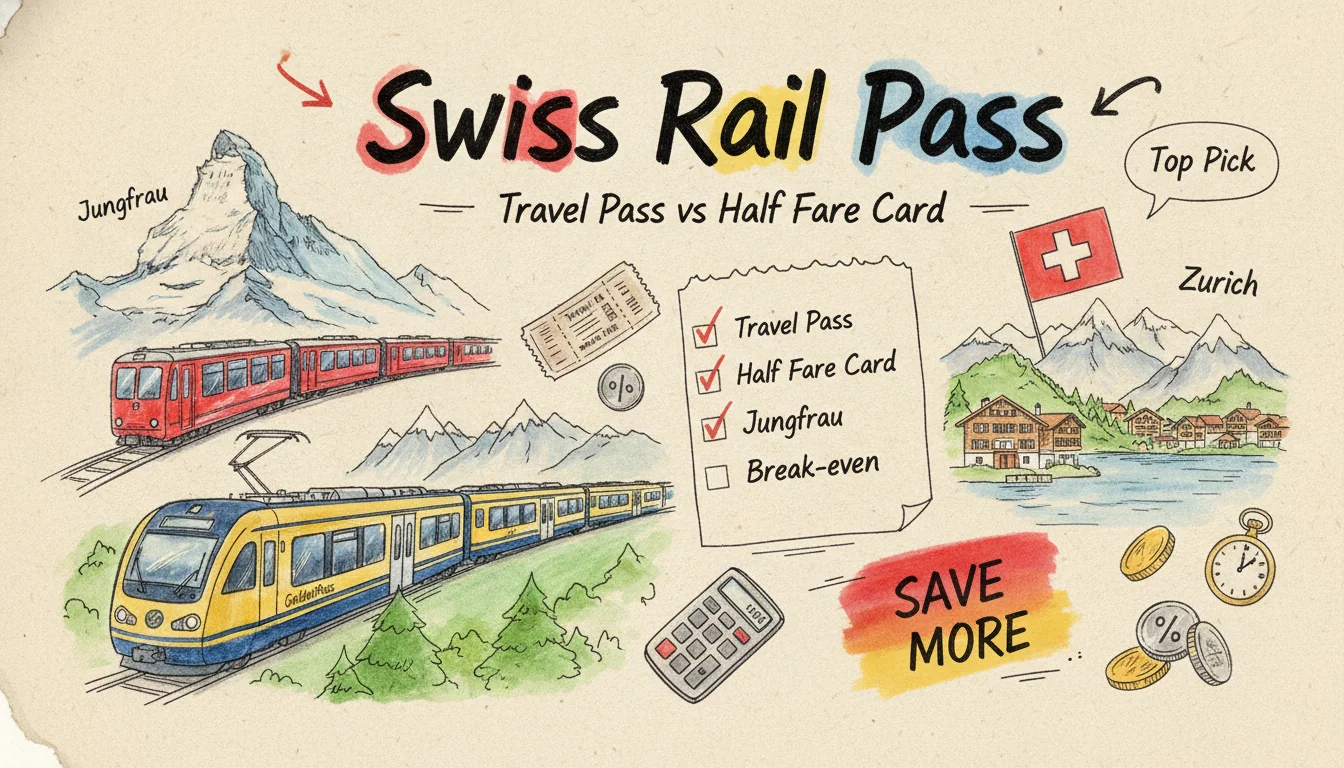
The Swiss Travel Pass runs CHF 254 for three days and CHF 439 for eight. A Half Fare Card is a flat CHF 150 that lasts a whole year. The gap between them is not "a bit more expensive." It is whether your trip actually pays that pass off. Real talk, Switzerland raised prices across the board for 2026: Half Fare Card jumped from CHF 120 to CHF 150, peak-season Jungfrau summit tickets now top out at CHF 234.80, and even GoldenPass seat reservations rose from CHF 12 off-season to CHF 16 in peak. Add it all up. After that, the advice everyone has repeated for a decade, "just buy a pass and don't think about it," finally cracks.
I took the three scenic routes Swiss visitors hit most often, namely Jungfraujoch, GoldenPass Express and Gotthard Panorama Express, and laid out every official fare and travel time. Then I matched each one against what you actually pay under a Swiss Travel Pass, a Half Fare Card and point-to-point tickets, so I could work out the break-even for each kind of traveler. No "Switzerland is gorgeous, you have to go" filler here. Just one thing: how you should buy your tickets, and the few thousand it saves you.
Understand what each ticket really sells, before the name fools you
The biggest trap in Switzerland's ticketing system is that all three tickets have names that sound like a "deal," yet they sell completely different things. After reading through the official terms, I see them as three pricing logics:
- Swiss Travel Pass: consecutive-day product. You buy 3, 4, 6, 8 or 15 days, and 2nd-class prices run from CHF 254 to CHF 469. During that window, national trains, buses and lake boats are "unlimited and free," most scenic trains carry no fare (you pay only the reservation fee), and over 500 museums nationwide are free. It sells "unlimited travel."
- Swiss Half Fare Card: valid one year, a flat CHF 150 (up from CHF 120 in 2026, a 25% rise), no class or age tiers. It does not let you ride anything for free. Instead it cuts almost all national transport plus most mountain cable cars to half price. It sells "every leg at 50% off."
- Point-to-point ticket: you buy nothing in advance and pay full fare leg by leg. A single Jungfrau run alone can eat CHF 234.80, but if you only ride 2 or 3 legs, your total might not beat a pass. It sells "flexibility, not locked to a fixed number of days."
Here's the thing: it all hinges on "will you use up the value." Per Switzerland Tourism's official notes, a Half Fare Card slices mountain railways like Jungfrau straight in half (50% off), while a Swiss Travel Pass only gives 25% off that same leg. That gap, 25% versus 50%, is exactly where 90% of first-timers get it backwards. They assume a bigger pass is automatically a better deal. On mountain legs, Half Fare is often far more brutal than any pass. Put entry prices side by side first: Swiss Travel Pass 2nd-class is CHF 254 for 3 days and CHF 439 for 8; Half Fare Card is a flat CHF 150; point-to-point costs CHF 0 to start and you pay full fare each leg. If you want to grab a pass directly, KKday's Swiss Travel Pass has an English checkout, so you skip wrestling with a foreign official site.
Jungfrau: the priciest leg, and the one that decides your ticket
Jungfraujoch is the single most expensive line item of any Swiss trip, and the leg where the three tickets diverge most dramatically. The summit round-trip from Interlaken Ost runs CHF 151.20 off-season (November to April) at the official rate, climbing all the way to CHF 234.80 for peak-day tickets. The official price list on jungfraujochtickets.ch shows this gap depends entirely on which day you go up.
Here is what each ticket actually costs (estimated at the peak CHF 200 tier):
| How you buy | Jungfrau round-trip actual | Discount mechanism | Who it suits |
|---|---|---|---|
| Point-to-point full price | ~CHF 201–234.80 | None | Going once, no other mountains |
| Swiss Travel Pass | ~CHF 150–176 | 25% off (official) | Also want unlimited valley trains |
| Half Fare Card | ~CHF 100–117 | Straight 50% off | Mountains are the focus, little valley travel |
The gap is real. On one Jungfrau ticket, a Half Fare Card holder saves nearly CHF 100 over point-to-point, and another CHF 50 or so over a pass. Last time I planned a Swiss trip for my family, this is exactly where I got stuck. On this leg, Half Fare's 50% crushes a pass's 25%, and I totaled both options out before I dared to book. Trust me, run the numbers yourself. If your trip is "mostly going up to see snow, not much valley movement," a Half Fare Card (CHF 150) plus a few half-price mountain tickets very likely lands well below the 8-day pass (CHF 439).
One brutal landmine to flag: from 1 May to 31 October 2026, the Jungfrau summit train requires a reservation, so whatever ticket you hold, you have to lock a slot first. Sell out on-site and you only get to reschedule. To skip fighting the official site for a reservation, KKday's Jungfrau day tour bundles the summit train and a guide together, with departures from Zurich, Lucerne or Interlaken, ideal if you would rather not deal with reservation details.
GoldenPass Express: where the pass finally shows its muscle
The GoldenPass Express is a different story. This scenic train linking Montreux and Interlaken takes about 3 hours 15 minutes, climbing from the vineyards along Lake Geneva into the Alpine heart, and it is the most popular of Switzerland's big three scenic trains.
The point-to-point fare is actually cheap: Montreux to Interlaken Ost is just CHF 56 one-way in 2nd class, and Lucerne to Interlaken Ost is only CHF 34. But here is the counterintuitive conclusion: the cheap leg is exactly where the pass shines.
The reason is the discount mechanism. The official fare table on holidaystoswitzerland.com shows Swiss Travel Pass holders ride the GoldenPass with "no fare at all," paying only the reservation fee, while the Half Fare Card cuts the fare in half (CHF 56 becomes CHF 28). Laid out:
| How you buy | Montreux→Interlaken actual | With reservation (peak CHF 16) |
|---|---|---|
| Point-to-point | CHF 56 | ~CHF 72 |
| Half Fare Card | CHF 28 | ~CHF 44 |
| Swiss Travel Pass | CHF 0 | ~CHF 16 (reservation only) |
The pass zeroes out the fare on this leg, leaving just the CHF 16 reservation. If your trip is "lots of legs, hopping city to city," that compounding free-fare effect is the real engine that pays the pass off. Not one big ticket, but a dozen small tickets stacking up free, one after another. If you want to benchmark other European rail products first, Klook's Europe transport promo hub gives you a price reference. What is discounted there rotates every quarter, so confirm the live code the week you book rather than trusting a number in an article.
Do not ignore the reservation fee either: peak (2 May to 1 November 2026) is CHF 16, off-season CHF 12. Prestige first class requires a reservation; 2nd and 1st class do not, but in peak you almost always need one, or you stand for the view. If you want lodging bundled in, KKday also has a GoldenPass Express 4-day 3-night classic package that ties the train and overnight stays together.
Gotthard Panorama Express: seasonal, with one supplement you cannot dodge
The Gotthard Panorama Express is the most unusual of the three routes, because it is a "boat plus train" combo. You first take a steam paddle-wheel boat across Lake Lucerne from Lucerne to Flüelen (about 2 hours 45 minutes), then switch to a classic-carriage train through the Gotthard pass straight to Lugano in the Italian-speaking region, 5 hours 29 minutes in total. It runs once a day, one direction only, and it is seasonal: in 2026 it operates only from 18 April to 18 October, shutting down entirely in winter.
This route's pricing trap is one supplement you cannot dodge. Per myswissalps.com and switzerlandtravelcentre, the full run at 2nd-class boat plus 1st-class train is CHF 135, but every passenger "regardless of ticket type" has to pay a mandatory supplement of CHF 24 on top. Across the three tickets:
| How you buy | Boat + train fare | Mandatory supplement | Total paid |
|---|---|---|---|
| Point-to-point full price | CHF 135 | CHF 24 | CHF 159 |
| Half Fare Card | ~CHF 67.5 | CHF 24 | ~CHF 91.5 |
| Swiss Travel Pass (2nd class) | CHF 0 (CHF 17 upgrade on train leg) | CHF 24 | ~CHF 41 |
A pass is strong here too, with a free fare. But remember: a 2nd-class pass has to top up CHF 17 to upgrade its train leg, plus that CHF 24 supplement, for about CHF 41 total. Fair warning, the easiest thing to miss is that CHF 24. Plenty of people assume "I have a pass, so it is all free," then get hit with the charge on-site and freeze. Read the terms. All three tickets owe this supplement: point-to-point pays it, Half Fare pays it, a pass pays it, CHF 24 with no exceptions, so budget for it up front. This boat-and-train runs just once a day over a roughly 6-month window from 18 April to 18 October, so if you want lodging tied in to skip scheduling legs yourself, KKday's Gotthard Panorama Express 3-day 2-night classic trip packages the boat ticket, train and overnight together.
Stack all three routes: the break-even for four kinds of traveler
Looking at single legs is not enough. What you really need to total is "the whole trip stacked together." I ran the full ticket math on the four most common Swiss itinerary types, and this is the most important table in this piece:
| Traveler type | Itinerary profile | What to buy | Rough cost logic |
|---|---|---|---|
| Mountain camp (under 5 days) | Jungfrau + 1 mountain, little valley travel | Half Fare Card | CHF 150 card + half-price mountain legs, usually below the 8-day pass |
| Marathon camp (8+ days) | Many cities, daily trains + scenic lines | Swiss Travel Pass 8/15 day | Free fares stack up, break-even by trip count |
| Dragonfly camp (3-day blitz) | Just Zurich + a Jungfrau round-trip | Point-to-point | Only 2-3 legs, a pass goes underused and loses |
| Middle camp (4–6 days) | Both mountains and city hops | Do the math, no standard answer | Half Fare vs 6-day pass often within CHF 50 |
The "middle camp" is the most agonizing, because a Half Fare Card (CHF 150) plus half-price mountain legs and a 6-day pass (about CHF 389) often land within CHF 50 of each other. At that point you have to add up your actual itinerary leg by leg, not plug into a formula. Here is a concrete example: a 4-day trip with one Jungfrau run (half price CHF 117), the GoldenPass (half price CHF 28) and two days of city trains (half price roughly CHF 40) totals about CHF 335 on the Half Fare Card, saving CHF 54 over the 6-day pass at CHF 389. But if you city-hop daily and ride 8 legs across 4 days, the pass's free stacking overtakes it. Sorting it out, a simple rule of thumb: lots of mountains, little valley → Half Fare Card; daily city hops → pass; only 2-3 stops → point-to-point.
I should also be honest about the pass's downside: its biggest risk is "buying it and not using it up." Once the consecutive-day version has two stationary days mid-trip, those two days of fixed cost are pure waste, so the pass really does not suit people with loose itineraries, and forcing it loses money. The Half Fare Card is no cure-all either. Be aware it does not discount a handful of private cable cars, and it only pays off if you accumulate leg by leg. People too lazy to total it up usually save less than they imagined.
The math of breaking even really comes down to one sentence. A pass is "fixed cost amortized," cheaper the more you ride; Half Fare is "marginal cost halved," saving on every leg but you have to accumulate it yourself; point-to-point is "zero fixed cost, zero discount." Work out your travel density and the answer falls out. If you are doing a multi-country cross-border trip, Trip.com's 10% off select European attraction tickets is worth weighing in too, folding French and Italian attraction discounts beyond Switzerland into one total. You can browse all the Switzerland-related deals in one place on the KKday store page.
Three details most people get wrong
First, do not forget to apply for the family card. Both the Swiss Travel Pass and the Half Fare Card offer the Swiss Family Card, where children aged 6 to 16 travel free or at a steep discount when accompanied by a parent. A family of four that skips applying basically pays for two extra tickets, and I have watched far too many people discover this only on-site.
Second, the class gap is smaller than you think. Take the Swiss Travel Pass: 2nd class is CHF 254 for 3 days and 1st class is CHF 405, a CHF 151 difference, about 60%; the 8-day version is CHF 439 in 2nd and CHF 697 in 1st, stretching the gap to CHF 258. Swiss 2nd-class cars are already very good, and unless you want to grab a big window seat for photos on a scenic train, 2nd class is enough for most people. The CHF 151 to CHF 258 you save covers another mountain, or even tops off your whole Jungfrau CHF 117 half-price ticket with change to spare.
Third, work out whether the Flex ticket is worth it. The Swiss Travel Pass Flex lets you pick 3, 4, 6, 8 or 15 "non-consecutive" travel days within a month, good for people with a few stationary days mid-trip. But Flex usually costs a bit more than the consecutive version, and if you travel every single day, the consecutive one actually saves you money. Do not pay an unnecessary premium just for the word "flexibility."
Where to buy and how to pay, so you do not eat an extra fee
Once the tickets are sorted, the last gate is "where to buy." There are mainly three channels for Swiss tickets, each with a hidden cost:
The first is the SBB Swiss Federal Railways official site. Pricing is the most transparent, simply the official rate, but its interface is mainly in English, German and French, and paying with a card from outside Switzerland usually pulls a foreign transaction fee of around 1.5%. On a CHF 439 8-day pass, that fee alone adds about CHF 6.6 (roughly US$8). For people comfortable in English who hold a no-foreign-fee card, the official site is the cleanest.
The second is Chinese-language reseller platforms (KKday, Klook and the like). Upside: a familiar-language interface, you can stack platform rewards or use a promo code, and for reservation-included trips like Jungfrau and GoldenPass you clear seat-locking in one go. Trade-off: platform prices occasionally run a touch above official, but for people who fear a foreign interface or a botched reservation, time saved usually makes it worth it. Last time I just could not be bothered to wrestle with SBB's reservation system, so I bought a summit-train day tour outright on a platform. I compared both sides. Platform was only slightly pricier, but the reservation hassle it saved was well worth it.
The third is buying on-site. Unless you have no other choice, I personally would not. The mountain legs that require peak-season reservations (like Jungfrau from May to October) are often sold out at the counter, and walk-up sales come with no discount, so you lose on both flexibility and price.
On payment, remember three things: use a no-foreign-fee card where you can, watch the maximum cap on platform promo codes (the European rail code, for instance, tops out at USD25 off), and add the reservation fee into your total separately rather than comparing the ticket figure alone. Lay the hidden costs of these three channels side by side, and the total gap sometimes sits right between that 1.5% fee and a single promo code.
FAQ
Q1: Can I buy the Swiss Travel Pass and the Half Fare Card together?
No, and there is no point. The two are mutually exclusive strategies: the pass is unlimited free, the Half Fare Card is half off every leg, so buying both is just waste. Use the break-even table above to figure out which camp you are in, then pick one.
Q2: Do I have to reserve for Jungfrau?
From 1 May to 31 October 2026, peak season requires a reservation, so whatever ticket you hold you have to lock a slot first. Off-season it is not mandatory, but I still suggest reserving on busy days. Buying a summit-included day tour through a platform like KKday usually handles the reservation for you, sparing you the fight with the official site.
Q3: Which is more worth riding, the GoldenPass or the Gotthard Panorama Express?
It depends on season and route needs. The GoldenPass runs all year, takes just over 3 hours and connects conveniently to Interlaken, good for people whose main itinerary is in central Switzerland. The Gotthard Panorama Express is seasonal (April to October), is a 5.5-hour boat-plus-train, and ends in Lugano in the Italian-speaking region, good for trips heading south into Ticino. The Swiss Travel Pass covers the fare on both (Gotthard still owes the supplement).
Q4: After the 2026 hikes, is the Swiss Travel Pass still worth buying?
Yes, but the bar is higher. Half Fare rose 25% (CHF 120 to 150), peak Jungfrau tops CHF 234.80, and reservation fees went up too, so total cost climbed. After the hikes, the "marathon camp" (8+ days, starting at CHF 439 but riding daily) is still cheapest on a pass; but the "mountain camp" now leans toward Half Fare, because that 50% mountain-ticket discount beats a pass's 25%. Pro tip: work out your travel density first, and stop reflexively buying the biggest pass.
Q5: How do I buy children's tickets for the best price?
Be sure to apply for the Swiss Family Card. Under-6s travel free, and 6 to 16-year-olds travel free or at a steep discount on most legs when accompanied by a ticket-holding parent. The card is a free add-on, so skipping it is a pure loss.
Sources
- SBB Swiss Federal Railways: Swiss Travel Pass official page
- Switzerland Tourism: GoldenPass Express
- myswissalps: Swiss Travel Pass 2026 pricing and coverage
- jungfraujochtickets.ch: Jungfrau ticket prices 2026
- Holidays to Switzerland: GoldenPass Line fares and timetables 2026
- Holidays to Switzerland: Gotthard Panorama Express 2026
All Deals
One Day Interlaken & Grindelwald Adventure Experience | Switzerland
Interlaken · 3.8 (5) · US$ · 229.42
8D7N Grand Train Tour of Switzerland – Classic Jungfrau
Jungfraujoch · US$ · 2,332.4 · from
2D1N Jungfraujoch – Top of Europe
Jungfraujoch · US$ · 879.43 · from
Switzerland Zermatt Peak Pass (with Swiss Travel Pass Option)
Zermatt · 4.8 (137) · 1K+ booked · US$
Jungfraujoch: Top of Europe Round-Trip Train Ticket | Switzerland
Jungfraujoch · 4.6 (16) · 200+ booked · US$
Swiss Travel Pass
Zurich
Paragliding Experience in Interlaken | Switzerland
Interlaken · 4.9 (113) · 900+ booked · US$
Interlaken: Quick Walk with a Local
Interlaken
Swiss Travel Pass: Unlimited Train, Bus & Boat Rides in Switzerland
4.9 (1150) · 20K+ booked · US$ · 323.79

Cool
Travel Deal OrganizerTravel deal data nerd. Specializes in early-bird flights, transit passes, and KKday/Klook stacking logic — calculates which ticket is the best deal. Comparison tables, price PKs, and rule breakdowns.
You May Also Like
Itoshima Without a Car 2026: Tour, Bus or Bike from Fukuoka?
A ¥7,980 Itoshima tour gives the Wedded Rocks 20 minutes; a ¥2,000 bus pass gives you the afternoon. Tours, bus, train and bike from Fukuoka, costed for 2026.
Yeosu World Island Fair from Busan: Buses, Costs and a 2-Day Plan (2026)
World Island Fair Yeosu (Sep 5 to Nov 4) from Busan: Sasang has 10 buses a day, Nopo only 4. A DIY 2-day trip is about US$58; the Klook tour skips the fair.
Saudi Arabia Trip 2026: eVisa, Advisories, Riyadh + Jeddah
Can you visit Saudi Arabia on your own now? Who gets the eVisa online, what US and UK advisories say, and a 7 or 9-day Riyadh-Jeddah plan from about US$161.