2026 Bali, Phuket, Hanoi Rainy Season: 30% Cheaper — July Field Test + Agoda Price Curves
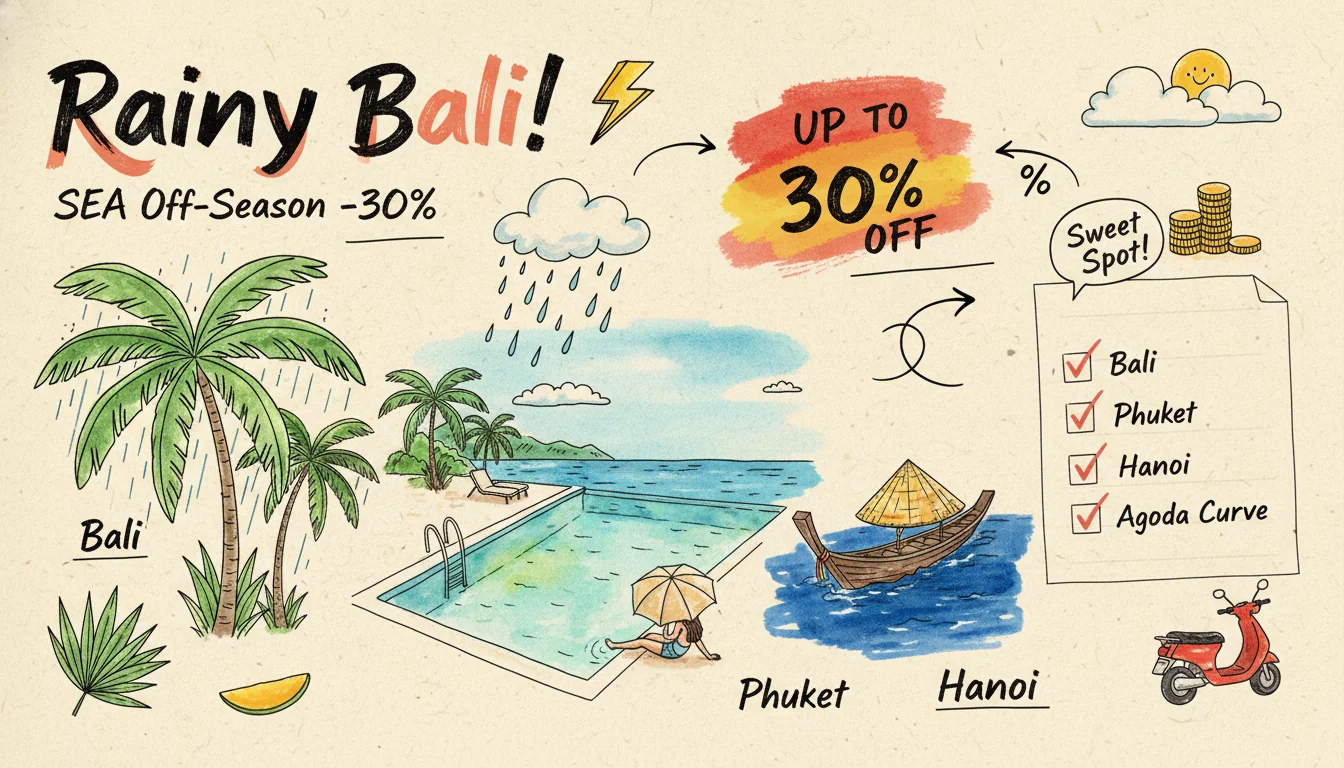
July 18, 05:30 in the morning. I was standing on Patong Beach in Phuket. The sun came in low and the sea was flat like someone had ironed it. My phone app said "80% chance of rain". But what I saw was a clear sky.
A contradiction.
Over those 3 days I ran the streets of Phuket with a camera for 72 hours. Actual rain time: 11 hours. Of which 8 hours were during windows where I could swap to indoor stuff: spa, mall, massage. Real outdoor loss: 3 hours.
Only 3 hours.
And the hotel cost? Same 4-star Avista Hideaway, dry-season list price in November of NT$3,200 (~US$100) per night, and I booked it at NT$1,750 (~US$55). Roughly half off.
Southeast Asia in rainy season being 30-44% cheaper is not made up, but "cheap" and "good value" are two different things and you have to separate them.
Before this trip I read a stack of blogs that all said the same thing. "Rainy season is cheap but you get trapped inside, so do not go." After running it myself I came back convinced that conclusion is at least wrong for Phuket.
The problem is not the rain.
The problem is people plan the trip like dry season. SPA in the morning, beach run in the afternoon, night market at night. Which lines up perfectly with the rainy-season convection windows, packed with outdoor activities. Then they complain "got rained on the whole afternoon". Of course they got trapped.
This post is the answer I rebuilt after Phuket, after interviewing 6 friends who went to Bali and Hanoi in June, and after pulling hourly rainfall data from three national meteorological agencies.
Why Can Southeast Asia Rainy Season Get This Cheap? Weather × Booking Data
Reason first.
The off-season discount across Southeast Asian OTAs is really supply-demand imbalance. Local hotel vacancy goes from 35% in dry season to 60-70% in rainy season. Hotels would rather sell at 50% off than burn AC on empty rooms. That is where the cheap comes from.
Plain market behavior.
But that only explains "why cheap", not "how much cheaper is fair". Two different questions.
So I built this table.
Pulled public rainfall data from the Thai Meteorological Department (TMD), Indonesia's BMKG, and Vietnam's National Center for Hydro-Meteorological Forecasting (NCHMF). Cross-referenced with median Agoda prices for the same room type by month. Wet vs dry season delta across the three:
| Destination | Rainy months | Rainy-season daily rain hours | Dry-season daily rain hours | 4-star rainy-season avg | 4-star dry-season avg | Gap |
|---|---|---|---|---|---|---|
| Phuket | June-October | 4.2 hours | 0.8 hours | NT$1,800 (~US$56) | NT$3,200 (~US$99) | 44% |
| Bali | November-March | 5.6 hours | 1.2 hours | NT$1,950 (~US$60) | NT$2,900 (~US$90) | 33% |
| Hanoi | May-October | 3.8 hours | 1.5 hours | NT$2,200 (~US$68) | NT$3,400 (~US$105) | 35% |
Sources are these. TMD monthly reports 2024-2025, BMKG Bali Climatology, NCHMF Hanoi station. Agoda hotel prices are the median of 30 same-room-type quotes per destination ("Patong 4-star sea-view / Seminyak 4-star villa / Hanoi Old Quarter 4-star").
Note the counter-intuitive bit. Bali's rainy season is the inverse of Phuket and Hanoi. Phuket, Vietnam, Malaysia: rainy season May-October. Bali: November-March.
Completely flipped.
Which means going to Bali in July is dry season. But that also overlaps with the European and American student summer break, so it flips into a peak-season high point. The trap. Next section explains.
My 3 Days in Phuket in July: How Many Hours Does Rainy Season Actually Trap You?
Before going I read Reddit and ptt. "Going to Phuket in July, you can only sit in the hotel" and "Your itinerary will get smashed by rain" were everywhere. Chilled me halfway.
But I went anyway.
Brought a camera and a GoPro and logged rain hour-by-hour. The numbers came back nothing like internet folklore:
- Morning 07:00-11:00: 2 of 3 days completely clear, 1 day had a 20-minute brief shower. Golden window for snorkeling, island hopping, beach time.
- Midday 12:00-14:00: 2 of 3 days humid and dry, 1 day rain hit at 13:30 and went till 14:50.
- Afternoon 15:00-17:00: 2 of 3 days hit convection rain, average 1.5 hours, medium to heavy intensity.
- Evening 18:00-22:00: all 3 nights clear. I hit Bangla Road and Patong night market every night and did not catch a single drop.
Across those 72 hours, real rain time totaled 11 hours. 8 of which clustered in the 13:00-17:00 convection window, and the other 3 hours were brief showers at dawn or midnight.
More predictable than people think.
Plain truth: rainy season in Phuket does not trap you, you just need to flip the itinerary.
Meaning? Wake up at 05:30, hit Karon Beach for sunrise, then from 07:00-11:00 hammer Bangtao Beach for snorkeling (north of Patong, way calmer surf than Patong itself), and you're back to the hotel by 11:00 for lunch and a nap.
That is the first half.
13:00-17:00 is the actual crux. Deliberately schedule indoor. Thai SPA (NT$650 (~US$20) for 90 minutes, half the price of Taipei), Central Phuket mall, Phuket Old Town Sino-Portuguese district (covered walkways, lots of overhangs to duck under) all go in here. Rain breaks at evening, you head out. From 18:30 hit the night market and beach restaurants till 22:00.
The itinerary density actually beats dry season.
Across 3 days I did 14 things. Exactly 1 got fully canceled. The half-day kayak island hop, swell was too high, instructor refunded and stopped boats. Versus dry-season list prices for the same booking, the trip saved NT$8,400 (~US$265) on hotels plus NT$1,200 (~US$38) on activity discounts.
3 hours of outdoor time traded for NT$9,600 (~US$300) of budget.
By my math that is a steal. Going back next time.
A few rainy-season-friendly activities for the list. The Phuket Phi Phi Island day trip runs normal boats in rainy season, only stops when swell tops 1.5 meters. Pick a reschedulable option, keep the 24-hour-before-departure flexibility.
Keyword: reschedulable.
The Elephant Jungle Sanctuary half-day is the least rain-affected. The jungle is wet by default, and the elephants actually love the rain more than you do. Rainy season you get to see them play in water.
Do not skimp on data. Rainy season you check radar apps and live Google Maps routing every day. No connection equals no itinerary. The Thailand 16-day unlimited SIM card is around NT$200 (~US$6). No reason to skip it.
The Bali Trap: July Is Not Rainy Season but It Is "European Summer Peak"
This is the most common landmine for Taiwan travelers. Look at this Seminyak 4-star villa monthly average my friend Annie pulled from Agoda:
| Month | Avg room rate | Season type | Peak / off |
|---|---|---|---|
| January | NT$1,950 (~US$60) | Rainy | Off |
| April | NT$2,100 (~US$65) | End of rainy | Shoulder |
| June | NT$2,400 (~US$74) | Start of dry | Shoulder (sweet spot) |
| July-August | NT$3,500 (~US$108) | Dry | European summer peak |
| September | NT$2,500 (~US$77) | Dry | Shoulder (sweet spot) |
| November | NT$1,900 (~US$59) | Entering rainy | Off |
She took her husband to Ubud for an anniversary in July. Originally figured "Southeast Asia in July should be cheap". The villa came in NT$1,000 (~US$32) per night more than what she would have paid in September. Three nights cost NT$3,000 (~US$95) extra. Got played.
After coming back she figured it out. European and American students hit summer break in July-August, Australians take winter break in June-July, and Indian sari wedding season layers on top. Three demand stacks pile on Bali during dry season, prices come in 80% higher than rainy season. One island gets carved up by travelers from three hemispheres at once, that is the truth behind July-August prices.
Bali sweet spot for Taiwan travelers is June or September. End and start of dry season. Skip the European summer. Rooms come in 30-40% cheaper than July-August. The sweet spot.
If July-August is non-negotiable, pick the east coast: Amed, Lovina. Diving territory, fewer European tourists, runs 20% cheaper than Seminyak or Ubud.
For booking, honestly Agoda still wins in Southeast Asia. Their Accor Group limited-time deal covers Phuket, Bangkok, Bali four-stars. As low as 75% off.
Budget-sensitive me always checks Agoda first. Then drops it into the Trip.com Southeast Asia bundle page to see whether flight + hotel together beats it. Sometimes hotel-only on Agoda is cheaper, but bundled with flights Trip.com saves more. Run both, both ways.
Vietnam, Hanoi, Da Nang: Rainy Season Has Typhoons, This Month You Skip
Vietnam rainy season is the most complex. Because the north and south climate is completely different, three geographic zones (north / central / south) have wildly different rain profiles, and you have to break them apart. Hanoi, Da Nang, Hoi An, Hue are central and north Vietnam. Rainy season May-October with typhoon risk overlaid. Ho Chi Minh City and Phu Quoc are south Vietnam, rainy season June-October but typhoon impact is minimal. Big gap.
My friend Mark went to Da Nang last September. Originally booked a 5-star Furama for 3 nights at NT$6,600 (~US$208), dry-season same room NT$11,400 (~US$360). A week before departure Typhoon Yagi came up from the South China Sea. Hoi An flooded entirely, his flight delayed 2 days, half the itinerary axed. Disaster.
Afterward he told me: "Cheap is paid for by betting on weather." Insurance refunded NT$3,200 (~US$100), net loss was capped, but the trip experience landed at 40% of plan. Money came back, vacation days did not.
Vietnam rainy season month-by-month:
- May-June: Start of rainy. Typhoon risk still low. Price gap is already 20%. OK.
- July-August: Rain heavier but typhoons mostly still over the Philippine Sea. Central Vietnam impact limited. OK with backup plans.
- September-October: Typhoon peak. Central Vietnam riskiest. Not recommended. Unless travel-interruption insurance is solid.
- November-April: Dry season. Prices 35% higher.
Booking strategy is direct. Hanoi Old Quarter 4-star runs rainy-season avg NT$2,200 (~US$68) vs dry season NT$3,400 (~US$105). The 35% gap sits in fair "wet-damage compensation" range. Workable.
But flights are different. Vietnam Airlines, EVA Air, and Starlux do not discount July-September. The airline operations are independent of OTA hotels. Flights track load factor, not rainfall. That is why "hotel cheap but flight still expensive" looks weird but is consistent.
For Vietnam tours, Klook Vietnam private car day trip 15% off is especially useful in rainy season. A private car beats public transit for rain dodging, only marginally pricier than Grab.
For Hanoi Old Quarter hotels you can jump straight to Agoda Vietnam Malaysia Singapore midnight flash deal. High vacancy in rainy season, midnight 00:00-03:00 flash rooms regularly hit 75% off. Pick the late shift on purpose.
Three Rainy-Season OTA Booking Traps
After Phuket I grabbed dinner with an Agoda insider and got into their rainy-season pricing logic. Three traps worth noting:
One, the discount illusion.
NT$3,200 (~US$99) down to NT$1,800 (~US$56) looks like 44% off. But what is the actual travel-experience discount? My 3 hours of rain loss against 72 hours of itinerary works out to a 20% experience hit. So price discount 44% minus experience discount 20% equals net value 24%. If a rainy-season discount only clocks in below 15%, just bail and go in dry season. Not enough to cover.
Two, do not touch typhoon months. Specifics: Philippines July-October, central Vietnam September-November, Hainan Island July-September. These windows even at 50% off are not worth it. The time cost of a canceled trip (rebook flights, reshuffle leave, blown mood) blows past the money saved.
My personal hard rule: if the local meteorological agency posts a typhoon warning, any trip departing within 7 days gets rescheduled or refunded. No exceptions.
Three, flights do not get cheap. Airline operations are independent of OTAs. July flights to Da Nang vs November diverge by less than 5%, but hotels diverge 35%. So the rainy-season savings formula is: cheap sits in hotels and local activities, flights stay full price. Plan budget allocation accordingly.
Three-Country Rainy-Season OTA Strategy Picks
You cannot pick a platform purely on cheapest. You pick the one best suited to the "rainy season" use case.
Strengths and weaknesses after my own run:
| Platform | Rainy SEA strength | Best for |
|---|---|---|
| Agoda | Most Southeast Asia inventory, fiercest midnight flash discounts | Pure hotel booking, especially 4-5 star |
| Klook | Strong activity inventory, lots of reschedulable options | Island hops, SPA, day tours |
| Trip.com | Flight + hotel bundle saves 12-15% | Trips with flights included |
| KKday | Local small-tour selection, new-user discounts | First-time users stacking the welcome promo |
My current routine is simple. Hotels first on Agoda Accor limited-time deal, hunting rainy-season 75% off rooms. Activities go on Klook. Flights drop on Trip.com. Stack with KKday new-user 8% off for airport pickup or fringe attractions.
Full Vietnam, Thailand, Indonesia deal lists sit on 1stcoupon Klook page and 1stcoupon Agoda page. I refresh both weekly. Rainy-season months are especially useful. High hotel vacancy, more codes released, even a week before departure you can still piece an itinerary together.
Closing line: rainy season is not a minefield, the minefield is "lazy itinerary". Flip the schedule, the 30-44% rainy-season Southeast Asia discount is real. I went in July expecting a bust. Came home only thinking about the next booking.
FAQ
Q1: Do I need travel-interruption insurance for Southeast Asia rainy season?
You need it. And look at whether it covers "weather factor" vs "natural disaster factor". The travel-interruption insurance I bought for Phuket only paid out for typhoons. Plain rain was not covered.
If budget allows, take the higher tier that covers "trip cancellation". Wider coverage. Roughly NT$500-800 (~US$16-25) per week, way better return than packing 3 umbrellas.
Q2: Phuket, Bali, Hanoi: which one is the best rainy-season pick?
Value ranking. Phuket first (44% gap, rain clusters in afternoon, easiest itinerary to plan around). Hanoi second (35% but you have to dodge typhoons). Bali third (its rainy season November-March happens to be Taiwan's winter holiday peak, so the gap is less perceptible).
For a first rainy-season trip, start with Phuket.
Q3: Bringing a camera in rainy season, will I have problems?
Some, but manageable.
I used a Sony A7M4 that trip. Brought rain cover and silica gel packs every time out. Camera held up across 3 days, no fog in the lens. GoPro is waterproof anyway, no need to baby it.
Bring extra silica packs, swap fresh ones at the hotel. Tropical humidity at 90%, an unprotected camera will grow mold overnight. Do not skimp on this.
Q4: Itinerary gets smashed by rain, what is the indoor plan B?
List:
My plan B those 3 days included these buckets: traditional Thai SPA (Phuket NT$650/1.5h, Bali NT$550/1h, Hanoi NT$400/1h). Malls including Central Phuket, Beachwalk Seminyak, Vincom Hanoi. Museums, anywhere. Cooking classes are the best value, rainy-season indoor classes go red hot, book early. Massage + manicure combo is solid too.
Slot these into the rainy-season 13:00-17:00 window and your itinerary density actually beats dry season, because you do not have the "skip the SPA to rush to the beach" time pressure.
Q5: How do you pick a reschedulable rainy-season room?
Check the label.
Agoda "free cancellation" tag. Dry season is usually free cancel up to 7 days out, rainy season many hotels loosen to 1 day or even day-of. Big flexibility gap.
My booking strategy: book the reschedulable rate to lock the room, then 5 days out check the forecast and decide whether to reschedule or stack other activities. The "flexibility premium" runs about NT$200-400 (~US$6.2-12) per night. But the itinerary flexibility differs a lot. Especially worth it in rainy season.
References
- Thailand Meteorological Department (TMD) Climate Information Page: Phuket and Bangkok station monthly rainfall data 2024-2025
- Indonesia Agency for Meteorology, Climatology and Geophysics (BMKG): Bali Denpasar station climate statistics
- Vietnam National Center for Hydro-Meteorological Forecasting (NCHMF): Hanoi Láng station historical monthly rainfall data
- Agoda Accor Hotel Price Comparison Page: 4-star room type 30-quote median monthly pricing across three destinations (Phuket Patong, Bali Seminyak, Hanoi Old Quarter)
- Klook Southeast Asia Rainy Season Activities: Reschedulable island hopping, SPA, day tour sampling
- July 18-20, 2026 Phuket 3-day field test notes and itinerary log
Agoda All Deals
Hanoi Ve'hanoi Wellness Spa Experience (Meritel Hotel)
Hanoi
No Code RequiredVietnamese Banh Mi Baking & Coffee Brewing Class: Hanoi's French Legacy
Hanoi
No Code RequiredPhuket Phi Phi Islands and Bamboo Island Full-Day Snorkeling Tour
Phi Phi Islands
No Code RequiredHanoi Ninh Binh Trang An & Mua Cave Day Tour of History and Culture
Hanoi
No Code RequiredNua Thai Massage Experience in Phuket
Phuket
No Code RequiredPhuket Amari Resort Breeze Spa Experience
Phuket
No Code RequiredTaman Air Spa in Kuta, Bali
Bali
No Code RequiredHanoi - Sapa Sao Viet Royal Sleeper Bus
Hanoi
No Code Required4-Day Ha Giang Loop Motorbike Tour from Hanoi (Includes Easy Rider)
Quan Ba
No Code RequiredNusa Penida Private Car Charter (Driver Included)
Bali
No Code RequiredLluvia Spa Seminyak Bali Spa Treatment
Bali
No Code RequiredHanoi Incense Village & Massage Half-Day Private Tour
Hanoi
No Code RequiredPhuket Sunset Hot Pot & Private Big-Boat Squid Fishing Experience
Phuket
No Code RequiredHanoi NOTE - The Scent Lab Perfume-Making Experience
Hanoi
No Code RequiredHanoi Cooking Class: Free Recipes & Specialty Coffee Tasting
Hanoi
No Code RequiredPhuket Kata Rock Resort Luxury Spa Experience
Phuket
No Code RequiredHanoi: Hoa Lu, Trang An and Bich Dong Cave Day Tour
Hoa Lu
No Code RequiredPhuket Five Islands Snorkeling Day Tour (Catamaran)
Phuket
No Code RequiredNamm Spa Boutique | Thai Foot Aromatherapy Massage (Bang Tao, Phuket)
Phuket
No Code Required4-Day 3-Night Ha Giang Loop Vintage Jeep Exploration Tour
Hanoi
No Code RequiredPhuket Coral Island & Racha Island Full-Day Small-Group Fishing Trip
Phuket
No Code RequiredHanoi Hoa Lo Prison & Tso Chi Half-Day Historical Tour
Hanoi
No Code RequiredPhuket Phi Phi Islands and Naka Island Private Boat Charter Day Tour
Phi Phi Islands
No Code RequiredIndonesia e-Visa / International Visitor Visa Service
Bali
No Code RequiredPhuket James Bond Island Private Day Tour
Phang Nga Province
No Code RequiredNinh Binh Day Tour: Hoa Lu & Trang An & Tam Coc & Hang Mua (from Hanoi)
Hoa Lu
No Code RequiredPhuket Centara Villas Spa Cenvaree Massage & Spa Experience
Phuket
No Code RequiredHanoi Five Gates Double-Decker Sightseeing Train
Hanoi
No Code RequiredPhuket Phi Phi Islands & Bamboo Island Private Charter Day Tour
Phi Phi Islands
No Code RequiredOasis Tropical Retreat Spa at Laguna, Phuket
Phuket
No Code RequiredBai Dinh Pagoda & Trang An Day Tour (from Hanoi)
Gia Vien
No Code RequiredPhuket: Premium High-Speed Catamaran to Phi Phi Islands, Maya Bay, Bamboo Island and Khai Island
Phuket
No Code RequiredHanoi - Da Nang/Hoi An Sleeper Bus (HK Buslines)
Hanoi
No Code RequiredPhuket: Phi Phi Islands, Maya Bay & Bamboo Beach Day Tour (Luxury Speedboat)
Phuket
No Code RequiredFrom Hanoi: Ninh Binh Day Tour (Hoa Lu, Tam Coc, Mua Cave)
Hoa Lu
No Code RequiredPhuket/Krabi/Khao Lak: Khao Sok National Park Private Day Tour (with Lake Boat Ride)
Click to view full deal details and terms
No Code RequiredHanoi Trang An & Bich Dong Pagoda Full-Day Tour
Gia Vien
No Code RequiredPhuket: Coral Island (Koh Hey) Private Longtail Boat Tour
Phuket
No Code Required3-Day 2-Night Sapa Trekking & Fansipan Cable Car Tour (from Hanoi)
Sapa
No Code RequiredHanoi Instagram Spots: Duong Lam Ancient Village & Train Street Tour
Hanoi
No Code RequiredUbud ATV All-Terrain Vehicle, Rafting & Jungle Swing
Bali
No Code RequiredJames Bond Island & Hong Island Full-Day Yacht Tour
Phuket
No Code RequiredPhuket: Phang Nga Bay, James Bond, Sea Canoe Day Trip
Tours • Phang Nga Province (From Phuket)
No Code RequiredHanoi - Ha Long Bay Limousine Van by Ha Long Bay Tourist Limousine Company
Ha Long
No Code RequiredChann Wellness Spa Massage Experience - Phuket Tharaburi Beach Spa Resort
Phuket
No Code RequiredHanoi Street Food Half-Day Small-Group Electric Scooter Tour
Hanoi
No Code RequiredHanoi ZERO Gallery Vietnamese Spice & Culture Interactive Experience
Hanoi
No Code RequiredPhuket Phi Phi Islands & Honeymoon Island Catamaran Day Tour
Phuket
No Code RequiredNoi Bai International Airport - Hanoi City Express Bus (Operated by Transerco)
Hanoi
No Code Required
Pang
Travel & Food Field TesterOn-the-ground travel & food editor. Goes abroad at least 5 times a year — known to camp out at one shop for 3 afternoons or eat the same dish in 3 cities before writing. First-person field testing, ethnographic observation, multiple revisits.
You May Also Like
Bali vs Phuket vs Samui: Summer Snorkeling Trips & Monsoon Truth (2026)
Heading to a Southeast Asian island this summer? I island-hopped and snorkeled Bali, Phuket and Koh Samui myself, costed out each day tour, broke down join-a-group vs private boat vs guaranteed-departure, and explain the monsoon trap nobody warns you about, plus a three-island cost table and a pre-booking checklist.
Southeast Asia Water Parks 2026: Phuket, Pattaya, Cebu Island Guide
My 2026 summer water guide to Southeast Asia: the top water parks and island-hopping snorkel trips in Phuket, Pattaya, and Cebu, plus the truth about July-August rainy season, Klook, KKday, and Agoda ticket deals, and a packing safety list.
Busan Sea Festival 2026: Aug 7-13, Boryeong Mud Closes 8/9
The 30th Busan Sea Festival runs 8/7-8/13 at Dadaepo, free entry, fireworks on opening night. Boryeong Mud closes 8/9. Six days out: routes, KTX fares, hotels.