Mauritius by Coast: 11 Water Tours and Where to Stay
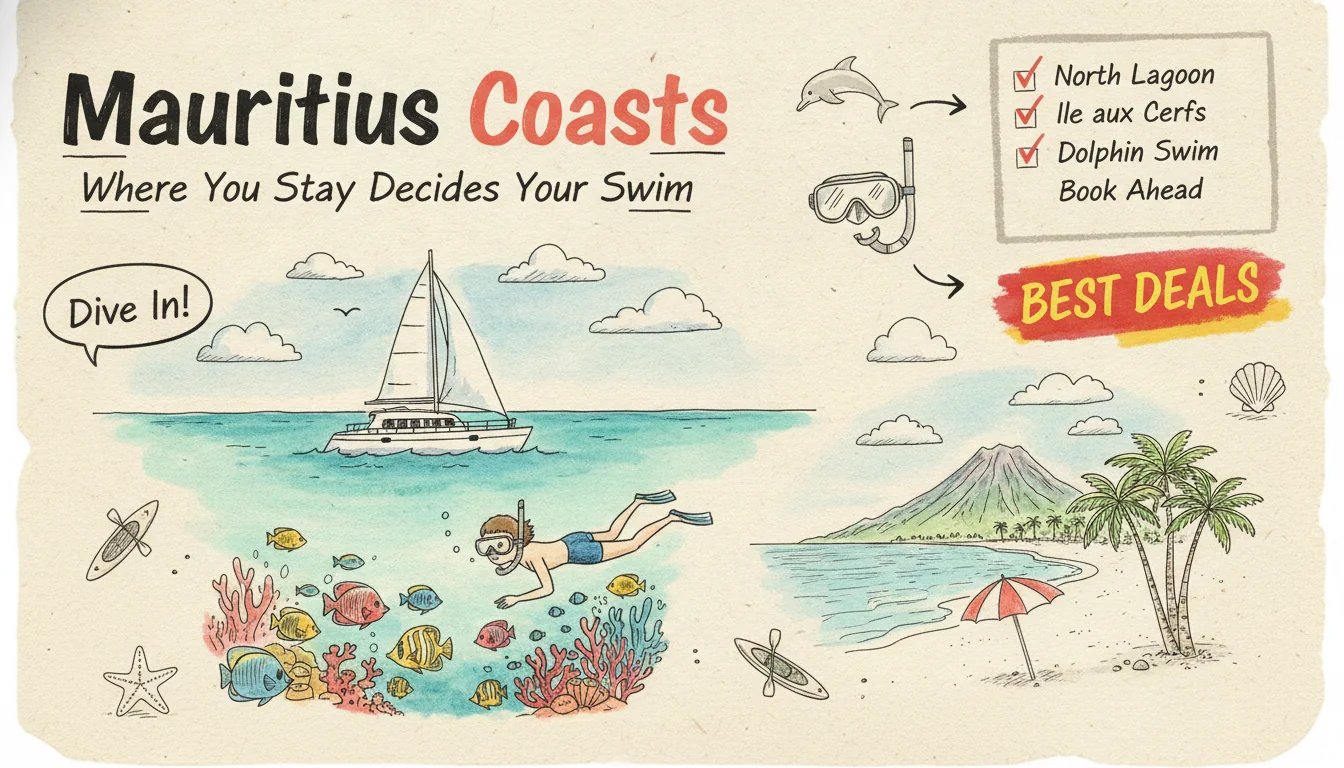
One line of small grey text at the bottom of a hotel page is what finally broke my deadlock: "water activities in this area may be adjusted to sea conditions during the winter trade wind season." That was the 10th Mauritius hotel tab I had opened, some time past 11pm on a Sunday night, and the 9 tabs before it said nothing of the kind. Those 9 all looked the same as each other. White sand, an infinity pool, one photo of a kid laughing in the shallows. The prices were not the same, and nothing in the photos explained why.
Let me be upfront about what this is. It is not a trip report. I have been to a fair number of islands and Mauritius is not one of them. What I did in September 2026 was pull all 11 Mauritius tours currently on the shelf, lay them out one by one, and match them against the island's geography and its wind season. The result is a table covering four places to stay. My younger kid is 5 and my older one is 7, so my first question about any tour is always the same: can we actually get in the water on this one? In Mauritius the answer mostly is not set by your hotel. It is set by which coast that hotel sits on.
Start with this table: four coasts, wind season, and what is on the shelf
I built it by sorting all 11 tours by where they put you in the water. The wind column follows what the meteorological and travel sources agree on: the southeast trade winds blow hardest from roughly May to September, they hit the east coast head-on, and the central mountains shelter the west and the north.
| Where you stay | Anchor towns | May to Sept trade winds | Tours on the shelf | Of those, in water or at sea |
|---|---|---|---|---|
| North coast | Grand Baie, Trou aux Biches | Relatively steady | 3 | 2 |
| Northeast tip | Grand Gaube, around Île d'Ambre | Workable inside the lagoon | 1 | 1 |
| East coast | Belle Mare, Trou d'Eau Douce | Windiest, choppy water | 1 | 1 |
| West coast | Flic en Flac, Black River, Le Morne | Most sheltered on the island | 2 | 2 |
| South coast | Bel Ombre, around Gris Gris | Big swell | 3 | 0 |
| Island-wide, from the air | Seaplane | Depends on the day | 1 | n/a |
3 + 1 + 1 + 2 + 3 + 1 comes to 11, which matches what I counted on the Klook Mauritius shelf. The column I want you to read is the last one. Three tours are based on the south coast, and between them they will put you in the water zero times. My own booking order comes later in this piece. The mechanism first.
Why the coast you sleep on decides whether you get in the water
Mauritius sits inside a coral reef. The reef holds the open-ocean swell offshore and leaves a ring of flat lagoon inside it, and that ring is the blue-green shallow water in every resort photo. The catch is that the ring is not continuous. Per Yellow Zebra's south coast area guide, the reef along the southern shore has breaks in it, so ocean swell runs straight through and hits the shoreline.
The second variable is wind. Several travel climate sources put the southeast trade winds at their strongest from about May to September, aimed at the east coast. The west and north sit behind mountains and are the calmest part of the island over those same months. Turn that around and the best snorkeling window runs from about October through April, with November and December the flattest and least windy.
Stack those 2 facts and Mauritius splits into 3 different seas. North and west work most of the year. East depends on the month. South looks incredible and you cannot get into it. Hotel star rating, room category and how good the breakfast is do not move any of the three.
North coast: the most island-hopping boats, and the longest drive from the airport
The area around Grand Baie has the densest concentration of boat trips in Mauritius. Three uninhabited islands sit off the northern shore: Coin de Mire (Gunner's Quoin), Flat Island and Gabriel Island. Per the trip notes from Civitatis and Tourism Mauritius, most island-hopping boats leave straight off the beach at Grand Baie, meeting at 8am and casting off at 8:30. Three of the 11 tours are based here, and 2 of them go out to sea.
With kids, what the north has going for it is short crossings, plenty of islands, and somewhere to land whenever you need one. I once tried a full day on a boat that never touched land, on a different island, and my younger one started asking when we were going home by 3pm. Since that trip, the first thing I check on any boat is whether the route has stops built into it. A five-island cruise with BBQ and snorkeling is the shape I look for: several chances to get off, so a seasick or restless kid is never stuck out there with nowhere to go.
The cost is drive time. Several airport transfer operators quote 60 to 75 minutes depending on traffic, which is 15 minutes longer at each end than staying on the west coast. If you have just landed and you are dragging 2 small kids who have not adjusted to the time difference, that extra hour has to go into the day-one energy budget honestly.
East coast: Île aux Cerfs is here, but from June to September check the wind first
The stretch from Belle Mare to Trou d'Eau Douce is the longest lagoon in Mauritius, and it holds both Île aux Cerfs and the Grande Rivière Sud-Est (GRSE) waterfall. The shelf has exactly 1 tour based on the east coast, tying the waterfall, snorkeling at Île aux Cerfs and a catamaran into a single day, sailing out of Trou d'Eau Douce. If you want the waterfall, Île aux Cerfs snorkeling and catamaran day trip in your plan, the order I would book it in is month first, date second.
Since the southeast trade winds hit this coast head-on from May through September, a holiday that lands in the northern summer, which is winter down there, means the roughest water on the island. Several guides say it plainly: on the east coast from June to September, both sitting on the beach and snorkeling lose a lot of what makes them good.
That makes the east the one coast where I think you pick the month before you pick the hotel. Come between October and April and it is one of the prettiest lagoons on the island. Come in July and the same room at the same price may buy you a week of looking at the sea instead of getting into it. The airport to Belle Mare runs 45 to 60 minutes, a decent bit closer than the north.
West coast: dolphins and Crystal Rock both sail from this side
If you only get one coast and the trip is built around water, the west has the best odds. The reason is simple. It is the most sheltered side of the island, and both signature Mauritius sea scenes are here. First, dolphins. Per the trip notes from several local boat operators, spinner and bottlenose dolphins rest off Tamarin Bay on the west coast, holding close to shore before they head out to feed, which is why dolphin boats almost all leave at first light.
Second is Crystal Rock and Île aux Bénitiers, sailing out of the Black River area. A full-day catamaran that strings Crystal Rock, Île aux Bénitiers and dolphin watching into one run is the standard version. Both of the 2 west coast tours on the shelf go out to sea, a rate of 100%, the only one of the four coasts to score full marks.
The thing to watch with kids is the wake-up time, not the sea state. Dolphin boats leave before dawn, which means getting 2 kids out of bed in the dark, into a car, and pushing every meal earlier. My 7-year-old can take that. My 5-year-old, woken 2 hours early, usually falls asleep on the boat before noon, so I pay for a full day and get half of one. The practical case for staying on the west coast is that it cuts that pre-dawn drive down to almost nothing.
South coast: the best scenery, the fewest places you can get in
The south is the coast I most wanted to stay on and the first one I crossed off after reading. Gris Gris beach is the most dramatic thing to photograph in Mauritius, with no reef softening anything and open-ocean swell hitting the cliffs directly. The reason it is dramatic is exactly the reason swimming is banned there: local guides and the signs on site both spell out that the reef has breaks, the rip currents are strong, and going in is prohibited.
You can see this on the shelf very clearly. The 3 south coast tours, which are the tea factory and Gris Gris beach half-day route, the seven-coloured earths with a rum distillery, and a full-day private tour of the south, are all land-based. Not one of them goes out to sea or snorkels. That is not a hole in what got stocked. The south is simply not the coast you get in the water on.
None of which means you cannot stay there. Bel Ombre and Blue Bay have lagoon-protected spots you can swim from November to April when the swell eases, but those beaches have no lifeguards, and a kid has to stay within arm's reach the whole time. I have taken mine to unguarded beaches a few times and the conclusion is simple: one adult is on duty and off their phone for the entire session. My read is that the south makes a good day inside a trip and a poor week to live in, especially if the first thing your kid says every morning is to ask whether you are going to the beach today.
Which of the 11 to book early, and which can wait
I sorted all 11 by how their supply works, because what makes a booking urgent is the product format, not how popular it is.
| Type | Count | What limits supply | When I would book |
|---|---|---|---|
| Tours labelled "private" | 5 | One vehicle or one boat per group | First, well before you fly |
| Private seaplane | 1 | Small fleet, and weather dependent | Early, and keep room to reschedule |
| Half-day small-group kayak | 1 | Small groups plus tide windows | Early |
| Shared catamaran day trips | 4 | Many seats on one boat | Relatively flexible |
5 + 1 + 1 + 4 is 11. Here I want to keep what I counted separate from what I concluded. "Labelled private" I counted straight off the product titles: 5 of the 11 have private in the name, or 45%. "Private tours need booking earlier" is my judgement, and the reasoning is that the smallest sellable unit of a private tour is the whole group, so the number of departures per day is far smaller than the number of seats on a shared boat.
What I do not have is per-product inventory or cut-off times. I tried the scraping route and the Klook product pages blocked me outright, and I would rather not pass off a number I never found as one I did. To confirm this precisely, look at the date picker on the product page before you book. Sold-out days show up greyed out.
In practice this is how I would sequence it. The private tours and the half-day Île d'Ambre kayak get booked at the same time as the flights. The shared catamaran day trips wait until the week's forecast is visible. I put the kayak in the early group specifically because it runs in small groups. Per the operator's notes, the whole thing takes about 3 hours, paddles about 300 metres into the mangrove channels, and sits about 25 minutes' drive from Grand Baie. Narrow channels and few seats make it the least flexible product of the set, so I would want at least 3 weeks of lead time. For the hotel and the flights themselves, Trip.com's Super Member Day on the 27th of each month advertises up to NT$400 (about US$13) off a hotel and up to NT$800 (about US$25) off a flight, which is worth pulling a long-haul booking date towards.
How I would plan these 11 with a 5-year-old and a 7-year-old
Conclusion first, reasoning after. If the trip is built around water and the kids are still small, I stay on the west coast and buy exactly 2 tours. If the kids can already snorkel on their own and the holiday runs long enough, I stay on the north coast and do island-hopping properly.
The case for the west coast is that it settles 3 variables at once: the most sheltered water year-round, the dolphin departure point right there, and 45 to 60 minutes from the airport. For a 5-year-old, cutting an hour of driving does more good than an extra hotel star. Mine starts squirming after 40 minutes in a car, and that is the one constant in my trip planning that has never once been proven wrong.
The case for the north coast is density. It has the most sea trips, the shortest crossings, and stops between the islands, so a kid of 7 or older who can handle a full day gets the most out of it there. The downsides are that 60 to 75 minute airport run and the cost of crossing the island: per Rome2rio route data, Flic en Flac to Grand Baie is about 45 minutes and Flic en Flac to Belle Mare about 52, so doing 2 coasts in 1 day burns roughly 97 minutes in the car.
On splitting the stay between 2 areas, my answer is not unless you have 8 days or more. Moving hotels writes off the day: checkout, drive, check-in, unpacking, plus a kid who sleeps badly the first night in a strange room. The real loss runs well past the driving time. Rather than splitting, pick one coast and stay put, and a longer stay usually gets a better nightly rate anyway. Agoda's global stays campaign goes to as much as 20% off, though the discounted rooms are limited and the price reverts once they are gone, so that one needs claiming early. To see the whole ticket selection for this part of the Indian Ocean in one place, scroll through the Africa deals page.
One last thing about the kids. Mauritius resorts are mostly single-level layouts with wide walkways, so more of them take a stroller than on most islands, but a stroller is never coming on a boat. For every day that goes out on the water, plan on carrying or holding a hand the whole day.
FAQ
Q1: I only have 5 days in Mauritius. Which coast?
The west. 5 days minus arrival and departure leaves about 3 usable days, which will not survive a change of base or long drives. The west is sheltered, the dolphins and Île aux Bénitiers are right there, and the airport is 45 to 60 minutes away. It is the setup that gets you the most water in 3 days.
Q2: Going in July or August. Is the east coast really off the table?
You can stay there, but adjust the expectations. July and August are the peak southeast trade wind months and the east coast takes them head-on, with choppy water that noticeably eats into snorkeling and beach time. The same budget over the same dates on the west or north coast buys a lot more usable days. If the east is non-negotiable, put the boat trips in the middle of the trip so you have room to move them.
Q3: Can a 5-year-old do the snorkeling and the kayaking?
Age and height limits differ by product, so check each one on its own product page rather than assuming island tours are all fine for kids. Judging by format, shared catamaran day trips are usually the most relaxed, because there is space to rest on board and a kid who does not go in the water is still comfortable. Kayaking and anything else that needs you to balance yourself is usually the strictest.
Sources
- Yellow Zebra Safaris: Mauritius South Coast area guide, reef breaks and swimming safety on the south coast
- Blue Bay Travel: Best time to visit Mauritius and Bamboo Travel: When to visit Mauritius, the southeast trade wind season and how it differs by coast
- Rome2rio: Flic en Flac to Grand Baie and Flic en Flac to Belle Mare, cross-island drive times
- Welcome Pickups: Mauritius airport transfer pricing and The Traveler: SSR Airport to Belle Mare transfer guide, reference drive times for each resort area
- Civitatis: Grand Baie northern islands tour, Coin de Mire, Flat Island and Gabriel Island meeting and departure times
- Mauritius Attractions: Île d'Ambre half-day kayak and Manawa: Amber Island sea kayaking, mangrove channel duration and distance
- Klook Mauritius product shelf, 11 tours checked on 2026-09-09
All Deals
Full-Day Catamaran Cruise: Dolphin & Marine Life Watching
Mauritius
No Code RequiredCrystal Rock & Benitiers Island Full-Day Catamaran Cruise with Dolphin Watching
Mauritius
No Code RequiredMauritius South Full-Day Private Sightseeing Tour
Mauritius
No Code RequiredGRSE Waterfall & Ile aux Cerfs Snorkeling & Catamaran Day Tour
Mauritius
No Code RequiredMauritius Private Island Hopping & Beach Lunch Tour
Mauritius
No Code RequiredMauritius Five Islands Cruise: BBQ & Snorkeling
Mauritius
No Code RequiredMauritius Ile aux Ambres Half-Day Guided Kayak Tour
Mauritius
No Code RequiredMauritius Bois Cheri Tea Factory & Gris Gris Beach Tour
Mauritius
No Code RequiredMauritius North Full-Day Private Nature Tour
Mauritius
No Code RequiredRentacar Argentina Summer Car Rental Deals 15% OFF – Antigua and Barbuda
Hit the road this summer and save up to 15% on car rentals during the busiest travel season. • Applicable destinations: Antigua and Barbuda, Australia, Bahamas, Barbados, Colombia, Fiji, Malawi, Mauritius, Peru, Sri Lanka, Tanzania, New Zealand, Jamaica, Chile
No Code RequiredMauritius Seven Coloured Earths & Rum Distillery Full-Day Private Tour
Mauritius
No Code RequiredMauritius Private Seaplane Scenic Tour
Mauritius
No Code Required
Toto
Family Travel EditorOn-the-ground family travel editor with two kids (5 and 7). Trips have to balance stroller routes, nap times, flat surfaces, and meal timing — turns 'family-friendly facilities vs reality' into actionable guides.
You May Also Like
HK Disneyland World of Frozen: Ages 5 & 7 Tested vs Ocean Park (2026)
I took my 5- and 7-year-olds to Hong Kong Disneyland's Pixar summer party and World of Frozen, then to Ocean Park. Real notes on 4-tier tickets, Premier Access payback, the 95cm Sliding Sleighs limit, Ocean Express, stroller routes, and diaper stations by age.
JUNGLIA Okinawa Age-by-Age Field Test 2026: 4 vs 7, Which 22 Rides Work
I took my 4-year-old and 7-year-old through all 22 JUNGLIA Okinawa attractions, with a 2026 summer height-and-age chart, stroller routing, diaper-station map, feeding-time pacing, and a 4-person ROI table vs Churaumi (¥2,180) and DMM (¥2,800), plus the Klook Fun Pass buy-1-get-1 and airport transfer notes.
Tokyo DisneySea 25th Anniversary 2026: Best Ticket Deals Guide
I break down Tokyo DisneySea's 25th Sparkling Jubilee ticket prices. 3-stage buy windows (4 weeks vs 2 weeks vs day-of) swing by ¥3,000. Klook vs KKday vs official e-tickets differ ~US$3.1-4.6 on the same booking. One table covers a real 2-adult-1-kid trip and the cash gap between paths.