Solo Female Travel in Italy 2026: Rome, Florence, Venice Tested
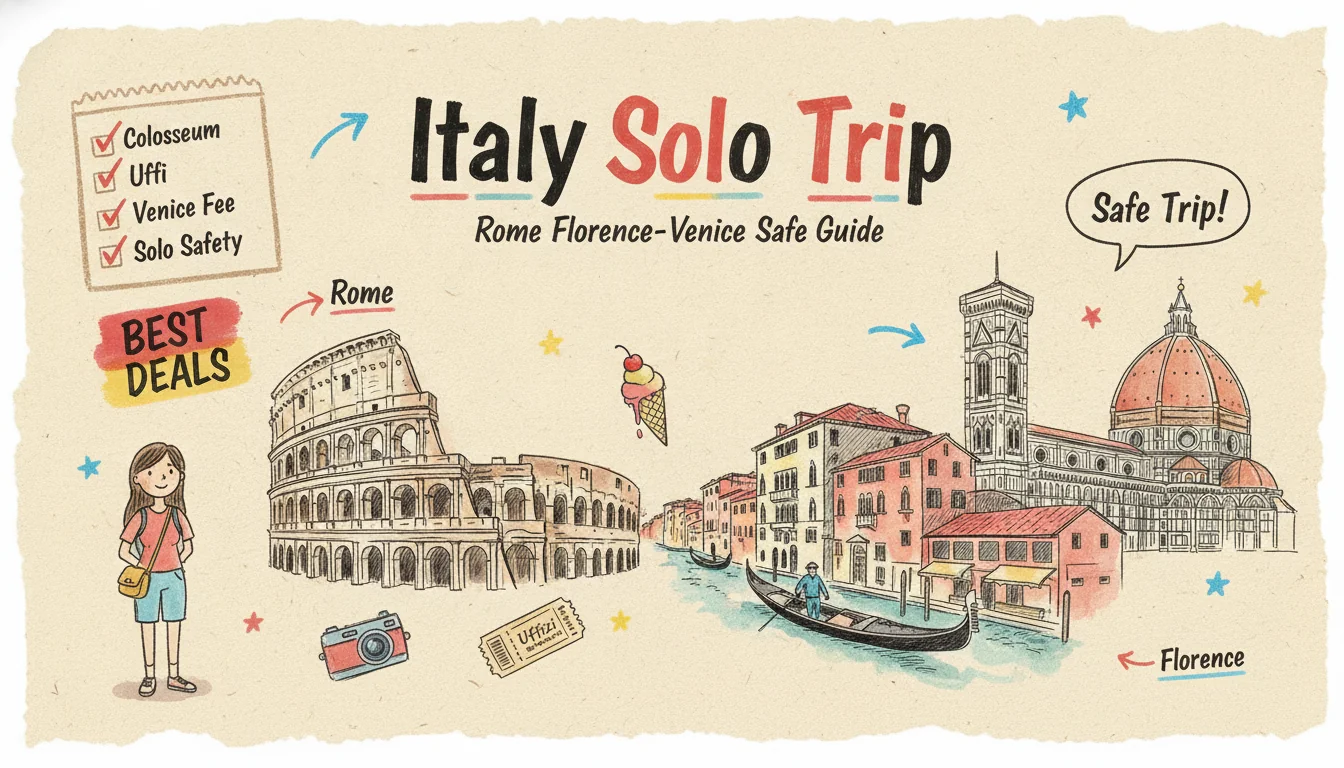
It was 5:47 in the afternoon, and I was standing alone at a sloped intersection beside Rome's Termini station, my backpack clipped to my front, my phone gripped in my palm without taking it out. Before the trip I had watched far too many "Italian pickpockets are terrifying" videos, and my head had already run through 30 versions of getting my wallet lifted. As it turned out, the street was busy with people coming and going, some carrying grocery bags, some walking dogs, and not one of them gave me a second look. I stood there for about 2 minutes before I realized I had been holding my breath the whole time.
For this trip I lined up Rome, Florence and Venice into a single route and walked it over 9 days: 4 nights in Rome, 2 in Florence, 2 in Venice, plus 1 near the airport. Before heading back each night, around 11 pm, I would write down what I spent that day, how many minutes each line ran, and which dark stretch of street I had detoured around. This post is not the kind that says "Italy is so romantic, you simply must go." Instead, I am laying out, one by one, the details that genuinely trip up a woman moving through these three cities alone: whether you need to book tickets ahead, how long the on-site lines run, what time you should call it a night, and what the front desk asks when you check in by yourself.
Why Italy's pickpocket legend is so far from the reality
Let me start with what people ask most: is it actually safe to go to Italy alone? My answer is that it is a lot safer than the version you scare yourself with online, as long as you know where the risk is concentrated.
The travel writer Carol once spent 39 days alone in Italy, by herself 99.9% of the time, and across all 39 days she made it through without a single thing stolen. That number surprised me when I first read it, because the density of horror stories online makes you think you will get robbed the moment you step off the plane. After walking it myself, I finally understood: Italy's safety problem is almost entirely about one thing, pickpockets in tourist hot zones, and violent crime against visitors is very rare. The train stations, metro stations and areas around famous landmarks in Rome, Milan, Naples and Florence are where pickpockets cluster most.
What you really need to watch is not a dark alley but a crowded spot. Pickpockets love a packed bus, those few seconds when metro doors are closing, and that moment when you are fumbling at a ticket machine. That is when someone steps in pretending to "kindly help" you and lifts your wallet in the process. In Rome, Carol ran into a man who started out posing as a missionary, then began asking which hotel she was staying at and whether she wanted a ride. She describes how she "immediately moved away from the road," and the man still followed her for a stretch until she walked into a crowded landmark area where he finally stopped.
So my first rule for women is simple: wherever people are packed tight, and wherever someone walks up to "help" you, that is the moment to put your hand on your bag. And on that note, that ticket-machine scene where pickpockets strike most is exactly the step you can skip entirely by buying your tickets online first. I make a habit of getting my tickets for popular sites sorted before a trip, so this time I never gave a pickpocket any chance to catch me at a window. To compare ticket prices across platforms in one go, you can start from the 1stCoupon Italy deals page.
The four anti-theft items I pack before leaving
On the gear question, I would rather be thorough than sorry. I copied all 4 things Carol used on her trip, and after testing them across 9 days myself, these are the ones I felt the difference with: first, a front-worn chest bag, so everything stays in your line of sight, which is far safer than a backpack worn on your back. Second, a slim money belt thin enough to wear under your clothes. I keep my passport, a backup credit card and part of my cash in there, separate from the spending money I carry outside.
Third, a phone lanyard, but here is the key: never wear it slung across your body, because that actually lets a scooter thief drag both you and the phone away in one yank. Wear the short kind that you can tuck inside your collar. The fourth one is the most counterintuitive: a pair of over-ear headphones that I wore all 9 days without ever playing music. Just looking like I was "listening to something and not easy to talk to" cut out roughly half the 5 or 6 strangers who came up each day to pitch or chat me up.
Carol made one more observation I really agree with: on her whole trip she carried only a backpack and a side bag, no rolling suitcase, and she figured this made her "look less like a tourist." Trust me, I deliberately did the same, leaving my big luggage back at my room and heading out each day with only a small bag, carrying myself on the street as much like a local as I could: steady steps, no zoning out over a map, no stopping mid-road to take photos. Looking like you know where you are going is its own kind of camouflage.
Rome: book the Colosseum first, the Trevi Fountain is best at night
Rome was my first stop on this trip, and also the city where the ticketing runs deepest. The single most important thing first: you absolutely have to book tickets on the official site in advance, otherwise a one to two hour line in peak season is normal. I am not saying this to scare you. It is the point Mimi Han's Rome guide hammers over and over, and I learned my lesson the hard way after queuing once myself.
Laying out the prices of a few main attractions, you will see that the "booking fee" is small money you cannot avoid but is well worth it:
| Attraction | Ticket | Online booking fee | Hours | What I saw on site |
|---|---|---|---|---|
| Colosseum | €16 | +€2 | 09:00–19:15 | The non-booked line wrapped halfway around; the booked entrance had almost no wait |
| Vatican Museums | €17 | +€4 | 09:00–18:00 (last entry 16:00) | Free on the last Sunday of each month, but the crowds are so brutal I would not recommend it |
| Castel Sant'Angelo | €15 | +€1 | 09:00–19:30 | Going up at dusk is just right for shooting the Tiber |
| Trajan's Market | €9.5 | +€1 | 09:00–19:15 | Underrated but a great walk, almost no line |
The Trevi Fountain and Pantheon run on a different rhythm. Trevi is free and open 24 hours, and by day it is so packed you cannot get a shot of yourself. I went after 10 pm, and once the lights came up, water echoed across a piazza with maybe 15 people left in it. I still remember that scene to this day. Mimi Han's guide also says the Trevi is "beautiful at night too," and I completely agree, plus at that hour the tourists in that area have not all cleared out and the shops are still lit, so walking through alone never feels empty. One reminder about the Pantheon: it started charging admission as of July 2023, so do not rush over assuming it is still free like a friend of mine did and find yourself shut out.
Heads up: there is also a common trap for women here. You are no longer allowed to sit at the foot of the Spanish Steps, with fines up to €400 if caught. I watched several women try to sit there for that cinematic photo, and a police officer right beside them blew his whistle within seconds. If you want a shot, take it standing, and do not trade a €100-plus night's accommodation for one snap. If you want to bundle these scattered Rome sights in one go, the Trip.com 10% off selected Europe attraction tickets and experiences can knock a bit off the booking fees; you have to buy the tickets anyway, so save where you can.
Florence: the Uffizi and David are the two hardest tickets of the trip
Taking the high-speed train north from Rome to Florence runs about 90 minutes. This city is small enough to cover entirely on foot in 2 days, but there are 2 tickets so hard to grab they will make you question your life choices: the Uffizi Gallery, and the original David at the Accademia Gallery.
The Uffizi ticket is €26, free for under-18s with a passport. For peak-season on-site queues, a guide by MiaoBa MiaoMa says "possibly one to three hours or more," and I believe that number. The day I passed a non-booked line, it wound from its entrance around into a side alley. The Accademia is even more extreme: the ticket is €16, half price at €2 for ages 18 to 25, but everyone has to add a €4 booking handling fee, and you can only book slots three months out, every 15 minutes from 08:15 to 17:45. Carol's Accademia guide spells it out plainly, that peak-season tickets are "in very high demand," and anyone who misses the official-site tickets can only switch to buying skip-the-line tickets on platforms like KLOOK or GetYourGuide.
Entering the Cathedral of Santa Maria del Fiore (the Duomo) is free, but that Brunelleschi dome you actually want to climb has to be bought separately. An official Brunelleschi Pass is €30, one ticket covering dome, Giotto's bell tower, baptistery, museum and crypt, all of which need a time slot picked online. The day I climbed the 463 narrow steps of the dome, a Korean tour group got stuck halfway up, and the entire staircase could not move for a full 10 minutes. Places like this really are not for spur-of-the-moment plans; lock in your time slot first.
The good news Florence offers women is that its evenings are more relaxing than Rome's. From Piazzale Michelangelo at dusk you watch the whole red-brick old town turn the color of the setting sun, and I stood there for nearly 60 minutes through that golden hour. The square was full of couples, people sketching, a street musician playing violin, and sitting alone on the steps did not feel out of place at all. If you want to save on tickets, a bundle like KKday Europe France-Switzerland-Italy passes from 50% off sometimes packs in fast-track tickets for the popular museums, so it is worth comparing against buying singly before you go.
Venice: 2026 adds an access fee, and skipping the booking doubles it
Venice has the most "hidden costs" of these three cities, and in 2026 it adds an access fee that a lot of people forget to budget for, so let me go into this part in detail.
First the access fee (Contributo di Accesso). Here's the thing, according to a Euronews report, in 2026 day-trippers coming and going on a single day have to pay this fee on Fridays through Sundays across April to July. Booking four or more days ahead costs €5, while paying on the spot without a booking is €10, exactly double. Coverage grows from 54 enforcement days in 2025 to 60 in 2026, and visitors have to register on an official platform, get a QR code, and face spot checks at seven city entrances. Note this only targets visitors who "come and go same-day." If, like me, you stay one night in Venice, it is already folded into your accommodation tax, so you pay nothing separately. That is one reason I tell women not to plan Venice as a single-day round trip: you save €5 to €10 and you skip rushing a last boat off the island in the dark.
I have organized the attraction and transport prices for you too:
| Item | Price | Notes |
|---|---|---|
| Access fee (same-day round trip) | €5 / €10 | About €5 if booked 4 days ahead, €10 on site; free if you stay a night |
| St. Mark's Basilica | €10 | Price went up as of July 2025; can buy a combo online including the Golden Pala |
| Gondola (daytime 09:00–19:00) | €90 | Private boat for 1 to 5 people |
| Gondola (night 19:00–04:00) | €110 | Same as above, with a night surcharge |
| Water bus single ride | €9.5 | Expensive bought singly; a day or week pass is better |
Honestly, I have to be straight with you about the gondola: taking one alone at €90 is a real splurge, because that price buys "the whole boat," not a single seat. Lillian's gondola guide confirms it is a whole-boat rate. When I went, I ran into two other women traveling solo at the dock, and our group of three split a boat on the spot, which came out to a bit over €30 each, far more reasonable than gritting my teeth and paying all €90 alone. If you are also traveling alone, take a look while you queue at the dock to see if anyone nearby is on their own, and asking "want to share?" is often easier than you think.
The water bus (Vaporetto) at €9.5 a single ride really is pricey. Abu's Venice transport guide, written by someone who likes to keep things easy, puts it bluntly: single tickets cost so much that "figuring out how to buy them is homework you do beforehand." Fair warning, take more than two rides a day and a day pass pays for itself. For lodging this trip, I booked a small inn on the edge of Venice's main island, a 4-minute walk from a vaporetto stop. That walk back at night was short, but Venetian alleys twist and turn with plenty of dead ends in dark corners, so I would rather add 5 minutes hugging a lit canal-side. To find a room that is "well located and easy to get back to at night," the long-stay deal at Agoda Stay Longer, up to 20% off suits anyone basing themselves in the water city.
When a woman checks in alone, what does the front desk actually ask
This is the question I get asked in DMs the most: when you check in alone, will the front desk look at you strangely, will they grill you with questions. I stayed in 3 types of rooms this trip, so let me lay out what I was actually asked.
Boutique hotels and chain hotels are the easiest. The front desk is process-driven, at most confirming one extra line, "One guest, correct?", and once that is settled they hand over the key without asking more. The ones more likely to chat are family-run B&Bs and hostel desks. Seeing you arrive by yourself, they often ask in passing "are you exploring on your own today?" or "would you like me to mark a safe route back for you?" These are not doubts; they are local kindness toward a woman traveling alone. My B&B host in Florence drew circles right on the map for "do not walk down these alleys at night," and that map was more useful than any guide.
A few check-in tips for women: fill in your name field in full when booking, but never publicly post which place you are staying at on social media; choose rooms with a 24-hour front desk or self check-in so a late-night arrival does not mean knocking and disturbing anyone; once inside, first confirm your door lock and that every window latches shut. These 3 steps take under 3 minutes total, but they let you sleep much more soundly. When picking a room I prioritize 2 conditions, "close to a station, lit streets at night," and discounted rooms on these platforms often sell out within minutes of appearing. To see the full list of lodging deals, you can browse the Agoda deals page on 1stCoupon and filter for safe location and price together.
Honestly, checking in alone in Italy is the most ordinary thing in the world, and women traveling solo are so common that front desks stopped finding it remarkable long ago. What actually makes you uncomfortable is usually a gaze you imagine in your own head, not anything other people are doing.
Three cities, nine days: my actual spending and time split
Let me lay out the whole trip's numbers so you have a baseline for your own budget. Over 9 days I roughly did 4 nights in Rome, 2 in Florence and 2 in Venice, with the last night spent near Rome's airport.
My flight this trip had 1 transfer into Rome, around NT$28,000 (~US$866) to NT$35,000 round trip (about US$870 to US$1,090) off-season, and noticeably more in peak season. For city-to-city travel I used Italy's national high-speed rail. Rome to Florence and Florence to Venice were each about 90 minutes, and booking early-bird tickets 1 to 2 months ahead, both legs together came to around NT$2,500 (about US$78); buying at a counter would cost nearly 2x that. For tickets, the Colosseum, Vatican, Uffizi, Accademia and Duomo dome together came to about €110 (about NT$3,800), and that does not yet count the gondola or the access fee.
Lodging is the most flexible piece. I chose mid-range rooms that were safely located and a 10-minute walk from a station, averaging NT$3,500 (~US$108) to NT$5,000 a night (about US$109 to US$155), with Venice's main island running 20% to 30% higher in peak season. To keep lodging costs down, book as early as you can once an itinerary is set, because last-minute booking during Italy's peak season is almost always sky-high.
Anyone who only locks things in at the very last moment can check Trip.com last-minute hotel deals, which refresh every Tuesday with discounted rooms for stays within 3 days, where a lucky grab can save you quite a bit. To save on tickets, do not miss platform promotions: Trip.com buy-one-get-one on selected tickets every Friday is one I check regularly, and for 2 people traveling together it cuts each ticket in half. All told, excluding flights, my 9 days of ground spending landed roughly between NT$45,000 (~US$1,390) and NT$55,000 (about US$1,400 to US$1,710), covering lodging, tickets, transport and food across all 3 cities.
Frequently Asked Questions
Q1: For a woman traveling alone in Italy, which city is the most dangerous? In terms of pickpocket risk to tourists, the train stations and tourist hot zones in Rome, Milan, Naples and Florence have the highest density; Venice, with no cars and many lanes but concentrated crowds, actually offers fewer pickpocket opportunities. But the nature of the "danger" is theft, not violence. Wear your bag in front and keep your cash separate, and all three cities are actually safer than many people imagine.
Q2: Do I have to book the Colosseum and Florence's David in advance? Yes, these two are the ones you most need to book ahead. The Colosseum on site without a booking often means a one to two hour line; the Accademia (David) only opens slots three months out, peak-season official tickets are in very high demand, and missing them means switching to skip-the-line tickets on platforms. I recommend locking in your time slots the moment your itinerary is set.
Q3: Do I definitely have to pay the access fee to visit Venice in 2026? Only day-trip visitors who "come and go the same day" have to pay, on Fridays through Sundays in April through July, about €5 booked four days ahead or €10 on the spot. If you stay at least one night in Venice, this fee is already included in your accommodation tax and you do not pay separately. So I suggest planning at least one overnight.
Q4: Is it safe to walk alone at night in Italy? For tourist night-view areas like the Trevi Fountain and Piazzale Michelangelo, with the crowds and shop lights still going, going alone is usually fine. What you want to avoid are remote dark alleys and low-traffic shortcuts. Heading back to the hotel, take the bright, busy main roads as much as you can rather than cutting through a small lane to save time, and carry yourself confidently on the way back without looking flustered. Get these few things right, and Italy at night is genuinely beautiful.
Q5: Are three cities in nine days too rushed? What is a smooth way to split it? It is not too rushed, but do not get greedy and try to cram in Milan and Pisa. My split was 4 nights in Rome (the most attractions), 2 in Florence and 2 in Venice, with high-speed rail of about 1.5 hours between each. Leave one afternoon in each city for pure walking with no attractions booked, because the most precious thing about solo travel is exactly this freedom to change your mind anytime.
References
All Deals
Italy Tuscany Day Tour (Chinese-Language 8-Person Small Group / Siena & Val d'Orcia & Pienza / Departing from Florence or Rome)
Siena
Cinque Terre Tour from Florence, with Optional Pisa Add-On
Florence
Italy F1 Bologna International Circuit round trip|Bologna city private car transfer
US$ · 17 · from
Feel the Rush in Italy
\ September 4-6 / · FORMULA 1 ITALIAN GRAND PRIX 2026 | Italy · US$ · 1,019.94
From Florence: Pisa, Siena & San Gimignano Day Tour
Florence
Rentacar Argentina Summer Car Rental Deals 12% OFF – Albania
Hit the road this summer and save up to 12% on car rentals during the busiest travel season. • Applicable destinations: Albania, Austria, Germany, Georgia, Qatar, Malaysia, Malta, Cyprus, Turkey, Greece, Hungary, Italy
Vatican Museums & Sistine Chapel + Colosseum Combo Tickets
Rome
Rome Car Rental | Colosseum, Roman Forum, Vatican Museums, St. Peter's Basilica
Rome
Colosseum & Roman Forum & Palatine Hill (Chinese Guide / Ticket Included)
Rome
FORMULA 1 ITALIAN GRAND PRIX 2026 | Italy
US$ · 1,019.94 · from · 17
(Dome Ticket Included) Florence Duomo Complex 2-Hour Chinese Guided Tour
Florence
Italy Dolomites Day Tour (Chinese Small-Group of 8 / Cortina & Lake Misurina / Venice Departure)
Cortina d'Ampezzo
Rome Vatican Museums, Sistine Chapel and St. Peter's Square Tour
Vatican
From Florence: Pisa, San Gimignano, Siena & Chianti Tuscany Day Tour
Florence
Colosseum, Roman Forum & Palatine Hill Small Group Guided Tour (Chinese Guide)
Rome
Italy Dolomites Lake Misurina & Cortina d'Ampezzo Day Tour (from Venice)
Calalzo di Cadore
Uffizi Gallery 2-Hour Guided Tour (Chinese Guide)
Florence
From Florence: Leaning Tower of Pisa & Cinque Terre Day Tour (Chinese Guide)
Vernazza

Nana
Solo Female Travel EditorSolo travel + women's-route editor. Has flown alone to 12 cities — writes 'safe routes', 'photo vibes', and 'one cup of coffee price points' into every guide. Loves alley cafes, design hotels, golden-hour street corners, and women-friendly spots.
You May Also Like
Munich Oktoberfest 2026: Why Augsburg Beats Munich Hotel Prices
Oktoberfest 2026 runs Sep 19-Oct 4. Munich vs. Augsburg hotel prices compared, plus tent deposits and the rate-locking tricks that cut peak-season costs.
Europe Trip Budget 2026: 10-Day Costs for Western, Eastern and Northern Europe
How much does 10 days in Europe cost in 2026? Daily budgets for West, East and North, my real Prague spending log, and 10 ways to stretch every dollar.
Kathmandu UNESCO Tour vs DIY 2026: NPR 5,700 and Skip TIMS
Seven UNESCO sites in a day tour or three days on foot. I priced every ticket at NPR 5,700, found the free multi-entry pass, and checked which permit you need.