First Time Going Abroad 2026: 7-Day Countdown Checklist
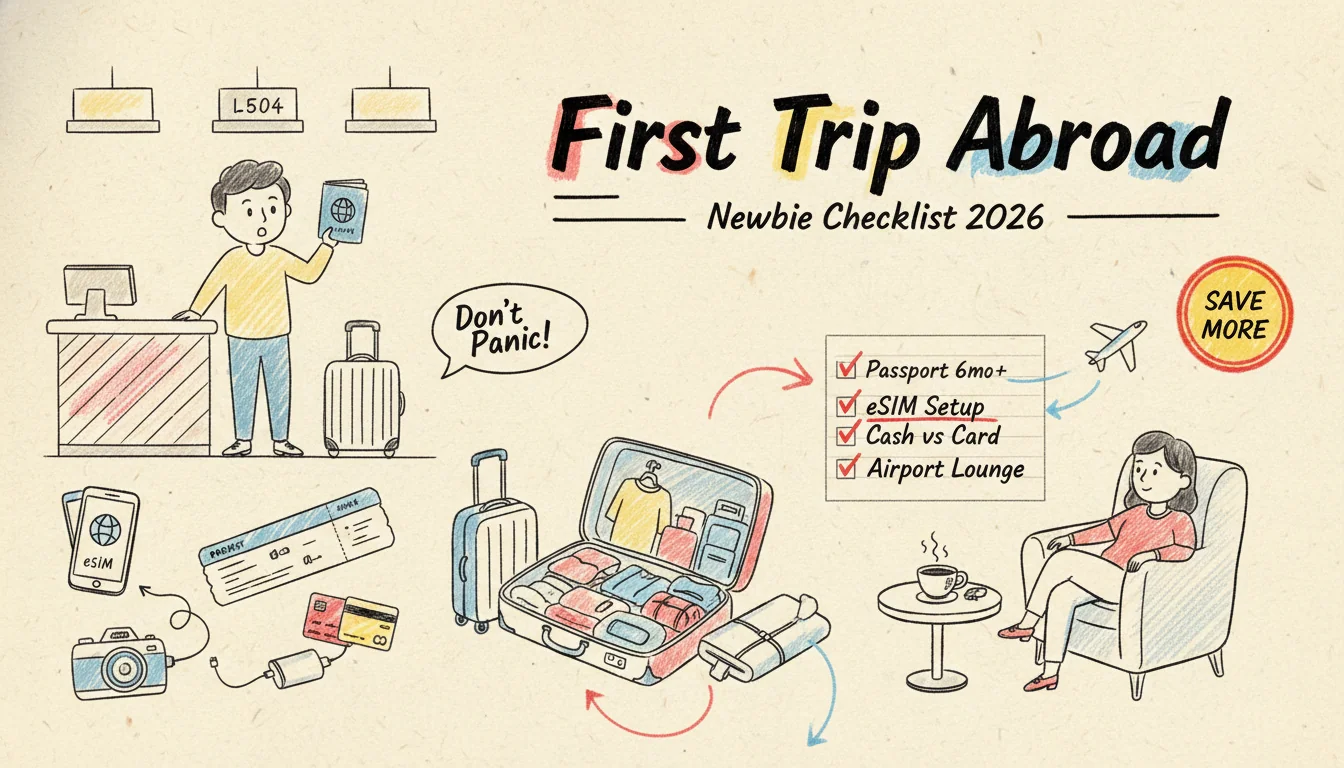
"I'm going to Japan next month, flying on my own for the first time, and I have no idea what to actually prepare." When a junior coworker dropped that line in my chat last week, I didn't just fire back a link. I asked her three things first: is your passport still valid, how are you handling internet abroad, and how much cash do you plan to carry. She couldn't answer a single one.
Honestly, my first trip in college was exactly the same. I stood fumbling at an ATM in Narita, grabbed the wrong card, pulled out 5,000 yen, and only realized later that card charged a 1.5% overseas fee. I paid an extra 200-ish bucks for nothing. I've already stepped on these landmines, so this guide lays out everything from zero to boarding, in the order it actually happens. Don't stress. It's easier than it looks.
30 Days Out: Lock Down Your Documents First
The very first thing, always, is your passport. A Taiwan passport needs at least 6 months of validity left, plenty of countries check this at the border, and if you're short on validity you get denied boarding on the spot. This is the rule beginners most often skip, and by the time you notice your passport is about to expire a week before departure, it's too late.
The good news is that from 2026 you can book a passport appointment online and skip the in-person queue. For visas, confirm your destination first: Japan and Korea are visa-free for Taiwan passport holders and let you stay up to 90 days, but the visa-free window and conditions differ for places like Thailand and Vietnam, so check each one carefully before you go. On top of that, most countries in 2026 require you to fill out a digital arrival form online before you fly (Japan's Visit Japan Web, Korea's K-ETA, and so on). These usually need to go in at least 72 hours ahead, so don't leave it for the day you board. My own habit is to photograph my passport and store one copy on my phone and one in the cloud, since a reissue goes much faster if you ever lose it.
So, simply put, 30 days out you confirm three things: passport validity, whether you need a visa, and whether there's a digital arrival form. Nail those three down, because if you don't, all the bookings in the world won't save you.
eSIM, Pocket WiFi, or Roaming? Here's How a Beginner Should Choose
Internet is the part first-timers get wrong most often. Let me break the three options into one table for you:
| Option | Best for | Rough cost | Pros | Watch out for |
|---|---|---|---|---|
| eSIM | Solo, newer phone | Japan 5 days ~NT$200-400 (~US$6-12) | No SIM swap, scan a QR and go, lightest bag | Phone must support eSIM |
| Pocket WiFi | 2+ traveling together | ~NT$80-150 (~US$3-5) per day | Shareable across people | Needs charging, has to be returned, can drop signal |
| Roaming | Can't be bothered to set up | Carrier day pass ~NT$199 (~US$6)/day | Least hassle | Most expensive over many days |
For a solo first-timer, I'd go straight for the eSIM. You scan a QR code and you're online, no swapping cards, no losing a physical SIM. Klook's Japan unlimited-data eSIM plan leans on a refund-if-unstable promise, which is friendly for beginners who are scared of getting burned. KKday also runs a Japan eSIM at 50% off that uses native carrier resources, so the speed tends to be more stable.
⚠️ One rookie trap to flag: eSIMs have an activation window, so don't buy too early. I'd order and install it 2 to 3 days before you leave, but hold off on activating it. Turn it on only after you land, that way you don't burn plan days you never used.
Currency and Overseas Cards: The Golden Cash-Foreign-Card Ratio
"So how much cash should I actually exchange?" That was my coworker's second question. My answer: don't turn all your money into cash.
What I do now is "30% cash, 70% card." Cash covers the small shops, transit, temple offerings, the stuff you can't tap a card for, while every larger purchase goes on a credit card with no foreign-transaction fee. For yen, I'd exchange part of it at your bank back home before you leave, because the airport rate is usually worse, and you avoid that when you can.
There are two landmines with overseas card payments. First, when the cashier asks whether you want to pay "in local currency or your home currency," always pick local currency (yen). Pick your home currency and you eat a DCC dynamic conversion fee with a terrible exchange rate. Second, carry two cards stored separately, one to spend and one as backup, so if one gets skimmed or locked you still have a fallback. That's the tuition I paid on my first trip.
Airport Lounges: Free or Pay NT$850 (~US$26), Should a Beginner Go In?
A lot of first-timers assume lounges are first-class only. They're not. Plenty of credit cards come with free lounge visits, and once you hit that card's terms for the period (usually tied to booking flights or spending a set amount), you get in free, with food, drinks, and quiet seats inside. It's genuinely handy when you arrive at the airport early.
Three things to keep in mind. First, "free" comes with conditions, and if you don't meet them you get charged. From 2026 the old DragonPass card was renamed U.First, and anyone who doesn't meet the program terms pays NT$850 (~US$26) per person per visit. Second, the go-anywhere Priority Pass costs US$469 a year, so unless you hold a premium card that bundles it, it isn't worth it. Third, companions usually pay separately, so check before you bring family in.
If your card doesn't bundle a lounge and you still want to try one, you can buy a single visit. Klook's Taoyuan Airport T2 Oriental Club lounge can be booked per visit, at a price that beats the NT$850 (~US$26) walk-up rate. For a first trip, arrive 3 hours early, grab a bite in the lounge, settle your nerves, and the whole journey feels a lot more relaxed.
Departure Day: Airport Flow and Baggage Red Lines
For international flights, get to the airport 3 hours before takeoff. The flow goes: check in and drop bags → immigration and passport control → security → wait at the gate (only now can you enter the lounge). A first-timer walking the full sequence takes roughly an hour, so leave enough buffer that you don't panic.
There are a few baggage red lines you have to remember, because breaking them gets you pulled aside:
- Liquids: no single bottle over 100ml in carry-on, all packed into one clear zip bag.
- Power banks: carry-on only, never checked, capacity must not exceed 160Wh, and from 2026 most airlines ban them from the overhead bin, so keep them under the seat or in your personal bag.
- Lithium batteries: spare batteries always go in carry-on.
Booking your airport transfer ahead is also smart. Dragging luggage through transfers on a first trip is an easy way to get lost, and Trip.com has a 12% off airport transfer so a car meets you the moment you land, which is peace-of-mind money well spent for a beginner. One more thing: flight delays climbed in 2026, so really don't skimp on travel inconvenience insurance.
Travel Insurance and Document Backups: The Two Things Beginners Skip
These two feel minor, but when something goes wrong, the people who skipped them regret it most. On my own first trip I missed both.
Travel Inconvenience Insurance: Seriously, Don't Skip It in 2026
That trip to Osaka, I hit a typhoon, the flight was delayed 6 hours, and my luggage showed up a day late. I had no inconvenience cover, so I swallowed the hotel and meal costs myself, about NT$4,000 (~US$124) extra. Only afterward did I learn that travel inconvenience insurance exists exactly to pay out for delays and luggage delays like that.
Because extreme weather has become more common in 2026, the odds of a flight delay are higher than a few years back, and inconvenience cover usually runs around NT$300 (~US$9) for 5 days while it can pay out several thousand. First-timers tend to think "it won't be that unlucky," but insurance is buying peace of mind, and this is one line I absolutely no longer cut. Note that payouts come with thresholds and conditions (say, a delay must hit 4 hours, and you have to keep your boarding pass and receipts), so read the terms carefully before you buy.
Document Backups: They Save You When Things Go Missing
Passport, visa, credit cards, before I leave I make three layers of backup: a phone photo, a cloud copy, and a printed paper copy stored separately. If your passport goes missing overseas, a reissue needs a copy of your documents, and a backup makes it much faster. I also save the overseas lost-card hotline for my credit card in my phone, so I can stop the bleeding the moment something gets skimmed. These take 5 minutes to do and can save you days of hassle.
There's one more thing first-timers easily misread: assuming that buying your flight on a card means you "automatically have insurance." In reality, the travel cover bundled with a card varies a lot card to card. I got burned on this exact point, assumed my card covered me so I didn't buy anything extra, and it turned out that card's inconvenience cover only paid for cancellations, not delays, so on a 6-hour delay I got nothing and ate over NT$4,000 (~US$124) myself. So before you charge a flight, check whether that card bundles travel accident cover or inconvenience cover and how many hours the threshold is, and if it falls short, buy your own. A 5-day comprehensive travel policy usually runs NT$300 to 500 (~US$9-15), versus a delayed night that easily runs into the tens of thousands, so this is one I now lock in first. I'll also quickly check the Trip.com deals page on 1stCoupon to see if there's a flight-plus-hotel package that includes insurance, since sometimes the bundle beats insuring separately.
The 7-Day Countdown Checklist
Last, here's a countdown you can follow step by step:
- D-7: Re-confirm passport validity, print or screenshot your tickets and hotel bookings.
- D-5: Fill out the digital arrival form (like Visit Japan Web), sort out your travel insurance.
- D-3: Buy and install your eSIM (don't activate yet), and swing by KKday's campaign page to grab your activity tickets in the same go.
- D-2: Exchange part of your foreign cash at the bank, confirm both credit cards are enabled for overseas spending.
- D-1: Pack your bag, decant liquids, keep the power bank in carry-on, fully charge your phone and power bank.
- D-Day: Get to the airport 3 hours before takeoff, double-check documents, phone, and wallet before you head out the door.
For more pre-trip tickets and deals, do a quick pass through the KKday deals page and the Klook deals page on 1stCoupon first, and line up your eSIM, transfers, and entry tickets all at once for the least hassle.
FAQ
Q1: For a first trip, roughly how much cash should I bring? Aim for the "30% cash, 70% card" ratio. For 5 days in Japan, say, 20,000 to 30,000 yen in cash is enough for small purchases, with everything else on a no-foreign-fee card. Exchange part of your yen at home first, don't wait until the airport.
Q2: When do I buy the eSIM, and when do I install it? Buy and install 2 to 3 days before you leave, but don't activate it yet. eSIMs have an activation window, so turning it on too early wastes plan days, and activating once you land is the sweet spot.
Q3: If my card doesn't bundle a lounge, should a first-timer go in? Depends how early you arrive. Three hours early and wanting a quiet bite to settle in, a single-visit purchase is well worth it; if you're rushing, skip it. Note that paying out of pocket or missing the threshold runs about NT$850 (~US$26) per visit, and companions pay separately.
Q4: Can I check power banks in my luggage? No. Power banks and spare lithium batteries always go in carry-on, never checked, capacity must not exceed 160Wh, and from 2026 most airlines require them under the seat, not in the overhead bin.
Q5: When the cashier asks home currency or local currency, which do I pick? Pick local currency. Choosing your home currency triggers DCC dynamic currency conversion and a fee at a lousy rate, which is almost always pricier.
Sources
All Deals
[Up to 20% Off] Japan eSIM Card - Unlimited Data, No Speed Reduction: Softbank Native Telecom R...
Japan · 4.4 (2088) · 40K+ booked · US$
No Code RequiredTaiwan eSIM card | 4G unlimited data access | Chunghwa Telecom roaming
Taipei · 4.4 (657) · 7K+ booked · US$
No Code RequiredUnlimited 4G LTE WiFi (Japan Airport Pickup) with Free Power Bank
WiFi & SIM cards • Japan
No Code Required【50% OFF】Japan Unlimited Data eSIM (Rakuten / KDDI / Docomo)
Japan · 4.2 (1.8萬) · 400K+ booked · US$
No Code Required【50% OFF】Japan eSIM | Daily 500MB/1GB/2GB/Unlimited Data eSIM
Japan · 4.4 (43) · 600+ booked · US$
No Code Required(Free eSIM) Thai Costume Photoshoot Tour - Wat Arun Bangkok (MyProGuide)
Bangkok
No Code RequiredFree eSIM - Maeklong Railway Market & Floating Market & Free Thai Costume Experience or Cafe
Samut Sakhon
No Code Required【50% OFF Flash Sale】Taiwan Daily/Total Data ESIM
Taipei · 4.0 (397) · 10K+ booked · US$
No Code Required[50% OFF] Japan eSIM | Docomo / KDDI / SoftBank / Rakuten | ChatGPT & Gemini Supported
Japan · 4.0 (1.7萬) · 300K+ booked · US$
No Code Required[50% Off% Off] Taiwan eSIM | 5G Network 1-30 Day eSIM | Supports ChatGPT & TikTok
Taiwan · 4.0 (4) · 25+ booked · US$
No Code Required[Up to 20% Off] Japan eSIM Card - Unlimited Data, No Speed Reduction: Softbank Native Telecom R...
Japan · 4.4 (2086) · 40K+ booked · US$
No Code Required(Free eSIM) Phnom Penh Iconic Instagram Cambodia Day Tour
Phnom Penh
No Code Required[50% Off Special Offer] eSIM for Mainland China, Hong Kong, Macau and Taiwan | 5G Internet Access...
Shanghai · 4.0 (30) · 400+ booked · US$
No Code Required[Buy 1 Get 1 Free on Selected Plan] Taiwan FarEasTone 4G/5G Unlimited Data SIM Card | Includes Ta...
Taiwan Taoyuan International Airport · 4.7 (1100) · 10K+ booked · US$
No Code RequiredEuropean eSIM | 4G High-Speed Internet with Unlimited Data, Daily Data, and Total Data Plans (I...
Andorra · 4.0 (279) · 3K+ booked · US$
No Code RequiredUnlimited 4G Portable Wi-Fi for Taiwan (Pick-up at Taoyuan Intl. Airport & Ezfly Taipei Store or...
Taiwan Taoyuan International Airport · 4.4 (2070) · 10K+ booked · US$
No Code Required(Free eSIM) Phnom Penh Oudong Mountain Day Tour
Oudong
No Code RequiredTaiwan Portable Wi-Fi Rental: Unlimited 4G Internet (Pickup at Taiwan Airports)
Taiwan Taoyuan International Airport · 3.8 (16) · 100+ booked · US$
No Code Required[KYC Pre-Registration – Fast Pickup] Taiwan SIM Card | Chunghwa Telecom 4G/5G Unlimited Data Prep...
Taiwan Taoyuan International Airport · 4.5 (4079) · 10K+ booked · US$
No Code RequiredJapan eSIM High Speed Data Plans [50% Off]
Japan · 4.2 (5404) · 100K+ booked · US$
No Code Required[50% OFF] Taiwan eSIM | Daily Data / Total Data / Unlimited Data Options
Taipei · 4.5 (589) · 10K+ booked · US$
No Code Required[50% OFF] Taiwan 5G eSIM | 1–30 Days | Daily Data / Total Data / Unlimited | Supports ChatGPT
Taipei · 4.4 (1201) · 10K+ booked · US$
No Code Required【50% OFF Flash Sale】Taiwan Daily/Total Data ESIM
Taipei · 4.0 (396) · 10K+ booked · US$
No Code RequiredEurope eSIM: High-Speed Daily Data / Total Data
Austria · 4.2 (1691) · 30K+ booked · US$
No Code Required[50% OFF] Japan eSIM | Docomo / KDDI / SoftBank / Rakuten | ChatGPT & Gemini Supported
Japan · 4.0 (1.7萬) · 300K+ booked · US$
No Code Required【50% OFF】Taiwan Unlimited Data eSIM
Taichung · 4.3 (1.2萬) · 100K+ booked · US$
No Code Required[KYC Pre-Registration – Fast Pickup] Taiwan SIM Card | Chunghwa Telecom 4G/5G Unlimited Data Prep...
Taiwan Taoyuan International Airport · 4.5 (4079) · 10K+ booked · US$
No Code RequiredEurope 4G eSIM
Austria · 3.8 (672) · 10K+ booked · US$
No Code Required[50% Off% Off] Taiwan eSIM | 4G/5G Internet Access Daily, Total, Unlimited Data eSIM
Taipei · 3.0 (2) · US$ · 0.64
No Code RequiredUnlimited 4G Portable Wi-Fi for Taiwan (Pick-up at Taoyuan Intl. Airport & Ezfly Taipei Store or...
Taiwan Taoyuan International Airport · 4.4 (2068) · 10K+ booked · US$
No Code Required4G SIM Card (SG & MY Delivery) for Thailand
WiFi & SIM cards • Thailand
No Code RequiredTaiwan 4G Portable WiFi (Taiwan Airport Pickup)
WiFi & SIM cards • Taiwan
No Code RequiredJapan eSIM High Speed Data Plans [50% Off]
Japan · 4.2 (5399) · 100K+ booked · US$
No Code Required【50% OFF】Japan Unlimited Data eSIM (Rakuten / KDDI / Docomo)
Japan · 4.2 (1.8萬) · 400K+ booked · US$
No Code Required[10% Off] Taiwan Portable Wi-Fi Rental: Unlimited 4G Internet (Collect & Return at Songshan/Kaohs...
Kaohsiung International Airport · 4.6 (6987) · 40K+ booked · US$
No Code Required[10% Off] Taiwan Portable Wi-Fi Rental: Unlimited 4G Internet (Collect & Return at Songshan/Kaohs...
Kaohsiung International Airport · 4.6 (6987) · 40K+ booked · US$
No Code Required
Yi
Budget Travel EditorBudget traveler. Even on a NT$30K monthly salary you can travel well — treats every trip as a budgeting puzzle, breaking down flights, hotels, transit, and meals line by line. Specializes in total trip budgets, first-time-abroad prep, and overseas card / FX comparisons — helping you dodge overspend traps and save up for the next trip.
You May Also Like
Geneva Costs CHF 2 to Swim and CHF 25 to See the UN: 2026 Ticket Prices
Geneva's city museums are free, the lake crossing is CHF 3 and the UN tour is CHF 25. The one genuinely expensive day is Mont-Blanc, and I priced both ways of doing it.
Delhi, Agra, Jaipur in 3 Days: US$158 vs US$321, the 2026 Cost Guide
I costed the 3-day Golden Triangle three ways at September 2026 rates. Monument tickets are ₹4,100 before you sleep or eat, and packaging it costs 9.7% more.
Gyeonggi Day Trips From Seoul 2026: 55 Minutes to Suwon, 80 to Everland
Line 1 puts you at Suwon Hwaseong in 55 minutes for ₩1,850. Everland is 80. I costed the three Gyeonggi day trips from Seoul in 2026 by door-to-door time.