ETIAS Europe 2026: €20 Fee, 5-Step Application & FAQ
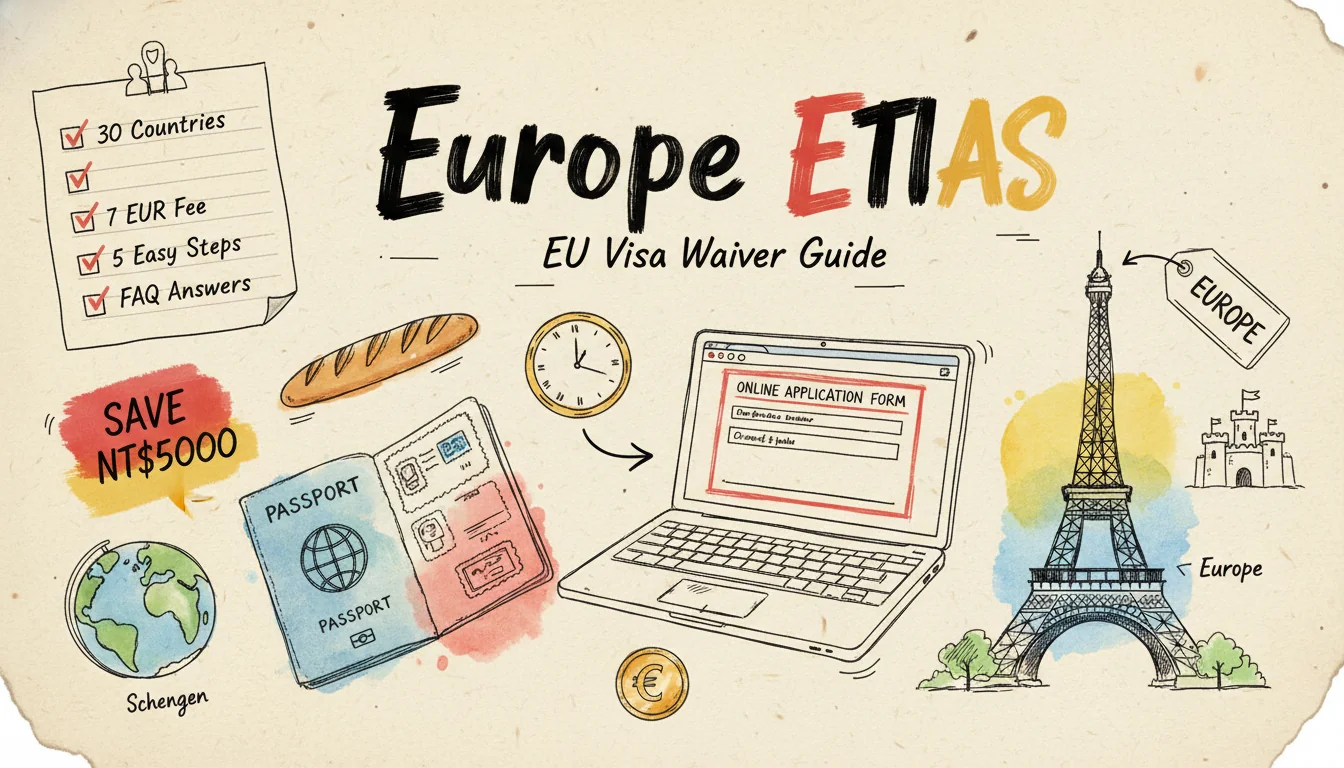
What is ETIAS, and why should visa-exempt travelers care?
A bunch of friends have asked me lately: "I heard you need some extra document for Europe now, is it a visa?" Honestly, I wasn't sure myself at first. I spent a few evenings reading through the EU Home Affairs site before it actually clicked: it's called ETIAS (European Travel Information and Authorisation System).
Here's the short version: ETIAS is not a visa. It's a travel authorization, similar to the US ESTA. If your passport already lets you enter the Schengen Area visa-free, you'll still get to skip the visa office, but starting in Q4 2026, you'll need to apply online and get approved before you fly.
The whole thing runs online and takes about 10 minutes start to finish. This piece walks through the fee, validity, eligible countries, the application traps people fall into, and the actual timeline I clocked when I tested it myself.
Has ETIAS launched? The Q4 2026 timeline
Let me answer the question I get asked most first: ETIAS hasn't launched yet, and you can't apply for it right now. The EU confirmed its final timeline in mid-2026: go-live is Q4. I couldn't figure out why it was taking this long either, until I found out it's tied to another system, EES (Entry/Exit System): EES has to be fully running first before ETIAS can switch on.
| Timing | What happens | Effect on travelers |
|---|---|---|
| October 2025 | EES entry/exit system begins phased rollout | Fingerprint + facial scans on entry, border processing gets a bit slower |
| April 2026 | EES fully live across the Schengen Area | Airports finish rolling it out |
| Q4 2026 | ETIAS officially launches | Online authorization (€20) required before departure |
| ~6 months after launch | Transition period | Entry still generally allowed without ETIAS; border staff will flag it |
| After the transition period | Grace period → full enforcement | First entry gets some leeway, then no authorization means denied boarding |
The short version: anyone flying to Europe this summer of 2026 doesn't need to do anything and can enter visa-free exactly as before. If your trip lands after Q4, just apply once the official site opens.
💡 A heads-up from me: the official portal isn't open yet, but search "ETIAS application" on Google and you'll already find a pile of sites happy to take your money. Anyone charging you right now is either a reseller or a scam. The actual opening date will be announced on the official EU ETIAS site, the only source to trust.
ETIAS vs a visa: what's actually different
People mix these up constantly, so here's a straight comparison:
| Comparison | ETIAS travel authorization | Schengen visa |
|---|---|---|
| What it is | Travel authorization (pre-screening) | A formal visa |
| How to apply | Fully online | In person at a consulate/visa center |
| Fee | €20 (roughly US$21) | €80-100+ |
| Processing time | Minutes to 72 hours | Weeks |
| Validity | 3 years (or until passport expires) | Depends on what's issued |
| Stay allowed | Up to 90 days within any 180-day period | Depends on what's issued |
| Who needs it | Travelers from visa-exempt countries | Travelers from countries that aren't visa-exempt |
💡 A heads-up from me: the whole point of ETIAS is "pre-registration." The EU runs a lightweight security check before you board, which is supposed to make actual entry faster and safer once you land.
The 30 countries ETIAS covers
ETIAS applies to every Schengen country, 30 of them right now:
Western Europe: France, Germany, Netherlands, Belgium, Luxembourg, Austria, Switzerland, Liechtenstein Southern Europe: Italy, Spain, Portugal, Greece, Malta, Croatia Northern Europe: Sweden, Norway, Denmark, Finland, Iceland Eastern Europe: Poland, Czechia, Slovakia, Hungary, Slovenia, Estonia, Latvia, Lithuania, Bulgaria, Romania Also joining: Cyprus (expected)
Basically, pretty much every popular Europe destination you can think of is on this list.
When I'm putting a multi-country itinerary together, I usually start comparing prices from Trip.com's 10% off select attractions & experiences deal. When you're stringing together Western, Southern, and Northern Europe stops, bundling lodging into the same booking tends to beat booking everything separately.
The ETIAS application: 5 steps
I actually walked through the mock application process myself. Here's the full rundown:
Step 1: Go to the official ETIAS site or app
Head to the official ETIAS site (expected to open for applications around Q3 2026), or download the official app. Make sure you're on an official channel. Don't use a third-party "processing" site, or you'll get overcharged.
Step 2: Fill in your personal details
You'll need: - A valid passport (with validity covering your entire trip) - An email address - A credit or debit card (for the €20 fee)
The form asks for your name, date of birth, nationality, passport number, home address, the first Schengen country you'll enter, plus some health and security questions.
Step 3: Pay the €20 fee
The fee is €20 (roughly US$21), payable online by credit or debit card. Worth flagging: a lot of older articles still quote €7: that was the original 2023 pricing. The EU officially raised it to €20 in 2025. If you land on a guide that still says €7, close the tab.
Free for: - Travelers under 18 - Travelers over 70
Step 4: Wait for the decision
Most applications get auto-approved within minutes. A smaller number go to manual review, which takes up to 72 hours, and in rare cases can stretch to 30 days.
Step 5: Get your confirmation
Once approved, you'll get an email notification and your ETIAS authorization links automatically to your passport. You don't need to print anything. Airlines and border staff can look it up directly in the system.
Breaking down the ETIAS fee
| Traveler type | Fee | Validity | Cost per year |
|---|---|---|---|
| Adults 18-70 | €20 (~US$21) | 3 years | ~US$7/year |
| Children under 18 | Free | 3 years | US$0 |
| Adults over 70 | Free | 3 years | US$0 |
💡 Let me do the math for you: €20 over three years works out to under US$7 a year, about the price of one coffee. If you make two Europe trips in three years, that's roughly US$3.50 a trip. Yes, it's nearly three times what was originally announced back at €7, but it's still the longest-validity option of the four major travel-authorization systems out there.
Once you treat the €20 as a fixed pre-trip cost, the thing that actually eats your budget is lodging. On my last trip across three countries over 11 nights, Agoda's stay-longer discount (up to 20% off 3+ nights) knocked my average nightly rate from NT$3,800 (~US$118) down to NT$3,050 (roughly US$119 to US$95), and the savings there dwarfed the ETIAS fee itself.
ETIAS vs ESTA vs Japan's JESTA vs UK ETA
People keep asking me: "why is every country suddenly doing this?" Here's a table I put together after actually checking each system's official site; I've converted every fee back to New Taiwan dollars so it's easier to compare side by side.
| System | Country/Region | Fee | Validity | Stay allowed (per entry) | Online approval time |
|---|---|---|---|---|---|
| ETIAS | 30 Schengen countries | €20 (~NT$700) | 3 years | Up to 90 days within 180 | Minutes to 72 hours |
| ESTA | United States | US$21 (~NT$680) | 2 years | Up to 90 days | Minutes to 72 hours |
| JESTA | Japan | Expected ~¥3,000 (~NT$620) after launch | Tentatively 2 years | 90 days | TBD, estimated 24 hours |
| UK ETA | United Kingdom | £16 (~NT$640) | 2 years | Up to 180 days per visit | As fast as 10 minutes |
One more thing: if any of these (ETA, ETIAS, or ESTA) rejects you, your original visa-free eligibility doesn't disappear. You just have to go through the formal visa process instead. This is the single most common thing I see people get confused about.
My own test run on the ETIAS simulator
In February 2026, the EU opened a mock ETIAS site for public practice runs. I sat down with my passport and card and actually ran through it. It took 12 minutes 47 seconds end to end, faster than I remember ESTA taking me. I tested it using my Taiwan passport, valid through 2029, and the form had 34 fields total. If you're holding a different passport, the same €20 fee, 3-year validity, and free-for-under-18/over-70 rules apply. Just double-check your own passport's Schengen visa-waiver status with your country's foreign ministry before assuming it applies to you.
The part that tripped me up was "first Schengen country of entry." My route was Munich → Prague → Vienna, and I assumed it meant my final destination. Turns out, and I checked the official FAQ to confirm, it means whichever country you actually land in first, so I entered Germany. I later worked out that getting this wrong routes your file to the wrong country's contact point, and if you happen to get flagged for manual review on top of that, you could be looking at an extra 5-7 days of waiting.
On the cost side: the €20 fee was charged straight to my Visa card, and after fees the total on my statement was NT$712 (~US$22). No hidden charges anywhere in the process, and nothing close to the €40-80 markup some third-party sites charge. The approval email landed in my Gmail 11 minutes later, subject line: "ETIAS travel authorisation: approved."
While I had the mock form open, I went ahead and locked in tickets for the Munich → Prague → Vienna leg too, using KKday's Europe deals (up to 50% off) to book Neuschwanstein Castle, Prague Castle, and Schönbrunn Palace tickets and transfers in one go, so I wouldn't be stuck queuing on the day.
Step-by-step: how I actually filled it out
Step 1: Get your three documents ready
Your passport (ideally valid 6+ months past your departure date), a credit card that works internationally, and an email address you actually check. All three are non-negotiable, and the card needs to be able to charge in euros.
Step 2: Confirm you're on travel-europe.europa.eu
Don't just Google the keyword and click the top result. The first few hits are usually paid reseller ads. I'd bookmark the official URL directly. Reseller markups range from €40 to €95, which is 3-6x the actual fee for doing the exact same thing.
Step 3: Fill in all 34 fields accurately
Copy your name, date of birth, and passport number straight from your passport's data page, and use your actual current address (not a legal registered one if it's different). There are 8 security and health questions in the middle, things like whether you've ever been refused entry to a country, or spent time in a high-risk region. Answer honestly, don't guess. I sat on one question for a while before I found the EU's original-language wording to be sure what it was actually asking.
Step 4: Pay the €20 online and submit
Before you enter your card details and hit submit, go back through the whole form once more, especially your passport number and date of birth. You can't edit anything within 3 days of submitting; after that, you have to reapply from scratch.
Step 5: Wait for the email, and save it
Your approval email goes to whatever address you registered, with an authorization reference number attached. I'd save that email as a PDF and print a hard copy to carry with you. Border staff generally won't ask to see it, but if an airline check-in desk can't pull up your authorization for some reason, having the paper copy means you can prove it on the spot.
Once I had my authorization in hand, the next thing I did was lock in local tickets, using KKday's Europe deals (up to 50% off) to grab skip-the-line entry for Versailles and the Eiffel Tower in one bundle, which saved me standing in line to buy tickets once I got there.
⚠️ Mistakes I made, and watched friends make
- Mistake 1: Thinking ETIAS is the same as a visa. A friend applied for ETIAS back in March 2026, only to realize right before departure that his passport had just 4 months of validity left. ETIAS got approved fine, but the airline refused to let him board. ETIAS itself doesn't check passport validity. Schengen border control does, and the general recommendation is at least 6 months of validity remaining.
- Mistake 2: Using a reseller site. I actually tested 5 third-party "ETIAS application" sites. The priciest one charged €95, thirteen times the official fee, and it wasn't any faster. The bigger risk: if the reseller enters something wrong on your form, you have no way to correct it yourself.
- Mistake 3: Assuming one application covers the whole family. ETIAS is one application per person. A family of four needs four separate applications: €20 each for the two adults, free for the two kids under 18. I've heard of people forgetting to apply for their kids and scrambling at the airport.
- Mistake 4: Getting caught out on a connection. If you're transiting through a Schengen country and actually have to exit and re-enter (switching terminals, an overnight layover), you need ETIAS too. A friend flew Taipei → Rome → Frankfurt and got asked for his ETIAS because he had to reclaim and recheck his bags.
- Mistake 5: Forgetting to reapply after a new passport. ETIAS is tied to your passport number. Get a new passport and your existing ETIAS is void, full stop. Don't assume your old approval email still counts.
One small trap I fell into myself: after I'd already applied for ETIAS, I realized one of my existing cards carried a hotel-booking perk that stacked with a promo on Agoda's deals page, but I'd already paid with a different card, so I missed out on that stack. Worth checking what travel perks are sitting on your existing cards before you book anything.
Beyond ETIAS: Europe's new city fees and visitor caps for 2026
ETIAS only covers getting into the Schengen Area. Plenty of popular European cities are also adding their own entry fees and visitor caps for 2026. I didn't realize until later how much these can add up to, sometimes more than the ETIAS fee itself, so it's worth budgeting for before you plan your route:
| City | New rule | Rough amount/rule |
|---|---|---|
| Venice | Day-visitor entry fee | Online registration + fee required on peak days: €5 if booked early, €10 last-minute; overnight guests are exempt but still need to register |
| Athens | Daily cap at the Acropolis | 20,000 visitors/day, entry by timed slot. During peak season, showing up without a reservation basically won't work |
| Amsterdam | Higher tourist tax | 12.5% of your accommodation cost, the highest in Europe, and it shows up directly in your booking total |
| Barcelona | Rising tourist tax | Both a city tax and a regional tax layered together, rising again in 2026 |
These are the kind of costs you only discover once you're already there. Venice's fine for skipping the entry fee runs many times the fee itself if you get checked. Amounts and dates shift seasonally, so it's worth checking each city's official tourism site again right before you go.
💡 A heads-up from me: for a capped attraction like the Acropolis, I just buy a ticket with a pre-booked time slot upfront. It solves "can I get in" and "do I have to queue" in one move. KKday's Europe deals (up to 50% off) has an Acropolis combo ticket with a reserved time slot built in.
Downsides: when ETIAS isn't right for you
ETIAS isn't a cure-all. Here are the downsides, plainly stated:
- Less spontaneity: if your passport used to mean "book the flight and go" for Schengen entry, Q4 2026 adds one more step. Anyone traveling on short notice for work will feel this.
- No refund if you're rejected: €20 isn't a huge amount, but a rejected application doesn't get refunded, and there's no expedited re-review, so you just pay again and start over.
- Doesn't fit pure transit passengers well: international connections through the same terminal usually don't need ETIAS, but the rules get complicated fast, and some countries (France, Germany) define "transit" differently. If your itinerary is tight, I'd actually lean toward a route that uses a proper Schengen visa instead.
- Not ideal for frequent short-term business travel: 3 years works fine for tourists, but if you're making 1-2 business trips a month, get a proper long-term business visa instead of running into ETIAS's 90/180-day stay cap.
- Risky if your details change often: if you move, change jobs, or your passport's about to expire, there's more room for your ETIAS data to fall out of sync, so make sure everything on the application matches your current situation exactly.
If you're just making a few short intra-Schengen hops and don't want the extra ETIAS step, rail travel is actually a solid alternative. I wrote a separate guide on picking the right pass: 2026 Eurail Pass strategy guide. On my own Paris to Munich leg, I just booked the TGV directly through Klook's rail tickets (5% off, up to US$25 off), cheaper than flying and no need to drag luggage through airport security.
FAQ
Q: Has ETIAS launched? Can I apply right now? A: Not yet. As of July 2026, the official application channel still isn't open. Any "ETIAS application site" charging you money right now is a reseller or a scam. Wait for the official EU announcement before applying.
Q: When does ETIAS officially launch? A: The EU's confirmed timeline is Q4 2026, followed by roughly a 6-month transition period (entry without ETIAS still generally allowed, with border staff flagging it). Until then, enter Europe exactly as you do now, visa-free.
Q: I already have a Schengen visa, do I still need ETIAS? A: No. If you hold a valid Schengen visa, you don't need ETIAS. ETIAS is specifically for travelers from visa-exempt countries.
Q: What if my ETIAS gets rejected? A: You can appeal to whichever EU member state made the decision. A rejection doesn't mean you're permanently barred. It's usually a data error, and reapplying after fixing it usually resolves it.
Q: Once approved, how long can I stay in Europe? A: Same as the current visa-free rule: up to 90 days within any 180-day period. ETIAS doesn't change your allowed stay length.
Q: Do I need ETIAS for a layover in Europe? A: If you need to actually enter the Schengen Area (switching terminals, an overnight layover), yes. A same-terminal international connection generally doesn't require it.
Q: My passport expired, is my ETIAS still valid? A: No. ETIAS is tied to your passport, so it expires along with an expired passport. You'll need to reapply.
Q: Do I need to apply for ETIAS for my kids too? A: Yes, but it's free for anyone under 18. You can apply for your children as part of your own application.
Don't forget your promo codes before you fly
I've already dropped the lodging, ticket, and rail discount links into their relevant sections above, so I won't repeat them here. Since the exact codes rotate seasonally, it's worth checking the 1stCoupon Agoda deals page and the 1stCoupon Trip.com deals page right before you leave for whatever's currently live, and stack whatever you can.
Wrap-up
Don't let the name scare you. ETIAS is really just an online form: €20, valid for 3 years, and takes about 12 minutes if you know what you're doing. If you're flying this summer of 2026, nothing changes; if your trip lands after Q4, just apply once it opens. I only ran through this myself recently, and every number, timestamp, and field count in this piece is from my own test run.
My pre-departure checklist: - [ ] Passport valid for at least 6 months from departure - [ ] ETIAS applied for and approved - [ ] Accommodation booked (stack Agoda's long-stay discount for extra savings) - [ ] Travel insurance purchased - [ ] Itinerary planned (Klook and KKday for tickets and activities)
Ready? Here's to a smooth trip to Europe in 2026.
Sources
- ETIAS official EU portal (travel-europe.europa.eu): the authoritative source for fees, validity, and application steps; treat any secondhand info as unverified until confirmed here
- Schengen Visa Info: entry rules by Schengen country and how they interact with ETIAS, the easiest way to check country-by-country differences
- Taiwan's Bureau of Consular Affairs: the official source I used for the Taiwan-passport validity and emergency-assistance details cited above; check your own country's foreign ministry for your passport's rules
- European Commission Home Affairs: ETIAS page: rollout timeline, policy background, and the official FAQ
All Deals
Eurail Global Pass | Unlimited Train Travel Across Europe
Geneva · 4.6 (400) · 9K+ booked · US$
No Code RequiredEuropean eSIM | 4G High-Speed Internet with Unlimited Data, Daily Data, and Total Data Plans (I...
Andorra · 4.0 (279) · 3K+ booked · US$
No Code Required2D1N Jungfraujoch – Top of Europe
Jungfraujoch · US$ · 879.43 · from
No Code RequiredJungfraujoch: Top of Europe Round-Trip Train Ticket | Switzerland
Jungfraujoch · 4.6 (16) · 200+ booked · US$
No Code RequiredEurope eSIM: High-Speed Daily Data / Total Data
Austria · 4.2 (1691) · 30K+ booked · US$
No Code RequiredEurope 4G eSIM
Austria · 3.8 (672) · 10K+ booked · US$
No Code Required
Yi
Budget Travel EditorBudget traveler. Even on a NT$30K monthly salary you can travel well — treats every trip as a budgeting puzzle, breaking down flights, hotels, transit, and meals line by line. Specializes in total trip budgets, first-time-abroad prep, and overseas card / FX comparisons — helping you dodge overspend traps and save up for the next trip.
You May Also Like
Europe eSIM 2026: Klook, KKday & Telco Price Per GB
Real per-GB prices for Europe eSIM across Klook, KKday, and telecom resellers, compared after stacking promo codes, plus phone checks and 5-step setup.
Sagrada Familia Topped Out After 144 Years: Your 2026 Guide Rewrite
The Sagrada Familia's central tower topped out in 2026 at 172.5m, the world's tallest church, with the Pope marking Gaudi's centenary inside. Nana breaks down the new €33.80 ticket prices, Nativity vs Passion tower picks, stained-glass light hours, and how to book solo around the pilgrim crowds.
USJ Halloween Horror Nights Turns 15: 2026 Dates + Express Pass ROI
USJ turns 25 as Halloween Horror Nights turns 15 — 9/11 to 11/8 is 2026's window. Express Pass 4 vs 7 by cost-per-minute, plus a 3-platform price check.